
LLTT Newsletter - December 2025 - More Guidance, Not less
LLTT Newsletter - December 2025
2025 Year in Review
It's hard to believe another year has passed. Thank you for being here with us throughout 2025. Here's what we covered month by month:
January kicked things off with a look at transcription and why it's an important skill for everyone to master, not just those sitting exams.
In February, we kept it brief to match the shorter month and shared thoughts on how Teeline transforms your professional identity — going beyond just note-taking.
March welcomed new subscribers and focused on understanding and correcting your shorthand errors. We looked at how analysing mistakes is key to improvement.
April explored 'Quick Thinking' in Teeline and what it takes to write at high speeds: perseverance, the ability to think quickly, complete concentration, and mastery of the system.
May tackled the learning and maintenance phases of Teeline — understanding when you're building new skills versus when you're keeping existing ones sharp.
June took a detour into history, examining Samuel Taylor's 1786 shorthand system and exploring how historical stenographic principles might inform our understanding of Teeline today.
July encouraged students to look deeply at their own notes. We discussed how examining your difficult sessions — not just your best work — is where the most useful information lives.
August identified the unprepared dictation trap: why students plateau and how constantly testing yourself doesn't teach you what you need to learn next.
September provided the escape route: the prepared dictation advantage. We showed how intentional skill development — not memorising passages—is the key to breaking through plateaus.
October continued with Stop Chasing Speed (Part II), emphasising that Teeline progress depends on deliberate slow practice, not just pushing for faster speeds.
November wrapped up the year with a focus on control — what you can and cannot control in your shorthand journey. The message: pour everything into your daily drills and muscle memory, then release your grip on speed benchmarks.
Thanks for being part of the LLTT community in 2025.
Why Teeline Learners Might Need More Guidance
The Teeline system has often been referred to as having freedom and flexibility because it doesn't rigidly dictate how every word and/or grouping must be written. Within the basic principles, you have flexibility to adapt outlines to suit your writing style. And if you're progressing well, brilliant. Keep doing what works.
But whilst some learners thrive with this freedom, others struggle without quite knowing why. For those finding progress harder than expected, there might be learning approaches worth exploring.
The Historical Context
Perhaps surprisingly, many early supporters of Teeline felt that a dictionary wasn’t necessary, for such a resource would suggest there was only 'one' way to write an outline. The thinking then might have been that the system should adapt to you, and not the other way round.
This philosophy does have merit. Teeline's freedom has allowed countless writers to develop personalised systems that work well. However, that freedom also comes with a learning ‘cost’ not everyone realises they're paying.
Two Different Learning Paths
When developing your own outlines from scratch, you're left making the final decision. Should I write it this way? Or that way? Leave something out? Use a blend? For some learners, this discovery process is engaging and effective. But for others, these decisions become exhausting. It's what we call the ‘discovery tax,’ and whether it helps or hinders depends on how your brain likes to learn.
Now consider a more structured approach. In the past, some systems emphasised standardisation more heavily (though they, too, had variations). You memorised strict rules and special forms. The initial cognitive load was high. But once internalised, word patterns became automatic. Your hand simply knew what to do.
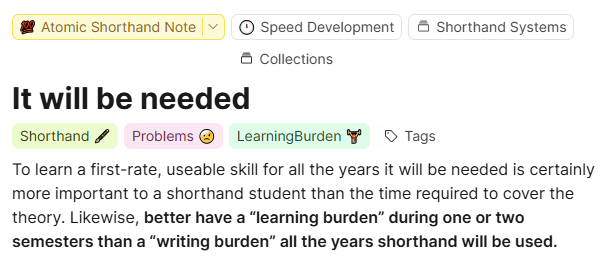
Neither approach is necessarily better. Some systems front-load the learning burden, while it might be said that Teeline distributes it across your journey.
What Some Learners Find Helpful
Some students say, "We're enjoying working out our own outlines. It's clicking for us." Brilliant. Those learners don't need much intervention. Others say, "We're fumbling in the dark. How should we write this?"
What they're really asking is, "How do proficient writers think about this?"
Both approaches are valid, but here's the interesting bit: whilst Teeline allows freedom, proficient writers naturally arrive at similar solutions. Not because there's a rule book, but because efficiency follows certain principles. Shorter outlines prove faster than longer ones, fluid pen movements increase speed, and consistent groupings reduce hesitation. These patterns emerge through practice itself.
All well and good, but discovering them on your own can take quite a while. Some learners enjoy that journey. Others would rather learn from experience and move on to developing speed.
Learning from Expert Models
For learners who find expert models helpful, more structured resources offer a different path. It’s not about imposing rules or contradicting Teeline's freedom, but revealing how experienced writers think.
In a nutshell: sometimes you don't know what's possible until you see it. You might spend months working out a solution to a problem only to discover that someone else solved it years ago in a way you'd never have thought of. We all know that learning from others can be a tremendous time saver. The same can be applied to learning shorthand.
It’s true you won't find everything others do useful to you. Some outlines that work brilliantly for one writer won't suit your hand or your thinking. That's just normal. The value isn't in copying everything you see. It's in exposing yourself to enough examples that you're bound to find many things that do work for you.
When You're Not Sure What's Holding You Back
Intermediate learners often feel this tension. You sense something isn't quite right with your Teeline studies, but can't pinpoint what needs changing. You have a strong sense that proficient writers might be doing something different, but can't identify what.
This is where expert models might help. Again, not as something to blindly copy, but as examples showing what efficient writing looks like. You can then decide which elements work for you.
Finding Your Path
Teeline's freedom is valuable. Many learners develop their own outlines and achieve excellent speeds doing exactly that.
But all learning has costs. Independent discovery takes time. Structured learning requires upfront effort. Neither is inherently better — the question is which suits how you learn.
If what you're doing is working, keep at it. But if you're struggling, consider whether learning from others' experience might save you months (or years) of trial and error.
Both work. The key is knowing you do have a choice — and choosing the path that gets you writing fluently and accurately.
As always, if you have suggestions or topics you'd like to see covered in future newsletters, please contact us:
https://www.letsloveteelinetogether.com/contact-us
If you find this newsletter helpful, please help us spread the word and forward to a friend!
A Parting Thought
Be sure to visit us at the LLTT Website, YouTube, Facebook, Instagram, Quizlet and Soundcloud.
If you’re looking for Teeline reading practice, Skill Building Through Reading 📗 - is available for purchase online.
Much work (and ❤️!) has gone into this 48 page, 6x9 softcover book:
Five 5️⃣ carefully selected passages: Improve your sight 👁️ recognition of outlines and word groupings.
Dual Format: Each passage includes both printed Teeline and the longhand ✍️ transcription.
Proven Learning Approach: Reading printed 🖨️ shorthand is a method long-favoured by skilled practitioners.
Whether you're a student, journalist, or professional seeking to improve your note-taking, this book will be a valuable addition to your Teeline learning resources.
To order, please visit the book’s landing page or respond to this email with any questions.



Add a comment: