after mystery, amazement
Today, weary from sitting and staring at my screen for hours, I decided to visit a friend I haven’t seen since last year: yarrow (Schafgarbe in German). She grows in the forest near my house, up on the hill, by the water reservoir, on a narrow strip of unremarkable grass. I bent down to the ground to look for her delicate shape. Perhaps I’m just too early, I thought. It’s February, after all.
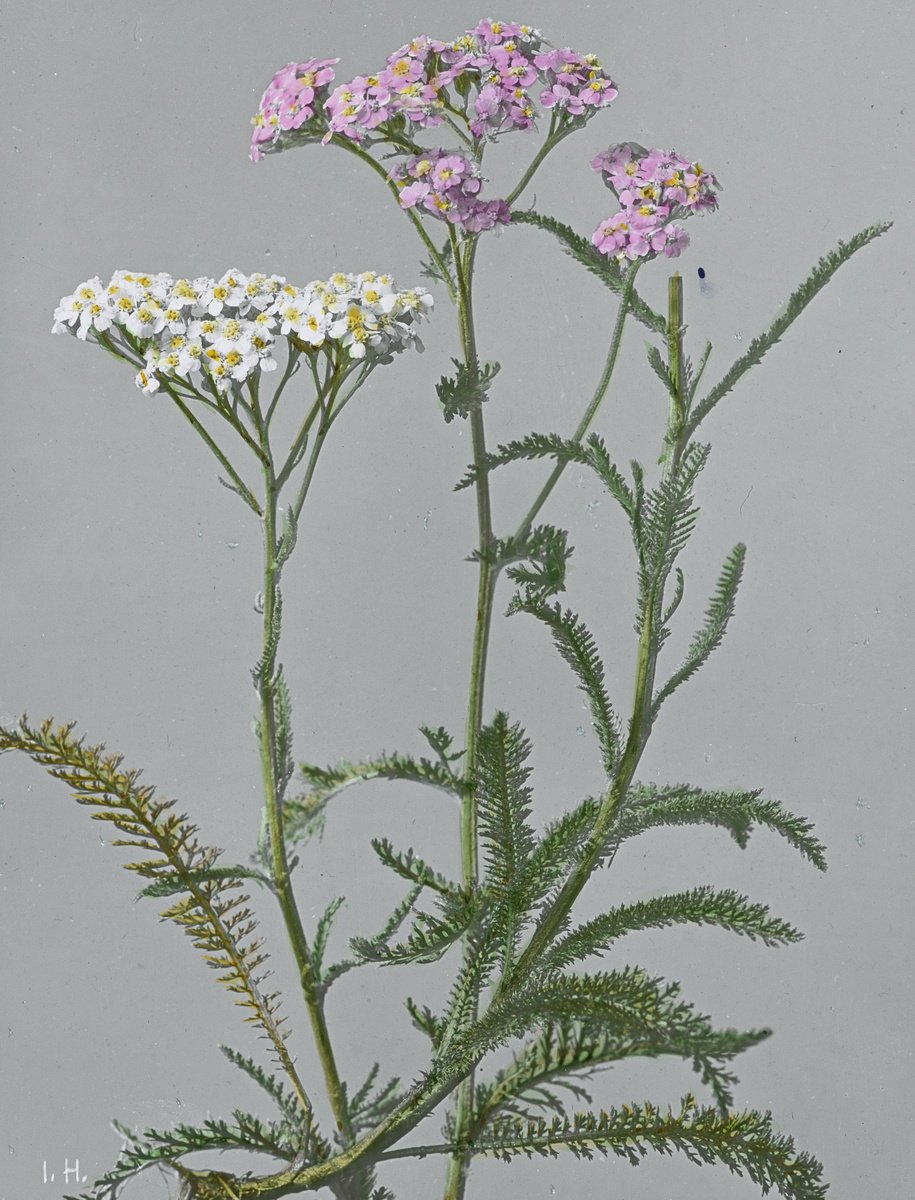
But there she was, pushed close to the cold muddy earth, partly shielded by wet brown leaves: this common yarrow had made it through the winter. She looked pale but still like herself.
I first met her about three years ago, in a community garden in Bern. It was August and she grew everywhere, though I would not have known that. One of the gardeners showed me how to spot her fern-like leaves, whose shape might remind you of a river delta, ice crystals or a drag queen’s eyelashes, depending on your frame of reference. I held a single long leaf in my hand, smelled it and then ate it, because the gardener told me to. I found that I liked eating that plant a lot. This strange taste of grass and pepper with a hint of liquorice, this ‘other’, irresistible.
‘The mystery was gone but the amazement was just starting,’ Andy Warhol once wrote. After I learned yarrow’s names, I grew amazed at her presence in the world. Her dried stalks have been thrown for thousands of years by Chinese shamans for divination with the I Ching. Her Latin name, Achillea, comes from Achilles who, according to Greek mythology, used yarrow to treat the battle wounds of his soldiers. She is medicine and has been used as such for thousands of years, both in Europe and by several Native American nations. Starlings pluck her stems to build their nests.
She is not picky about where she shows up. I have met her on the edge of football fields, parking lots and in the middle of long-neglected gardens. The reason I’m writing about her now is partly because I hope you’ll meet her on one of your next walks and partly because I wonder what your own yarrow might be. What amazes you? What is your portal to the more-than-human world? It might be a tree, or a mountain. It might be a river, or many rivers. It might be birds or your cat. It might be the moon or the wind. It might be something growing in your backyard that has waited, all your life, to start a conversation with you.
A lot of people have told me in recent weeks that they cannot imagine things getting any worse than they are now. And yet. I had this sense that each person I spoke to also had a quiet knowing in their bones. Some truth humming underneath all the noise: things will get worse. But how will we cope?
I certainly don’t know how. But perhaps the ‘not knowing’ is the point: There are things we can only discover about ourselves in a moment of crisis, like our ancestors did in the centuries before this one.
February brings us, among many other things, a Lunar Eclipse in Aquarius (on the 17th) and the only exact conjunction between Saturn and Neptune in Aries (on the 20th). It is, in my humble opinion as an astrologer, one of the most difficult, confusing and surreal months of 2026.
February will likely confront us with a further loss of order and the irreversible breaking down of structures both metaphorical and literal. Back in June of 2025 I first wrote about this conjunction (which occurs roughly every 35 years), naming some of the themes associated with it: the erosion of boundaries, the melting down of certainties, and yes, irresponsible leadership.
Expect bad decisions to be made fast. Expect some of those bad decisions to be your own and forgive yourself. Whatever happens this month, don’t wind yourself up trying to get ‘a clear picture’ of anything. That is for later.
If you can, go outside. If nothing else works, just stare at a wall for a while. But most of all, trust that whatever lies ahead will meet us where we are. Not our perfect selves, not the versions of us who have finally conquered our to-do lists. It will be just you and me, in the messy middle of our lives, living through extraordinary times. May we know that we are not doing this alone. May we greet our friends and prepare our gardens for spring, amidst everything.