
How I Got Pregnant On The Train
"This statement I am about to write concerning Fred and myself is the honest truth."
Content Warning: Pregnancy, abortion
When I first began working on a travelling exhibit about a land grant to the Esquimalt & Nanaimo (E&N) Railway Company, I joked that it was not an exhibit about trains — at least not directly. Luckily for fans of the E&N Railway and its operations there are already three well-researched books about the E&N Railway and its trains written by Donald MacLachlan and Bob Turner.
MacLachlan worked for the E&N for 42 years, from the 1940s to the 1980s, and witnessed the gradual decline of rail transportation on Vancouver Island. In retirement, he used that experience to research and write a history of the railway. Over this period of significant change, the railway company also disposed of many documents relating to its history. Recognizing the significance to the railway's history, MacLachlan and other railway workers squirreled away many records destined for the trash. MacLachlan amassed a large archival collection and upon his death in 2011 the records were donated to the BC Archives.
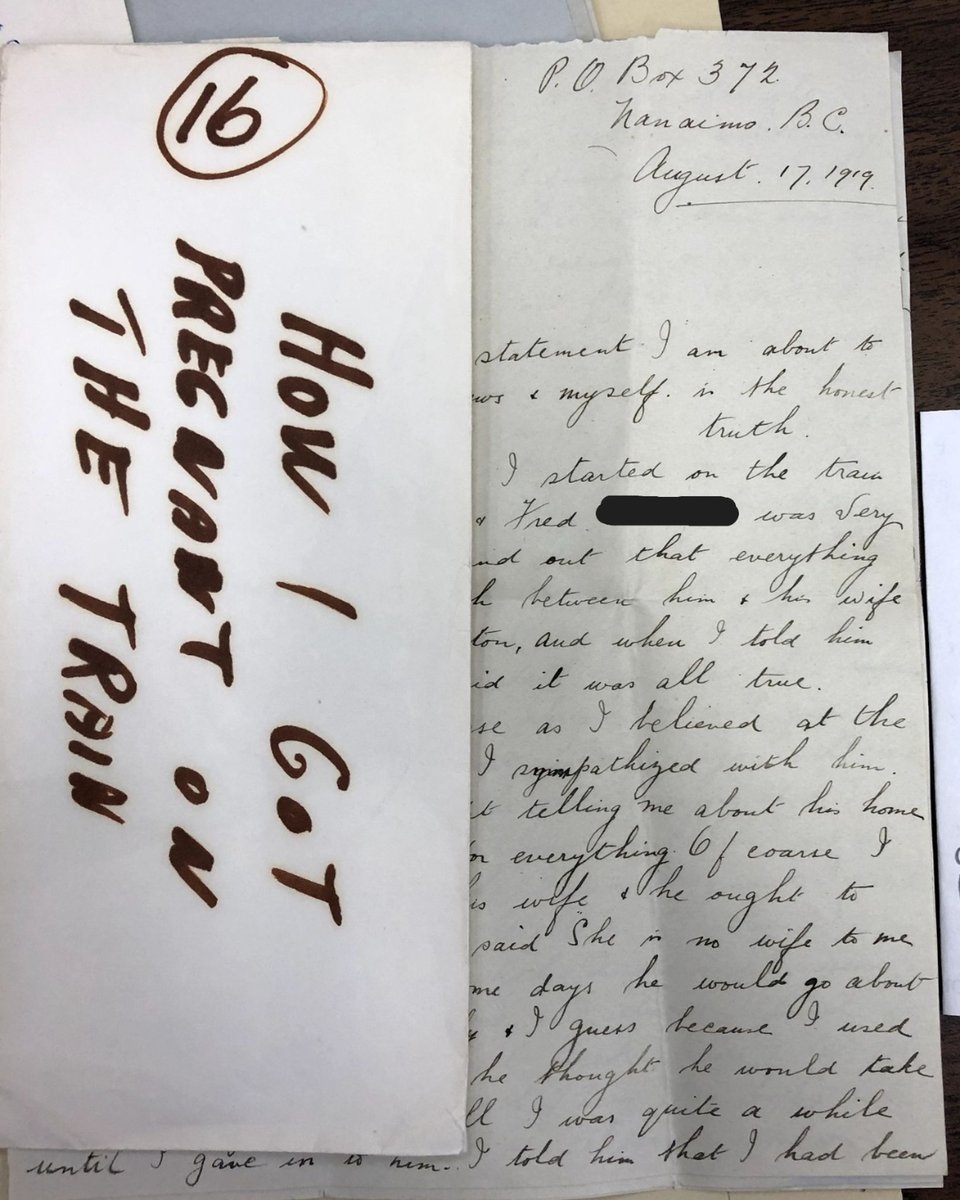
The Donald MacLachlan Fonds contains photographs, correspondence, reports, maps, and ephemera relating to the E&N and other railways in western Canada. MacLachlan organized the records into files for his own research purposes, often using envelopes labelled with subject headings or notes attached to the record. I reviewed the fonds as part of my research for the travelling exhibit. One document that was not relevant to the project was just too intriguing not to read. MacLachlan labelled a handwritten letter with the following description:
"How I got pregnant on the train."
Margaret and Fred
"This statement I am about to write concerning Fred ... and myself is the honest truth."
So begins a letter from 1919 written to E&N Railway Company General Superintendent HE Beasley from Margaret, a news agent on the railway's passenger trains. The letter details Fred's insistent advances and a story he told her about being unhappy in his marriage. Fred also worked on the train as an engineer.
Margaret continued: "Some days [Fred] would go about his work quite melancholy + I guess because I used to try and cheer him up, he thought he would take advantage of me. Well it was quite a while until I gave in to him. I told him that I had been brought up straight + I wanted to keep straight. He said he would watch that nothing went wrong + of course I trusted him. It happened in the toilet of the parlor car "Ladysmith" while the train was in motion during work hours. It seemed so funny that several times when I came out of the toilet he was always in the passage looking out of the window. We were together about five or six times + when everything did not go right with me he said I had better see a doctor for which he gave me $10 (ten dollars)."
Margaret tells Beasley that she did go see the doctor who did not think she was pregnant and neither did she, at least at first: "...I never thought I was pregnant. I never had an ache nor a pain...My baby was born [in] May. He is thirteen weeks old to day + I dont feel right yet. I am not able to go out to work + I have been a great expense to my parents, what with the Doctors Bill $35, Hospital $59. Ambulance $2.50, and also nourishment + clothes for baby as well as nourishment for myself."
A family in the archives
In the letter, Margaret describes a lecherous Fred, a man who left her with the child and the bill. "He said he would watch that nothing went wrong + of course I trusted him."
We don't have the reply to Margaret's letter, if there ever was one. Superintendent Beasley and the E&N Railway Company held significant political and economic power on Vancouver Island. I think this makes Margaret's letter an especially confident and courageous act.
We can find Margaret (age 27) and her son Roy (age 2) in the 1921 census. They are living in Nanaimo with her parents and younger brother. Her father's occupation is listed as a sea captain.
Fred died in 1925. His obituary described him as "...most popular with both the railway and the general public." He left behind a wife and two children (not including Roy).
Margaret's story continued. In 1927, at age 34, she married a "master mariner." The marriage certificate lists her occupation as a cook. The new family moved to Vancouver.
Margaret died in the early 1960s and Roy died in the the early 1980s. He had a wife and two sons. Those sons also had children and it seems likely there are living descendants on Vancouver Island. Knowing this, I have withheld Margaret, Roy, and Fred's surnames. It may be that the story of how Margaret got pregnant on the train was known to Roy and to his children.
But perhaps not. She could never have known that Donald MacLachlan would one day come across her letter — one among many that he collected and donated to the BC Archives.