omake! #2: Disco Elysium (2019): men and sadness and the anatomy of failure
I’m down with a massive cold this week (overwork + stress-induced lack of sleep + going out lots of places with grubby germy humans in + it was -25 C out = yeah, that’ll do it). What this means: I am too congested to work, and must play video games. They will interact with me narratively at a nice and stately pace and not impose real-life consequences on my brain.
Which is how I spent a stunning amount of hours down the throat of Disco Elysium — something to which I’ve showed up quite late. And: oh. God, what a treasure. What an absolute gift. I’ve played it through twice in the past few days, utterly emotionally involved and frequently furious or delighted by the little jerks and turns of the plot as it’s uncovering. (I missed a lot the first time; I am picking through every corner on the second for the rest.) And it came clear that this review gets its own omake! edition. There is so much to say about this: some of it quite conflicted even as I’m so deeply impressed.
Content warning: We are heading into the dark waters of serious talk about heterosexual misogyny and how it plays out on people’s living bodies. Some of that’s textual and some refers to the personal, and it’s about particular shit men do because this game is absolutely men talking to other men about shit men do, so we’re meeting it where it lives. Yes, it’s in service to discussing the art, the art is not a beard for me to vent; the experience serves the reading. But this is your seatbelt warning that I didn’t hold back about how I felt here, about that shit men do. Let it be known.
***
On the surface, Disco Elysium is a modern Fallout-style RPG: You’re mostly talking with people, there’s a lot of skills and rolls predicated on personality traits and social awareness skills, and you have a slightly blank-slate character with a few mysteries to solve.
It’s foundationally described as an RPG at the intersection of 1970s-style cop movies and traditional tabletop, and while that does sum up some of the A-plot — dissolute cops, troubled young women running from their pasts, restless labour unions, decaying post-war neighbourhoods, and an offshore mercernary lynched and hung from a tree, who no one’s talking about and everyone’s linked to — that only begins to cover it. This is marvelously written, a structural and thematic hall of mirrors with a decided beam of light at the end of it, and it is a whole world in there: funny and smart and dark and delightful, smart about people without being cruel but sometimes just biting enough. If some of the other things I played this past month are playspace for cognitive load management, what’s fascinated me with this story is how it’s clever, satirical, intimate, incisive playspace for failure. On every conceivable scale.
Disco Elysium sets the scene for that instantly: You wake up monumentally hungover, naked, and sick in a trashed hotel room with no memory of the obviously awful and obscene shit you did while you were drunk. What you quickly find out: You’re a police officer, for the specific qualities of what that means in this particular world (much more limited and constrained than in ours); you used to be a good one; and you’ve just spent three days making a horrible scene and drinking yourself into amnesia instead of investigating the murder that happened last week out back, because you are desperately, unmanageably sad about something you cannot, right now, name. Different parts of your personality have acquired shorthand names, and they’re battling it out quietly inside your head, giving you a double dozen anthropomorphized competing urges — your operating skill tree! — to work with or reconcile. And the world around you is a trashed, labour strife-rocked, tangibly post-Soviet island city under occupation and mired in poverty, with shades of broken systems literally everywhere. But there is a corpse hanging from a tree out back of your hostel, the local Union-run neighbourhood hates you both institutionally and personally, and you probably have to get your shit together if you’re going to do this job.
It’s a starting line made of alcoholic and systemic rock bottom. And then, in a very non-edgelordy way — a surprisingly absurdist, sometimes grim, tongue-in-cheek, legitimately emotionally serious way — you immediately have to get up and figure out putting something right in a way that means making some roleplaying choices on how you’re going to inhabit that.
This is amazing. It had me at hello. And this was before, narratively speaking, shit got quite thoughtfully and seriously and repeatedly more complicated.
Martinaise — the neighbourhood you spend your time in, and solve your case in — is small and stylistic and grubby and so thoroughly realized. As the most neglected neighbourhood in the conquered quasi-colony of Revachol, it’s all half-bombed buildings that weren’t rebuilt 40-odd years later; a failed business district that’s developed a mythological curse; the flaking half-remains of a tourism plan that never materialized. It’s weirdly beautiful. The soundtrack helps it; the occasional pauses, if you bump up your Shivers skill and listen to the city, to note birdsong or wind or what people are doing far away on sleepy neighbourhood blocks at sundown, make it more so. There’s an ambient fierce loving for this messed-up place that makes it instantly worth showing up for, and presents a reason to put things right.
It also does help that there is a lot of character writing in this small neighbourhood, and you’re not even close to the worst person in the immediate area so you can’t entirely mire down in shame. But most of those people are quite complex if you stick with them, even if that’s new depths of contemptible behaviour or competing motives or just a lovely tendency to zig when you think they’ll zag. People surprise you a lot. Sometimes they lie or come clean. And the partner you’re assigned from the first minute? Is patient. And boundaried, and kind.
The lovely thing about your new partner, Kim, is that he’s a bit of a social lifeline/walking quiet hint system. He will pull you back when you’re doing something that he feels is a bad idea or going too far. He’s not always right; he’s not the voice of the game. He has some different priorities than you. But it’s very clear that on a basic level, though you’re pastless, disoriented, and a mess, you can foundationally trust him, and that’s quite powerful. You kind of know he’s actually got your back, as a character or a player. It’s an actually healthy relationship on many levels. In my first playthrough, I made my most mistakes during the afternoon Kim was off delivering the body to the morgue, and I was left to my own devices, doing way too much solo without my backup, on way too little information. I got in over my head so, so fast. I got smarter the second time. I did not do the important shit alone. This is not just game mechanics. This constitutes a parable.
***
This is also a world that, as a bunch of the criticism on this has noted, is stuffed with ideologies — and is interestingly constantly both presenting and taking the piss out of all of them full-time. This is a game where one of your axes is potentially interfering between a (legitimately corrupt) dockworkers’ union and the offshore corporation that owns the docks (and the stalled truckers who are just trying to make a living, locked outside the gates), and treats that with all the nuance available to pack in. There are politics.
The developers of this game were an Estonian-based (and then international) arts collective, one that was quite political, and there are active sidequests for the game’s four political orientations: communism, fascism, moralism (kind of an incremental status-quo-beats-violence project) and ultraliberal (pure naked capitalism). You unlock the option to commit to them based on the dialogue options you’re taking, get different outcomes with different sets of characters if you’re on the same political sides, and — well, they’re all treated with an interesting lack of mercy. Most games and political discussions will be selling you the perceived positive points of an ideological school of thought, like everyone’s an MLM all of a sudden. Here, if you want to take one on, you have to get through the barrage of satire first, and then click “yes please.” They’re all treated, in some ways, as near-cartoonish forms of extremism: little inflicted ways to be insane in a flock. There is no moderation. You go big or go home, and this game has some real opinions on the consequences of going big. This delights me.*
* Read the in-game text descriptions behind that link. The one for fascism has me howling with bulls-eye accuracy, and what they’ve quoted there for communism isn’t even the beginning of the skewering the game’s dialogue has in store — some of it very, very funny, and some of it, near the end, terrifyingly serious.
That’s balanced interestingly, though, against a mechanics situation that doesn’t reward a lack of commitment. If you try to build a character that’s well-rounded, average at everything? Play things cautious? Not piss off too many people, stay straight-faced? You can’t get anywhere. You will flub too many rolls in every direction to actually make progress. You have to get wildly bad at something or other so you can be actually good at something else, commit to some course, make choices here and just step into the arms of all those failures they’ll inevitably rack up. Obviously it’s on my mind this month, but: yeah, well. Here endeth the lesson. The recursive, recursive lesson which never actually, it turns out, ends. You’ve got to make some decisions here, or die in the mud. But which decisions you make — well, that’s the decision, isn’t it?
What that ended up looking like for me was a little hilariously revelatory. I stayed full away from any kind of formal ideology — look, there is no ruleset that’ll cover your every situation, sorry mates — instantly recognized Oh. Shit. I’m sad. I’ve made myself into trash, and immediately just offered apologies and amends literally anywhere the dialogue let me (and it does). At one point one of the internal voices (Authority, I think?) pointed out Oh, I’ve figured out what kind of cop you are. You’re the Sorry Cop. You’re sorry for everything. This was clearly being pitched as pejorative, and I was just like: Yup. That I am. Good with it. Change starts with accountability. And I apologized my way into people actually wanting to help me a little more often, trusted my gut, kept my word, and thus liberation of a sort. There are places you can’t get in this game by being honest, but, y’know. I felt better doing so.
(Bear in mind: I also willingly built this character with a little extra madness, just because if a game names the anthropomorphization of its inner intuition/imagination/emotive instincts Inland Empire? I instantly go yes, that’s correct, and will follow it anywhere. So I did things that were perhaps a little mad all the way through, just because — I mean it, I cannot express how much I feel seen by that one association. Although I would perhaps tweak mine slightly to a different kind of polity. The galaxies inside me aren’t really expansionist. Just. . . large. Something with shoals.)
***
The thing is — and this is where spoilers and the content warning are about to happen, so please slow up if you’re planning to go play this (and I would strongly recommend it):
The thing is, what strikes me most about the whole story is the ocean of gender politics woven through it. What sparks off, or even acts as the battlefield for this particular crime, in the end, has to do with Klaasje, the erstwhile femme fatale archetype of the piece. And it’s not, I think, even anything she particularly does: she shows up from another country rather on the run, sleeps with who she wants regardless of what anyone else thinks about it, drinks what she wants, behaves badly in ways that are largely confined to her own orbit, really? And other people project a great, great deal onto that. They theorize it, take it personally, overinterpret it, wrap it up in political trappings, and start acting like they’ve got the right to do something about it. And this one woman and her quite private self-destruction loop — let’s be plain, she does lie about a lot and has a truly shady past, and makes some really shitty choices, this is all true — becomes the focal point for the bullshit of men she doesn’t even know, to absolutely horrifying results. For others, yeah: depending on how you play it, it puts a few deaths on the ledger — or a lot of deaths. But also for herself. What she goes through during this — one group of men insisting the guy she claims as her lover actually raped her, a bout of serious stalking, having to watch that corpse dangle and be progressively mutilated over a week outside her window — is . . . I can’t encompass it. I would go mad, or burn the building down. She’s lying to me on several fronts — I didn’t even catch her at it on the first go-round, only the second — and I kind of don’t care. I model that experience, and — I cannot get over Klaasje. Where she uses her agency (and she does, and is quite savvy about it). The places where she lies about that (and she does). The position she’s in.
There is one out lesbian character in the game, Ruby: someone Klaasje also claims was possessive, controlling, obsessive with her like you see multiple people gradually reveal themselves to be. When you catch up to Ruby, you get a different story from her: that she wasn’t trying to make demands of Klaasje, just was legitimately worried about this girl’s “destructive patterns with men.” She didn’t want to rescue her and run away together, just was saying: You know, you can stop. You can leave. I will take you if you want. There’s never enough information or followup available to know whose version was true (both? who knows?). But you can see it: the possibility that Klaasje projected that pattern onto Ruby because she’s so used to it, or that Ruby’s just enacting the same kind of nosy-assed rescue, or or or. Nobody approves of who Klaasje settles on to be fucking. Everyone is sure they know the truth of who Klaasje is, and that’s a truth that remains elusive. But notably, everybody is sure it’s their business: whether it’s to rescue someone being abused, or correct someone who’s committing political betrayal, or almost reapportion sexual resources to the “right” place, in a parallel so close to the idea of colonial resources being extracted from this town and the Union strike for self-determination happening next door, the macro-scale arguments about possession and who has a say in their own labour — that it’s fucking brutal to sit with. Gutting.
It’s an incredible encapsulation of the ways this story’s messing with relationship dynamics. The problem isn’t that everybody’s, per se, lying; the problem is that everybody has their own very particular lens on the question. They all will eventually tell you the truth as they see it — see above: four different kinds of ideologies, all kind of wrong — and who on earth knows if that means much?
And this story knows. It’s riddled with little bits of setup, onramp, knowing: from the side comment you can make to the shopkeeper who’s pulled her daughter out of school to act as a greeter, who asks you to rate her performance out of ten, where you can say that you don’t rate human beings like that, they’re people. Or the fishing village being fundamentally run by its women residents, while the men skulk out back getting drunk and trying to hide little bits of money from their wives.
Or the two old men playing petanque at the roadside, once childhood friends and for decades on opposite sides of that revolution — who, it turns out, were mostly spatting over the affections of the rather indecisive girl down the block who had relationships at various times with both of them. Why wouldn’t she decide? you ask; they don’t know. They seemingly haven’t asked her, or never chose to square the situation. There’s this block of incuriosity around her own perspective, this mythmaking they’ve built to cordon it off, and instead of moving on or getting bigger lives, they’re still here bickering. She’s been dead of old age for two years.
Or the biggest insult — a turning-point insult you level at one set of characters to get them to finally talk — involves comparing them to all the shitty cops back at your station. They claim Klaasje’s been sexually assaulted, and they’re using it to justify violence, but are still sitting around here talking about someone’s tits; you can and do call them those fucking guys. The fact that the game feeds you this as a stunning bit of contempt — and that it works — says everything. As does one of the minor, more levelheaded women characters, who in a moment of sympathy cuts off your political wheel-spinning with: “I think you’re just hung up on some chick.”
I’ve frequently said that you can suss the ethics of a narrative by what works or it feels should work in its own frame, and that shows here. It’s where the characters with the most integrity get the most impatient with you and others that tells the tale; it’s which indictments are levelled and expected to actually hurt. The ways the narrative is simultaneously obsessed with and will keep slapping you around for any kind of objectification.
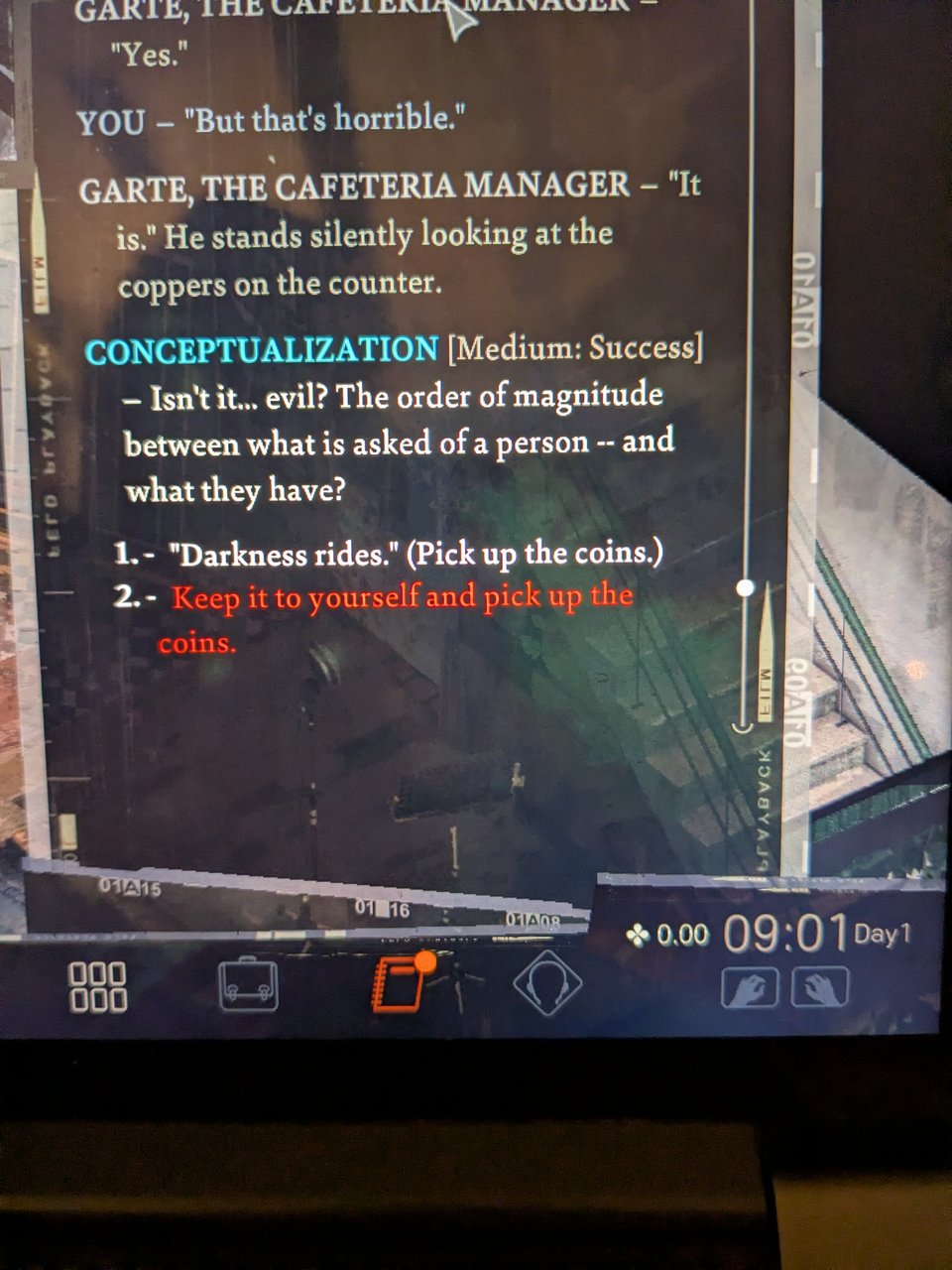
Disco Elysium is, on many levels, thinking real fucking hard about misogyny. The writing is quite nuanced and aware about most of what it’s doing there: considering the constellation of perspectives on self-pitying, violent misogyny arrayed like thematic circuits, it’s visibly a comment. It’s not explicitly stated. It’s everywhere. Your face is pressed against it inexorably, full-time. It’s soaked through.
And when the question is the sexual choices of a woman who wasn’t quite inclined to explain herself to others, who’s being projected on every way from Sunday — and may not inherently understand herself, period, because she is a mess — being externalized into . . . ideologies, symbolic battles for symbolic points, all kinds of bullshit on top of what’s just plain raw sexual jealousy and loneliness and desire? Oh boy. Oh boy oh boy, oh no. And it’s awful to say, but when you’re a person who’s had to deal with lonely, hungry men, all you can say to it is: Yeah. That. A woman whose body and life is treated basically like a flashpoint, and all she was doing was minding her own goddamned business in the ways she saw fit.
I just . . . yeah, you see why I can’t stop thinking about Klaasje?
It is, on a certain level, the rawest explication of Men and Their Bullshit I have possibly ever seen. The kind that could only come from inside the house, because it’s too intimate, too detailed, and frankly, too disgusted. I’m floored, in some very complicated ways.
***
I don’t know how this game will read to people who aren’t used to swimming in the waters of “we are thinking about misogyny on both practical and theoretical levels.” I’ve been doing it for a while: for writing projects and, frankly, my own survival as things on that front get increasingly worse. I suspect, if you are newer to that topic, differently positioned to it, react differently to it, this story hits different. A lot.
What made it, at times, hard for me to take was what I think it might presume of its audience: their starting position. I think it knows, but it’s written towards people who it’s pretty sure don’t yet know, and probably ought to learn a thing or two about it. Do what you might, you end up playing a foundational self-pitying misogynist in some ways that you can only partly avoid. If you’re coming from a less humane starting position on misogyny, that’s not going to feel abrasive; it might be relatable, comfortable, normal. It might be an anchor, or even a reach outside your own comfort zone. That language starts to sit in your own character’s mouth, especially around his own failed relationship, building to an arc of what I’m pretty sure is supposed to be some player self-awareness.
This came out in 2019. That’s both prime time for both the discussions on gaming as empathy machine and the concept of complicity in mechanics, and prime time for a massive tidal wave of misogyny in discussions around same — to which there were creative reactions. It’s not a bad guess as to what’s happening here.
Thing is, that’s a wildly different experience for those of us who weren’t having that problem to start with, and were already quite brutally and persistently aware.
If there was one place in this game where I stalled, it was one of its ending conversations, the landing of your protagonist’s major emotional arc re: his failed relationship, what went wrong, what actually happened there, and why he drank himself into amnesia. I think, if you were on this journey as a learning journey too, it would be a slap of realization: that very of-the-era complicity moment. But when you’re not in that cycle, when you never were? It asks me to inhabit the other side of every petulant, edge-of-violent but why won’t you date me? conversation I’ve had to terrifiedly fend off for my entire goddamn life; the kind where you keep your face calm and detach your voice from your body and just get through this, just outwait it, make no sudden moves because you’re in close quarters with a man who’s clearly stopped seeing you as a human being and is visibly out of control. I have been having this conversation with men on and off since I was fourteen (ironically, the age Klaasje doesn’t quite admit to — but which you can math out — for when she was entered into beauty pageants, and when the game implies a whole lot of things about her life and messed-up relationships with men started). I have reflexes for that conversation. I am sure every man who launches that shit on me is absolutely convinced he is the victim there. There is no explaining to them what they’re doing in that moment. I’m not even all that conventionally attractive, just alive and breathing in proximity to hungry, fucked-up men who want to write their own story all over you, all over your nostrils and mouth, just keep feeding you the script they want to hear back regardless of whether it’s real, regardless of your entire actual existence, insistently, as nothing but a prop for their undiscriminating hunger until their stupid useless words fill your throat and you can’t fucking breathe.
So I don’t know how this ending reads to men. I don’t know if it’s revelatory or relatable or redemptive or lands like the piece of complicity awareness that I suspect was intended. But as the person who’s lived life on the other side of that awful shitty practice of emotional cannibalism? I wanted to just — yeah. I didn’t want that filth in my mouth. I don’t know if I’m even interested in how masc-coded people read that or if it’s literally the last thing I ever want to know, so what I don’t know can’t show up again to hurt me and I don’t have to pound it into shards and dust. But. It will change how you strike off this, which side of that conversation you’re used to having. If you understand it as a mortal threat. If it makes you exhausted, and furious, and afraid.
***
Ironically, this is a thought which came up for me last month. I didn’t mention it here, but: sat in on an afternoon webinar which was ostensibly supposed to be about the rise of affective digital extremism — someone’s postdoc research being made into a book — which got so close to and absolutely missed this very thing. The speaker was talking about some of the very sexualized forms online Islamophobia’s taking: memes about Muslim men basically stealing marriageable women, anchor babies, just really raw lonely horny pure-id displacement of a whole other situation onto an imagined Other so nobody has to get real or self-aware about why girls aren’t keen to touch or make friends with them in the first place. The fingerprints of this same situation are all over it. Organized racism as a displacement activity, in the same ways all the ideology in Disco Elysium is there as this purportedly animating force in Martinaise, but when you actually work the case, really it’s all excuses: not communism, or history, or labour, or principle, or loyalty, but the sheer fact that everyone treats who a woman is fucking as a public-consultation situation and wants to get their two cents and 9 mm bullets in.
Even the webinar speaker couldn’t see past this one: she seemed to think this surge of racist content was actually about Muslim men somehow; was actually about a motivated, intrinsic, personal kind of directed hate, about something they even did, and not the deflection shield for a deep, intimate, useless unskilled inadequacy experienced by people who can’t even verbalize their needs, never mind strategize or meet them. It’s not exactly coming from a mountain of fucking strength, let’s put it that way.
It’s a little horrible to look at whole hate movements from my lofty meaningless little perch and go: “Yeah, but that’s just the bullshit on top,” but — it kind of is? Emotionally secure people who can face themselves, see their needs, and find ways to meet them don’t need to do that shit. They can live with and metabolize their own failures. They can work from them without having to pull in external and justifying bullshit, or tell defensive little stories. Functioning, secure people can fail and not fuck up everyone’s lives.
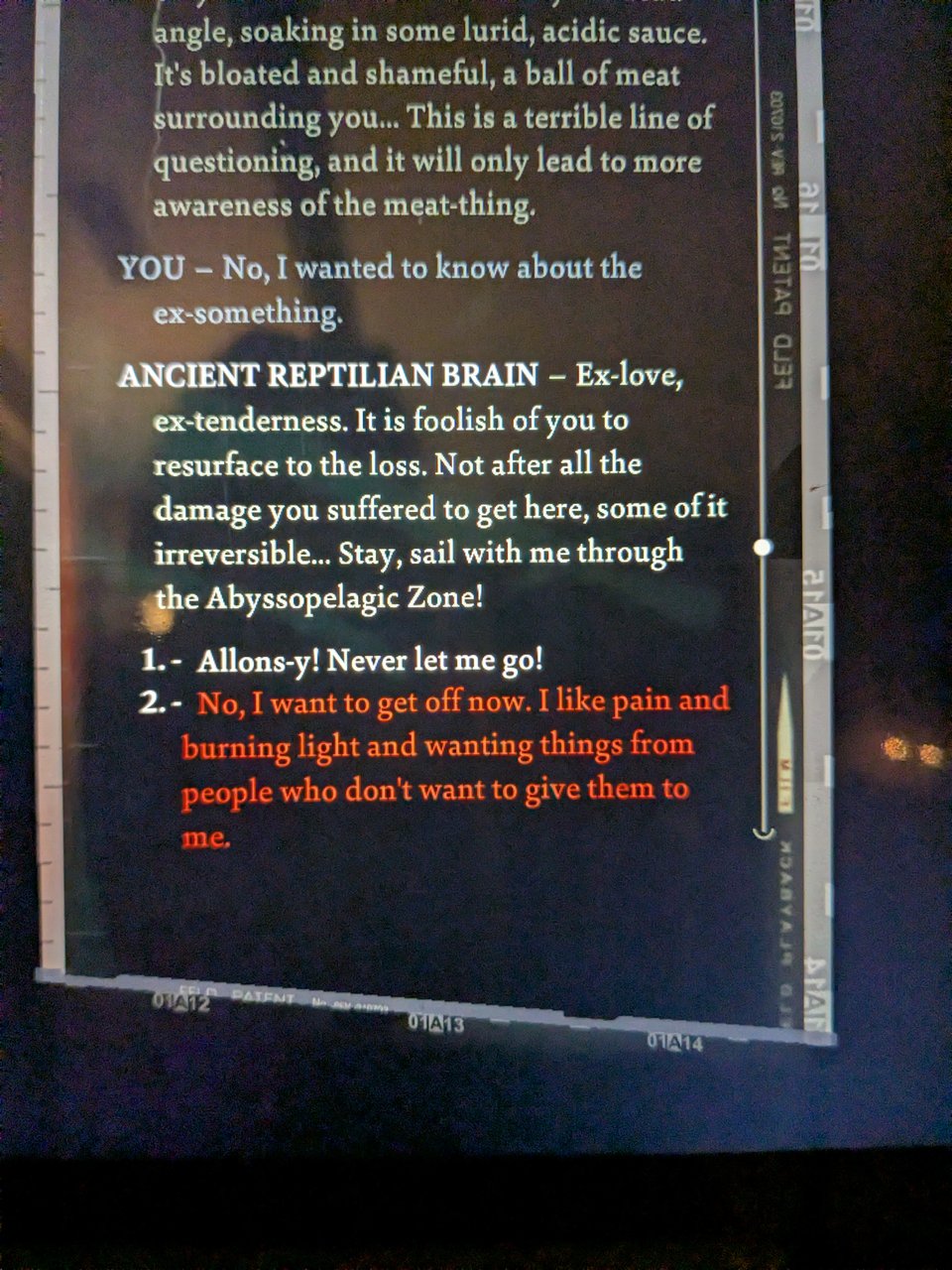
What I think Disco Elysium understands — and why I’m so impressed by it, and why I’m so shaken by having to morbidly click through this detective of mine begging the ghost of his long-departed ex to love him again as she waits him out in that horrible familiar way, feeling that disgust course through my chest, for the first time absolutely hating him for doing me like this — is the bullshit.
It’s not about any of that high-minded, principled, ideological-crusading crap, really. Every man I’ve turned down on his own dubious fucking merits, rightly or wrongly, made up some kind of bullshit story about how it was actually something else, something he could blame or punch out. Sometimes they’ve had the disgusting bad grace to share that with me: the bullshit stories they’d made up about why I didn’t want them, even though I’d told them the truth in the first place, like some slightly unsteady sick cat bringing me a dead fucking mouse for my pillow. Every man who’s come to me complaining about some woman who turned him down, wanting “advice” (read: bias confirmation) had some tiny nascent conspiracy theory going about it already, and seemed to feel betrayed by my horror at what they were saying. Look at yourself. She told you already, in plain words. What the fuck are you doing.
What I think this game somehow understands is the problem that is the bullshitting. How awful, degrading, and poisonous that is to everyone involved. And it parts the ribs and autopsies that fucker open with an amazingly keen blade.
Disco Elysium is, among other things, messing with detective tropes in general, and I’ll go so far as to suggest that this is one of them: That it’s not the woman that puts the fatale in femme fatale, it’s the bullshit: the projection, the utter inability to just see relationships fail and let them be failures instead of world-shaking mythologies or politics or conspiracies. To just live in some sane way with the idea that something didn’t work out, and won’t. To just, in some consensual way, stop forcing ideas onto human bodies and let people be.
***
With all this said — with this anger attached, and even because of this anger attached — I’m still saying: highly recommended.
This is a beautiful piece of art, handling emotionally and socially fissile material in a way where it wasn’t just pretty, and wasn’t just narratively gripping, but — I could fall into it, and feel simultaneously quite wry about my own tendencies, but also laugh. It legitimately had me feel every emotional turn. I was, almost instantaneously, there. And by and large, around the one problem of that rampant piteous neediness and the ways it’s talking about something that I am quite sincerely sure is Men Talking Between Men About Man Stuff, I did this feeling as if I was in safe, perspective-bearing hands. Perspective is important, I think, in narrative: If you show you have some, you can get a lot more trust inherent from your readership, and Disco Elysium is almost nothing but perspective; perspective all the way down. The problem — and liberatory mechanism — of perspective.
I’m back to that fundamental kernel, as I digest that second playthrough: This game is playspace for failure on a nuanced and layered and incredibly wrought level. And because of who they consider the audience, I think they’re thinking about one particular fundamental, pulsing, overriding form of failure: the failure of men (other men; this team is mostly men and that is quite core to how to read it) to tell themselves the truth about what’s missing here and to stop wreathing it in layers of armoured, self-destructive bullshit. To just cut the shit already. I’m convinced it knows. It reads far, far too personal to be anything but a call from inside the house. No one writes this near the bone from outside the experience.
I loved spending time with this. It’s beautiful. It fucking hurt, and not in a way that teaches me anything because I have a different perspective on this situation and I already knew. But for once, we’re being honest about something many people struggle to be honest about, and in a way that’s not didactic or combative, just — prismed, gorgeous, structural, frequently quietly brutal.
This is really special. I would absolutely recommend it. It’s an empire inside. It has shoals.