Twenty years of submitting
2025 literary submission stats
Individual works submitted: 21
Chapbooks submitted: 2
Number of literary journals submitted to: 24
Chapbook contests submitted to: 5
Residency applications: 2
Residency rejections: 2
Rejections (by individual work): 85
Acceptances: 5
Residency acceptances: 1 (off the waitlist)
Published works: 1 (One poem in Mayday Magazine, April 2025)
Forthcoming works: 4 (Three poems in New England Review, one poem in The Florida Review, both Spring 2026)
Chapbook contests still in consideration: 3
Journals where my work is still in consideration: 11
Individual works still in consideration: 12
Money spent on submission fees: $385.63
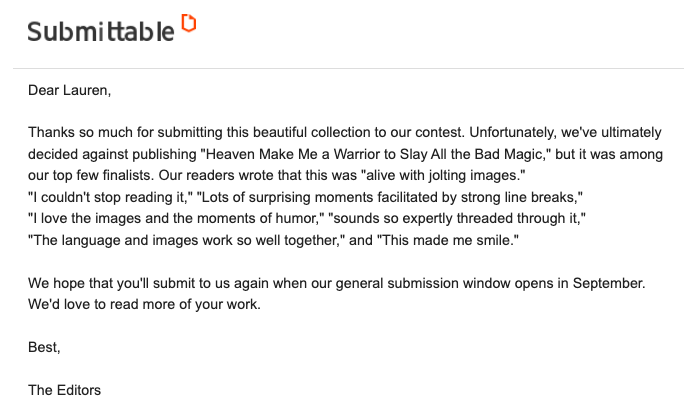
I have been submitting my work for publication since my senior year of college, when my creative writing professor taught us how to find literary journals, how to write cover letters, and how to choose the best work to send out. He taught us the difference between a “fuck you” rejection — an impersonal form email or (back in the day) a mailed slip of paper — and a celebratory rejection that offered feedback or asked you to submit again at a later date. He stressed that any rejection, but especially personal, positive rejections, were a reason to buy yourself pizza.
We mostly submitted our work in the mail back then. I’d print out five poems, arrange them with the best one on the top of the stack, and put them in a manila envelope with a cover letter and a SASE. Rejection letters arrived by mail. I’ve saved them all in a file folder. But my very first acceptance came by email, from Puerto Del Sol.
Ten years ago, I joined Women Who Submit, an organization dedicated to encouraging women writers and non-binary writers to submit their work for publication. At the monthly submission parties, we would gather with snacks and stacks of literary journals open for submissions, and get to co-working. Any time someone hits send, they announce it to the room and we all clap and cheer.
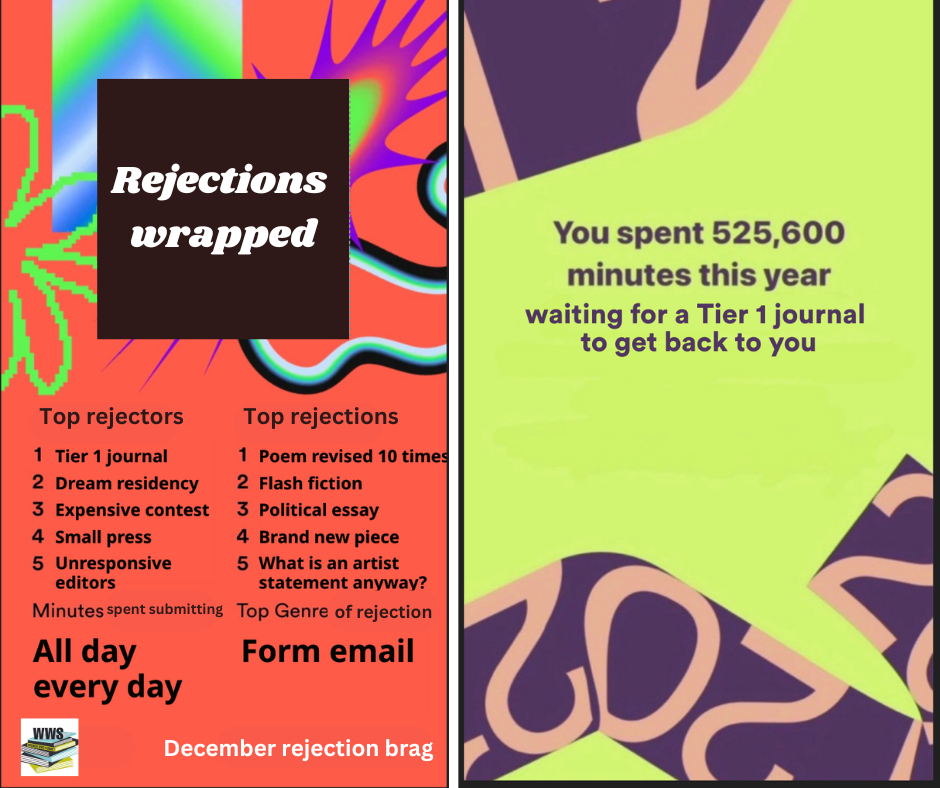
In my ten years with WWS, at times a blog editor, a website editor, a special events coordinator, a fundraising committee member, and a Board member, I’ve continued my own submission practice, learning from the knowledge and skills of our members. I also post the monthly Rejection Brags in our Facebook group.
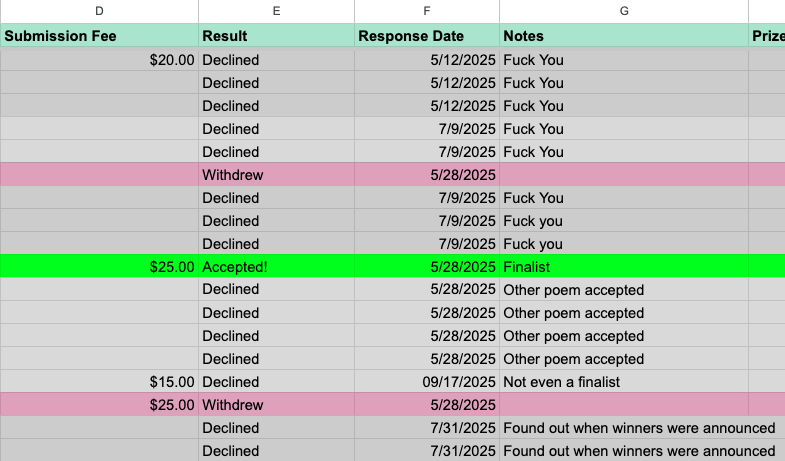
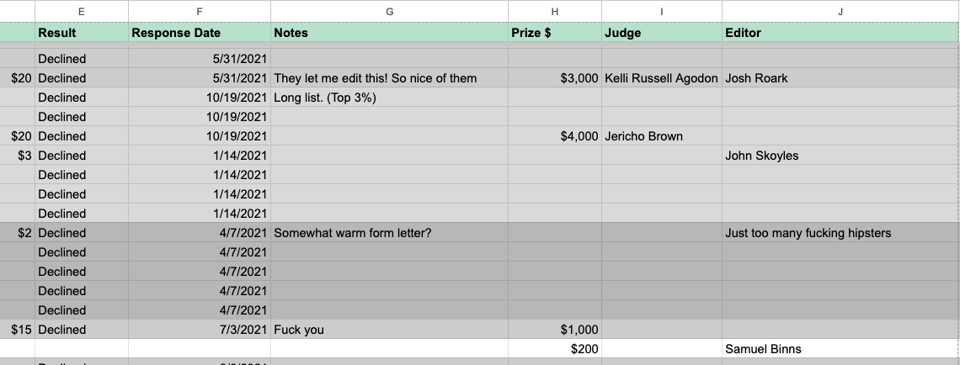
I keep a detailed spreadsheet tracking my submissions, with columns for title, journal, date submitted, response, response date, notes, submission fee, prize money (if any), judge (if it’s a contest), and editor. If I’m submitting multiple poems to the same journal (which is par for the course, as most journals request 3-6 poems per submission), each poem gets its own line. This makes it easier to track which pieces are at which journal, and how many times each piece has been rejected, and where they are still under consideration. This is useful when I get an acceptance and need to withdraw the piece from other journals. I try to have any individual poem out for consideration at ten places simultaneously. So if I receive one rejection, I submit to another place.
If you’re a woman or non-binary writer and you have been wanting to submit your work for publication but you feel daunted by the submission process, see if there’s a WWS chapter in your city! You can learn:
how to find literary journals
how to know which outlets your work is best for
how to write a cover letter
how to know when a journal is open for submissions
how to track your submissions
how to research and apply to residencies
If you can’t join WWS because there’s no nearby chapter or because you’re a man, my best piece of advice would be to look at the acknowledgments page in your favorite authors’ books. Find out where their work has been published before; in what journals did the individual poems, stories, or essays in this collection debut? Then research those journals and find out when their open reading periods are.



Add a comment: