To be on the side of life
I wanted to write about poetic influences today. I wanted to write a newsletter about the poets I’ve read over the years, and how each one has shaped my poetry at different stages of my life, but that will have to wait. Because this weekend, the United States and Israel the zionist entity* teamed up to rain death and destruction on Iran. They massacred 150 schoolgirls with an airstrike on their school. That alone should stop the world. They also bombed a hospital. In their relentless strikes across Iran, they have killed over 200 and injured at least 700.
I say “they” but it’s “we.” It’s our tax dollars, our government, our bombs, bought with our income. Consent manufactured by our newspapers.
Meanwhile, the zionist state continues to weaponize food in its genocide against Palestine, by closing all border crossings in Gaza, imposing another blockade and famine on Gaza’s already starved population. During Ramadan. They have done all of this with the unconditional support of The United States. Food prices in the markets are about to skyrocket due to short supply, so mutual aid projects like The Sameer Project, as well as survival campaigns found on Lifeline For Gaza, can use all the financial help they can get right now.
Two years ago today was The Flour Massacre, where the IOF killed over 100 hungry Palestinians in Gaza who were waiting for food aid. That didn’t stop the world, but should have. The justifications poured in. “Blah blah blah right to defend itself blah blah blah.” Just as the justifications pour in today, “Iran must never be allowed to have a nuclear weapon blah blah they are a threat blah blah blah.”
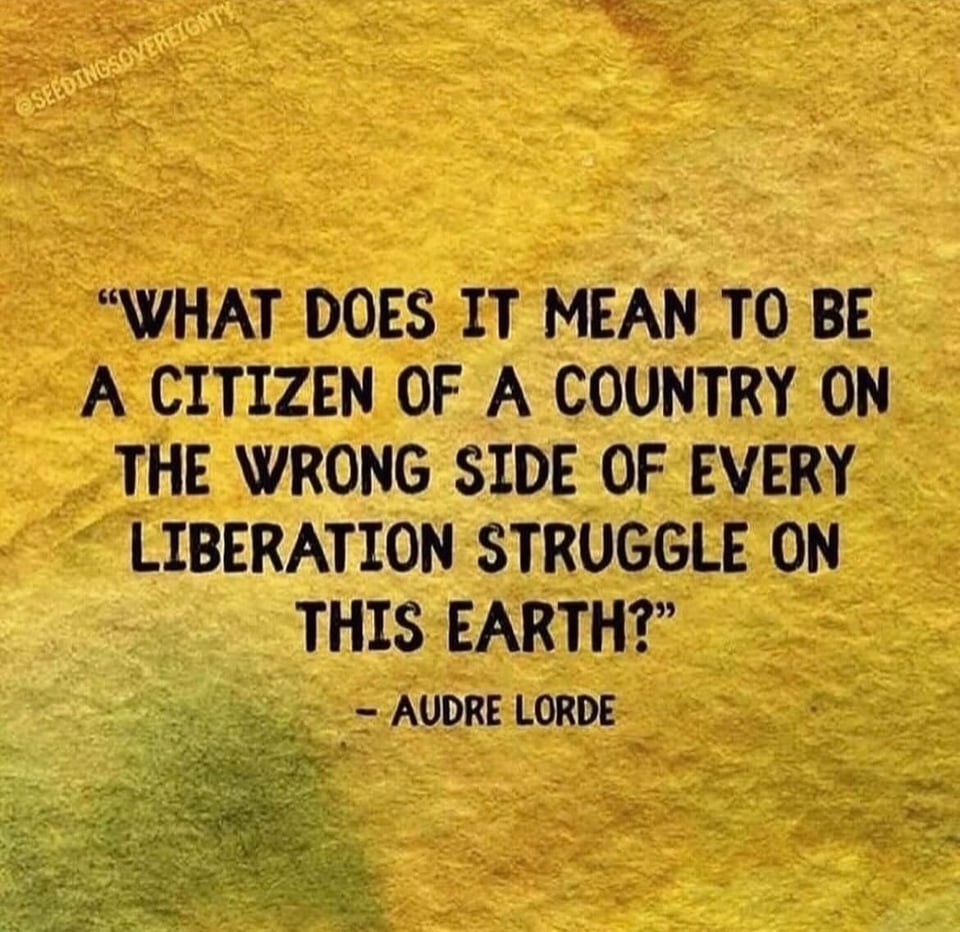
I hope we one day live to see the complete disarmament and dismantling of these illegitimate settler colonies that have wrought so much apocalyptic horror in the world. I hope we work towards Land Back for all indigenous peoples and the waning of settler power. As a settler citizen, I am aware that this means loss of my own power and privilege, and that my political solidarity must run against the grain of my supposed material interests. No one knows exactly how to get to this horizon. I only know that it’s urgent, because zionism and imperialism are the opposite of life. I hope children one day grow flowers in the compost of these states’ moral rot. That won’t bring back the 150 Iranian girls, nor the thousands of Palestinians exterminated in the last two and a half years of genocide. But it’s a necessary horizon that those of us on the side of life must walk towards.
My heart is with the people of Iran today, the people of Palestine, Lebanon, Syria, Iraq, Yemen, and every place that has born the brunt of imperialist terror campaigns. My heart is with the people resisting genocide by any means they can.
*If that term is unfamiliar to you, it’s the Palestinian term (translated from Arabic) for the state that stole their land in 1948 and has been torturing and massacring their people ever since. Many people use it to refrain from legitimizing “Israel” as an actual country or place. Palestine is the place. Palestine is the land, from the river to the sea. The zionist entity is the colonial apparatus, the structure of apartheid and genocide that drilled itself into the land to occupy and control the indigenous people. As Steven Salaita says here,
“The term is disrespectful in just the right measure and implies that “Israel” is a temporary phenomenon haunted by something older and more lasting. It evokes Palestine even when describing the occupier.”
Or, as Sarah Aziza writes in her memoir, The Hollow Half,
“[The Palestinian village of] ‘Ibdis fell in July [1948]. By then, the new nation had declared itself officially Israel — but on many Arab lips, it would remain the Zionist entity. A foreign body, sterile and metallic, named only for what it came to take."
Many people opposed to settler colonialism have drawn the obvious connections between the founding and structure of the zionist entity with that of this colony that calls itself The United States, which is why in anti-imperialist writing you will often see “The United States” written in scare quotes, or described as “the settler colony occupying Turtle Island [the original name given to this continent by many indigenous people].” These linguistic conventions invite and challenge the reader to reframe their received conceptualizing of nation-states. They challenge us to think of the land as eternal and fundamental, the indigenous inhabitants as the both the beginning and continuation of the story, and the settler state as a temporary occupier, an interloper.


Add a comment: