One thousand days
It has been one thousand days of genocide against Palestine. One thousand days of infanticide, scholasticide, ecocide, domicide, urbicide, epistemicide. One thousand days of learning new words for all the brutal ways a state can attempt to exterminate a people, land, and culture.
I don't want to be writing about genocide as often as I do.
But I write about it. I think about it. I say things on the internet and in my poetry about it. Because it's happening in our name and with our tax dollars. Because it's the greatest moral crisis of our time.
Not because it's the worst thing that humans are currently doing to other humans - how could that even be measured? - and not because it's the highest casualty count of all current genocides.
But because it is livestreamed with documented, irrefutable proof, and still, still, STILL, denied, rationalized, and justified.
Because no matter how many human rights organizations confirm the fact that, yes, Israel and the United States are attempting a wholesale extermination of Palestine, that yes they are deliberately destroying the healthcare system, deliberately assassinating paramedics and journalists, deliberately enforcing mass starvation, deliberately destroying agricultural land, deliberately maiming and disabling people, no matter how many stories we hear about Palestinians being beaten, tortured, raped to death, bombed, burned alive, gassed, sniped, mauled by attack dogs, imprisoned as children, kidnapped, left to bleed in the street, trapped under rubble, executed, handcuffed and thrown in mass graves, we are still surrounded by legislators, media outlets, and nominally "progressive" organizations running cover for the state committing these acts of annihilation.
Many of us are still surrounded by genocide deniers in our personal or professional lives, people who launder that stance with both-sidesy vibes and agonized handwringing. Those of us who have been advocating for Palestine since October 2023 are chastised for doing so "too early.” People who had been advocating for Palestine for years prior are smeared as crazy, fringe, unhinged, too radical.
Last year, I read three diaries written by Palestinians in Gaza. All three were diaries written during the first year of the genocide.
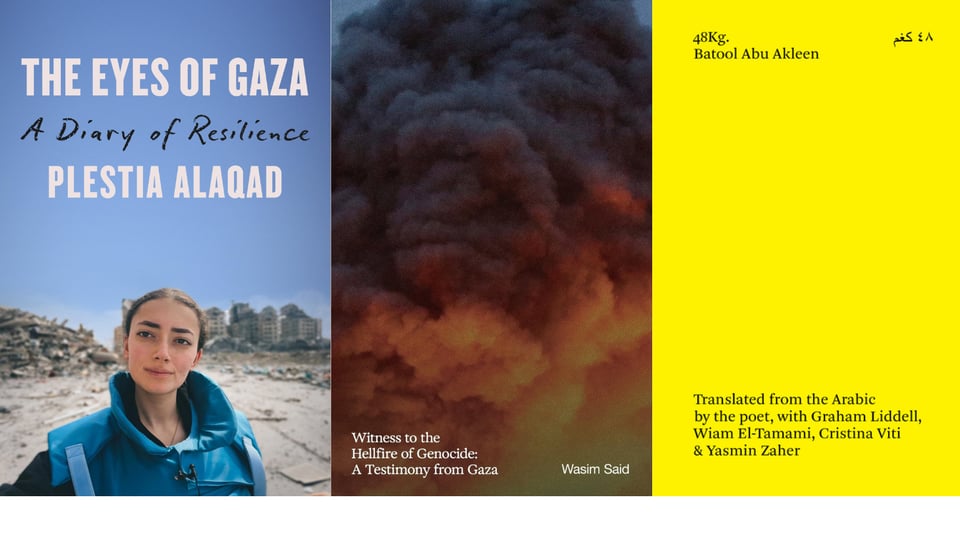
The Eyes of Gaza: A Diary of Resilience by Plestia Alaqad
Witness to the Hellfire of Genocide: A Testimony from Gaza by Wasim Said
48Kg. poetry by Batool Abu Akleen
Reading these testimonies should dispel any reasonable person's lingering assumptions that "Operation Iron Swords" began as “legitimate defense against a terror attack” that "eventually went too far" and "turned into a genocide" after an undetermined amount of time and number of Palestinian deaths.
As genocide scholars, human rights organizations, and Palestinians themselves on the ground have been telling us, it was always a genocide. Point of fact, Israel’s leaders were announcing their expansionist intentions immediately as well, and referring to Gaza as “human animals,” “the children of darkness.” The actions of the zionist state occupying Palestine on October 7, 2023 were a genocide because their actions were already a genocide on October 6, 2023, and in 2021, and 2018, and 2014, and 2009, and 2007, all the way back to 1917. What commenced on October 7, 2023 was an annihilatory escalation of what has always been the objective: maximum Palestinian land with the fewest Palestinian people, an aim achieved through mass imprisonment, siege, starvation, ethnic cleansing and slaughter with U.S.-made weapons.
But there is a difference between knowing something and reading a firsthand account of it.
These testimonies speak of the bombed houses on October 8, 2023, the first bombed hospital on October 17, 2023. The crowded hospitals and missing fathers. The humiliating search for food, the daily indignity of waiting in line with 2,000 people for one toilet at a shelter, and then that shelter being bombed. The Flour Massacre. The massacre and siege of Al Shifa.
“In truth, nothing I write really matters. Because, if you want the honest truth: we don’t matter, we have no value in the scales of this unjust world. If the world saw us as human beings, our extermination would have stopped long ago.”
-Wasim Said
These are not easy books to read. Even Plestia's, which has a youthful, quotidian tone at times, is haunted by the ghost of the life she could have had, the life she deserved to have. It is the book I would recommend first to anyone who has yet to read a single book by a Palestinian (The second would be They Called Me a Lioness by Ahed Tamimi). Plestia and her family managed to evacuate Gaza in November of 2023, but the home she knew has been decimated. With our money. With our consent.
Many white U.S. Americans prefer to read "middle east analysis" by white, western journalists and heads of state. We are encouraged to genuflect before the expertise these architects of statecraft supposedly hold, and accept as gospel their accounts of “peace deals” while they derisively admonish Palestinian campus protestors and their Black, Brown and Indigenous allies for “not knowing their history.” These pundits and politicians are considered neutral arbiters of an intractable conflict that could be solved if only it weren’t so tragically mired in irrational, ancient savagery. They deliver their sacred opinions in The New York Times and The Atlantic to a population that has been so steeped in Islamophobia and anti-Arab racism since even before 9/11 that most people don’t even notice the dog whistles. We’ve been carefully taught not to.
Thankfully, there are historians and scholars from a variety of communities who are educating people and turning the tide of public opinion. Many of us have spent the past three years reading about Palestine and Palestinian history, unlearning all the American propaganda. And this is good to do. Reading about Palestinians is important. But nothing will radicalize you like reading Palestinians themselves.
I am aware that I run the risk of sounding too stentorian, too righteous, and that might cause people to tune out. I have lost relationships because of my advocacy. Some people find me cringe and annoying. Being a loud, angry pain in the ass is off-putting.
But I’d rather regret being exhausting than regret holding back my rage.
I want to do more than encourage us to read books today. I want to go into the next half of the year focused on supporting mutual aid to keep Palestinians alive, like The Sameer Project and Gaza survival campaigns, as well as supporting activists who are receiving harsh sentences for resisting genocide. (Read about the Filton 25, the Stanford 11, the Golden Gate 26). Fighting the war machine becomes more possible when we support people actively resisting the war machine, in all parts of the world.
“The world sometimes treats us like terrorists, trying to justify its complacency in allowing us to be massacred. And we know the perception, we read the propaganda just like everyone else. But the reality is that we’re the opposite. In Gaza, you are never just a number. Even though we lose more people than our hearts can handle, every single one is remembered, and loved, and mourned. Because that’s what you’d want to happen for you, and that’s the least a human deserves.”
-Plestia Alaqad
I don’t think we should be forgiven for any of this. But I do think we each need to grapple with how we can change our lives in ways we never imagined. Gaza must live.


Add a comment: