"A process of constant curiosity and creation"
on Camonghne Felix's new book
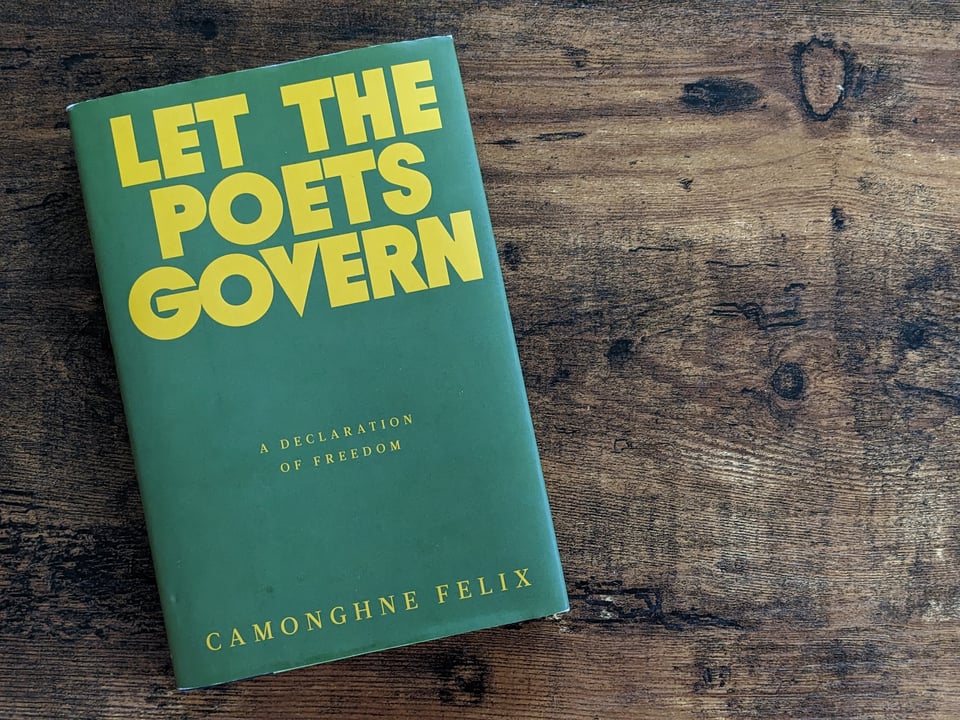
Earlier this month I read Let The Poets Govern by Camonghne Felix. I heartily recommend it to anyone who is interested in poetry or political thought, or anyone who wrestles with how language shapes and is shaped by our world.
Felix writes, “Each of us has the ability to see the world through a poet’s eyes, the ability to find ourselves in a process of constant curiosity and creation, where what we want to see is made visible in real time.”
This book challenged me to think of how I approach both poetry and organizing. Felix writes of her youth in New York City, her political coming of age among slam poets and radical Black elders, her career as a speechwriter for Elizabeth Warren, her time spent as a consultant in DC, her disillusionment with electoral strategy, her disgust and disappointment at liberal leaders’ failure to oppose the genocide of Palestine, and her return to grassroots organizing. She writes of Black poetic traditions and innovations that have threaded through struggles for liberation. She writes of the poetics of the socialist revolution in Grenada, the Caribbean island of her ancestral lineage: “Revolution is a birthright, and the colonizer should fear the people’s resistance forever.” She also turns her sights on the poetry of that colonizer, delving into the poetics of 15th century papal bulls that provided religious cover for the Western world’s crimes against humanity: “strategic declarations meant to do exactly what they set out to do: extort, enslave, dominate, and expatriate all non-white/non-Anglo/non-Christian peoples— armed with God’s glory and God’s armies.”
Felix is concerned with how language constructs our thought. She takes the concept of imagination seriously, because imagination is what governs our ideas of what is possible or impossible.
“The challenge is to let the poem speak to you, to let it call to you, and in response, allow it to radicalize you. To allow it to transform your idea of humanity, to transform your understanding of human interconnectivity. To let it be the start of a long conversation with the world around you, this world you are constantly responding to, this world that is calling to and responding back to you.”
The prose builds and flows at times like a sermon, at other times like an academic lecture, at other times like a lyrical reverie. The reader emerges changed.


Add a comment: