
on meaninglessness
It is a tale told by an idiot

I started writing this essay in January, after I heard former Border Patrol commander Greg Bovino say this about ICE following the execution of Renee Good: “What we do is legal, ethical, and moral. Everything we do every day is legal, ethical, moral, well grounded in law.”
It was one of the first times I’d engaged with the news since giving birth. I put on NPR’s Up First podcast, took my dog for a walk, and caught up to the horrors. But when I heard the words “legal, ethical, and moral” slide out of Bovino’s mouth as easily as if he was stating his name, I had to pause the podcast. I had to look up at the bare branches of trees and ask, “What the fuck are we doing here?”
We know that this administration lies. It has been openly at war with facts for its entire existence; the phrase “post-truth” rocketed into common parlance after 2016. We all watched Trump’s mouthpieces lie with even greater shamelessness than usual throughout the ICE-in-Minnesota news cycle at the beginning of this year. It was as unsurprising as it was sickening to see the videos of protesters being gunned down at close range—to witness what happened—and then hear political officials tell us that something else entirely had happened.
For a time it was popular in my corner of the internet to share a quote from 1984: “The party told you to reject the evidence of your eyes and ears. It was their final, most essential command.”
This quote rang true for our political moment, but something about it felt inadequate to me. Yes, they lie. Yes, the fracturing of any kind of shared experience thanks to the social internet means that lots of people believe the lies. Yes, reality is crumbling beneath our feet. But many of the messages coming from the highest seats of power are more than untrue. “Everything we do every day is legal, ethical, moral, well grounded in law.” To call this a lie would be like calling a cylinder a circle. It’s a distortion not just of truth, but of meaning itself.

what is meaning?
In literary theory, you learn about this concept called “the sign,” gifted to us by Semiotics Daddy Ferdinand de Saussure. A sign has two parts: the signifier and the signified. In a classic example, the word “tree” is the signifier and an actual tree is the signified. Or in another example:
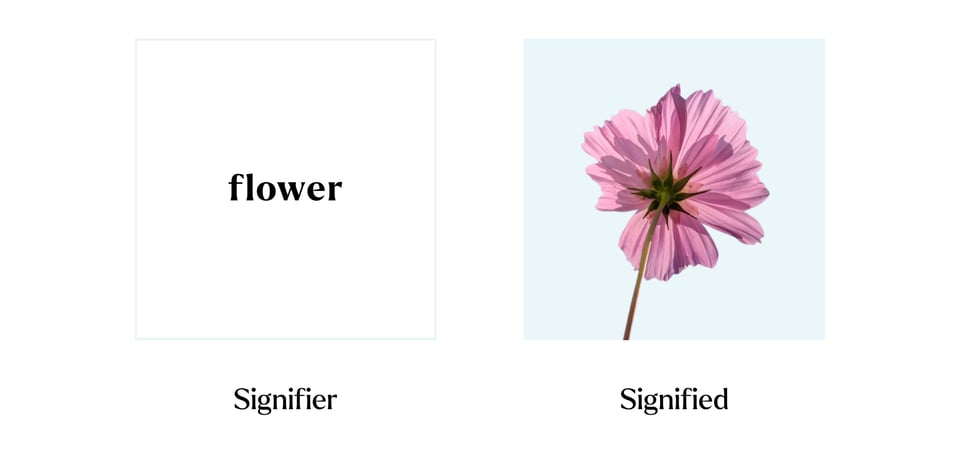
A sign is what happens when you make a shape with your mouth, or put a marking on a piece of paper (signifier), to evoke an object, action, or idea (signified). That link between language and reality, that instantaneous image your brain conjures when you read the phrase “elephant hula hoop competition”—all of that is meaning. A word means something. Tree means 🌳. Flower means 🌸. To point at a tree and say “Look, a flower” would either be an error or a lie. Flower does not mean 🌳. Everyone knows this, even children.
But language comprises a vast network of signs, most of which are a bit more complex than tree. What does ethical mean? What does moral mean? To understand these signs, you have to understand a whole bunch of other signs: right and wrong, good and bad, admirable, detestable, bearable. These meanings can all wobble a little, based on culture and context—but only a little. Ask just about anybody whether shooting a peaceful protester at close range is moral, they’ll say no. Ask them whether an unprovoked military occupation on domestic soil is ethical, they’ll give you the same answer. Everyone knows this, even children.
And yet. “What we do is legal, ethical, and moral. Everything we do every day is legal, ethical, moral, well grounded in law.”

Powerful entities calling bad things good isn’t new—it’s kind of fundamental to how power works: If something is unjust and harmful but gives you power, you’ll say that it is actually very just and totally harmless if it means you get to hold onto that power. Historically, this inversion of meaning has been aided by justification or rationalization. Christian hegemony was God’s plan. Imperialism was a civilizing mission. American westward expansion was both God’s plan and a civilizing mission.
But lately it feels like we’ve been skipping a step. Political figures on the right are not doing the rationalization dance, but simply stomping their feet and saying, “ICE good. War in Iran good. Fossil fuels good.” Or, more specifically: “What we do is legal, ethical, and moral.”
Are they lying? For something to be a lie, a speaker must know the truth and intentionally communicate something else. But it’s possible that these people believe what they’re saying, that their brains have been so boiled by Facebook and Fox News that, to them, flower means 🌳.
I think it’s a third, worse, more idiotic thing. I think these people are not aware of what they’re saying. The shapes their mouths make have been severed from the concepts those shapes were meant to signify. Flower doesn’t mean anything at all.

signifying nothing
In his 1946 essay “Politics and the English Language,” George Orwell rails against the “bad habits” that plague writing and speech, from dying metaphors to pretentious diction to meaningless words. All of these sins are both symptoms of, and contributors to, a lack of conscious thought and intention in political writing. “In prose,” he writes, “the worst thing one can do with words is to surrender to them.” And that is exactly what he accuses his contemporaries of doing: Mindlessly adding canned phrases to a cursed midcentury word salad instead of choosing words that convey what they’re trying to say—instead of writing what they mean. According to Orwell:
A scrupulous writer, in every sentence that he writes, will ask himself at least four questions, thus: What am I trying to say? What words will express it? What image or idiom will make it clearer? Is this image fresh enough to have an effect? … But you are not obliged to go to all this trouble. You can shirk it by simply throwing your mind open and letting the ready-made phrases come crowding in. They will construct your sentences for you – even think your thoughts for you, to a certain extent – and at need they will perform the important service of partially concealing your meaning even from yourself.
Orwell claims this cognitive autopilot is a cyclical problem, one where our writing “becomes ugly and inaccurate because our thoughts are foolish, but the slovenliness of our language makes it easier for us to have foolish thoughts.” It’s a kind of entropy, a slow-motion surrender. Today, we can see it taking place not just in the White House, but also in most senior leadership of the Democratic Party and every single post on LinkedIn. There are just some words and phrases that people love to use, so much that their meaning has completely eroded away. Now more than ever. Fighting back. Shared commitment. Data-driven. (LinkedIn is not relevant to this essay, I just hate logging on there so much and need to vent.)
If, as Orwell writes, “political speech and writing are largely the defense of the indefensible,” then essential to that defense is the severance of words from meaning. We can do that in small cuts, like when an “attack” becomes a “major combat operation.” But we can also do that in great, gouging, broadsword slashes, like when millions of people have watched a video of an unarmed woman being gunned down at close range and are told it is “legal, ethical, and moral.”

The Trump administration didn’t invent weaponized meaninglessness, but they did take it nuclear. Into a vacuum of meaning, they have declared victory a dozen times in a war that they nevertheless continue to wage. They have labeled an entire category of person “criminal,” despite an overwhelming absence of actual criminality. They have issued unenforceable, often senseless, executive orders, hoping to reshape reality in their image or, if that fails, disregard reality altogether.
And of course there is Trump himself, who has cultivated a persona of meaninglessness for as long as he’s been in the public eye. He says he is rich, he is savvy, he is right, he is loved, and he never loses. He claims, constantly, qualities that objective observation would not confer upon him. He does this with such relentless insistence that after a point, the shapes he makes with his horrible little mouth cease to mean anything at all.
And when nothing means anything anymore, that’s when you’re truly free. Free to oppress and call it liberation. Free to wage illegal war and call it anything you want, even “war,” because the bombs you drop on schools thousands of miles away are as meaningless as any word you may use to describe them. Free to abduct people off the streets, to dump them back outside where they will die in the cold, and know that all your opponents can do about it is fling more words at you, straight into the vacuum of meaning. (Words that have probably also been diluted by the grand tradition of stock phrases and euphemism and empty political promises.)
It’s a nice place to be, this vacuum. Free of want and free of fear. People like J.D. Vance and Marco Rubio, who once said words that implied they detested this vacuum, have slipped comfortably into its gravity. In the sensory deprivation tank of meaninglessness, consequences and shame slide right off you. Lying is effortless here, because in fact there’s no such thing as a lie. Words are just shapes your mouth makes. Everything we do is legal, ethical, and moral. The emperor’s clothes are splendid. Flower means 🌳. I love Big Brother.

postscript
In my day job as an editor, one of the most common questions I ask clients is this: “What do you mean?”
In the professional world as much as in politics, jargon and stock phrases and unnecessary verbosity are everywhere. Reaching for ready-made language and shoving it into a document is easier and faster than closing your eyes, asking “What am I trying to convey?” and carefully selecting the words that will achieve your goal. Writing has always been hard.
But it’s important to do this hard thing. We need clarity of thought and intention in politics, we need it in our relationships, we need it in our quarterly reports.
In Orwell’s words, language is “an instrument for expressing and not for concealing or preventing thought.” This is an instrument that we can all work daily to clean, to tune, and to play with something like harmony. This is work we can all do—in fact it’s work we must do—to keep ourselves out of the void and in the real world, where flower means 🌸. Where moral and ethical mean moral and ethical. Where words and actions mean something.

note
Flower Friday has officially hit 100 subscribers! Thank you all for signing up to read it.
This newsletter grows exclusively by word of mouth. If you think a friend might like this, it means a lot when you forward it to them. And if you particularly like or dislike a certain issue, it means a lot when you tell me what you think! This is a space I’d like to continue to improve, to give you a reason to keep reading.

