
in defense of the landscape photo
Just because we take pictures on our phones doesn't mean we have to look at them there.
A couple years ago, my husband and I received an Aura frame as a gift. Much as it mortifies me to speak well of any consumer good that is not food, I must confess this product absolutely rules. It rules so much that we bought one for a bunch of our relatives this Christmas, and so far they all seem to agree that it rules.
Our frame sits on the mantel; I can see it from my desk. At any moment throughout the day, I can glance to my left and see a different photo that makes me happy to look at. There’s our dog on a rock in Crested Butte. There’s my husband at the train station in Antwerp. There’s a picture from our wedding. There’s that really excellent photo of a Highland cow I took at Loch Lomond.
For me, the appeal of the Aura frame isn’t just about displaying high-quality images in a visually appealing way, or saving money/wall space on framed prints, or even sharing photos directly to other people’s frames, though that feature is rad. (Take note if you have a kid on the way and your folks live out of state: This is a hit). The thing I’ve most enjoyed is that the frame has given me a way to look at photos—to access memories—that is not on my phone. And by extension, looking at photos has once again become a shared experience.
When my family gathers at someone’s house, an Aura frame is in full view and often becomes part of the conversation. Someone might ask, “When is that from?” Or they might sigh and point at the frame and say, “That was such a fun night.” Or they might laugh and ask, “Why do you have a random picture of a Highland cow on here? Wait, really? You took that picture? Wow!”

The frame is wider than it is tall, so landscape photos inherently suit it better. Portrait photos either leave black space on the sides or are displayed in scrawny pairs, half the size of their swole landscape peers. Because of this, I’ve found myself more intentionally taking landscape photos over the last year. I’ve also found that I am a little annoyed when other people add portrait photos to my frame.
When I was in high school, I remember taking issue with the new trend of “vertical video.” Phones were getting better at capturing decent video but people lacked the common sense to turn those phones sideways before hitting record. That meant YouTube—and, to my film studies teacher’s dismay, student film project submissions—was getting overrun by these tiny portrait-oriented videos with great thick bars of black to either side. At the time I assumed this would be a short-lived issue. People would realize these videos were no fun to look at, maybe the smart phone companies would turn the whole design sideways, solutions to this problem were surely forthcoming.
Obviously, I called that one wrong. Portrait photos and videos are the norm today not just because we use our phones to take pictures and videos, but because our phones are often the primary means by which we view those pictures and videos.
In the 1960s, communication theorist Marshall McLuhan coined the phrase “the medium is the message.” Essentially, he meant that a communication medium in itself—not its contents—deserves our scrutiny. What broadcasters aired on TV, for example, was to McLuhan less important than the fact that TV existed in the first place, because “the ‘message’ of any medium or technology is the change of scale or pace or pattern that it introduces into human affairs.”
In the case of the smart phone, the change of scale, pace, and pattern that it introduced was to make the consumption of entertainment media more accessible, more immediate, and more private. When I was a kid, you had to boot up the shared family computer and allow for several minutes of load time to watch a video, an activity you often did with friends, fighting over who got to sit in the chair and who had to kneel next to it. When our parents were kids they gathered in front of TVs to watch shows, and a couple generations before that the kids had to go to movie theaters to be entertained. Farther back we get puppet shows, playhouses, amphitheaters, cave drawings. Until recently, the activity of looking at stuff (which in best-case scenarios we can call art) was a shared one, limited to discrete events or time slots. But the internet changed that, and then smart phones really changed it. Now, being entertained—or seeing recent photos of my family members—is an activity that can spring directly from the palm of my hand to my eyes; I don’t have to share that activity with anyone.
Fortunately, the phone-ification of visual media has remained contained to phones. We don’t mount portrait-oriented TVs to our walls today; movie theaters aren’t shaped like the garbage chute in Star Wars; all the live-action Disney remakes, while bad, are still widescreen. And fortunately, “big screen” activities like watching Taskmaster or going to see a movie are still things we do with (or at least among) other people.
But unfortunately, while portrait orientation has stayed on our phones, our phones have stretched and warped to fill every empty corner of our days. We look at these things far more often, and for much more cumulative time, than we look at TV screens or photo albums or cinema projections (and possibly more than all those other things combined). If the medium is the message, then the message of a portrait photo is, “You will look at this on your phone.”

As I’ve written about previously, I am tired of looking at my phone. I’m so tired of it that I started wearing a watch just so I wouldn’t have to keep tapping the cursed thing awake to check the time. And because I’ve recently had a child, I’ve been thinking a lot about how to capture and preserve memories in a way that does not further chain our family to a phone (and that does not depend on the whims of a tech company). How do I want this kid to look back on his young life some day? Do I want to be a camcorder parent and stitch together hours of amateur home video footage? Do I want to imitate my friend’s dad and build a website from scratch, on my own private server, that houses terabytes of family photos?
For now, the approach that seems most appealing—and, let’s be real, easiest—is to simply print photos and stick them in a physical photo album. There is something nice about holding a tactile picture in your hand, about turning pages in a book as a way of traveling through time. So I bought a couple albums at the end of last year and have spent a few minutes every week since then compiling, curating, and cropping selections from my archives to print. A tedious process, but a nice one. And hopefully one I won’t have to repeat in the future now that my photography habits have changed.
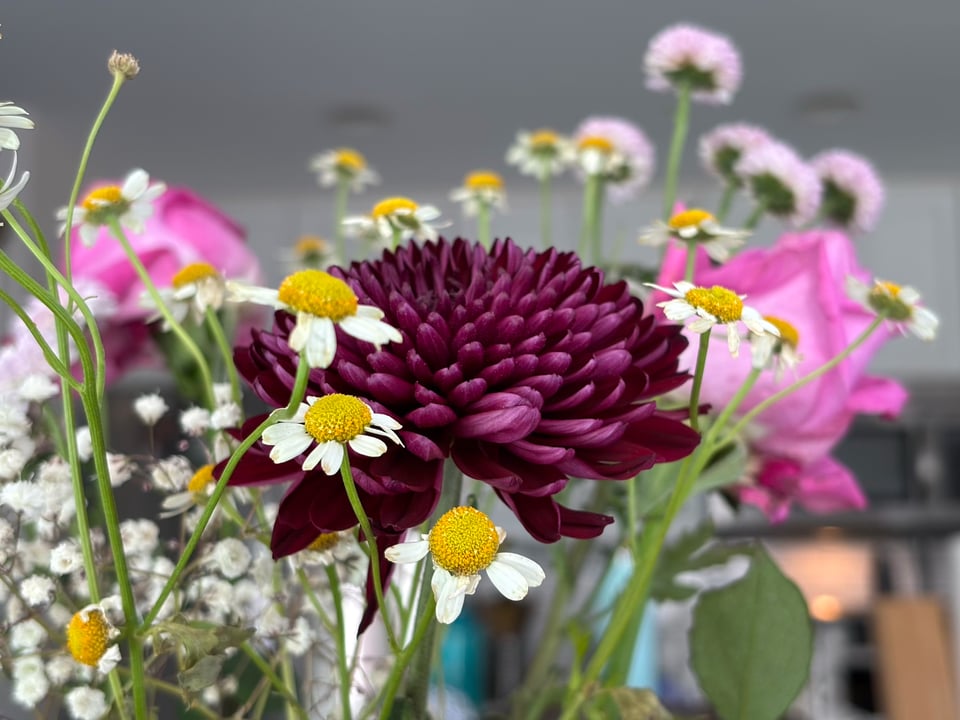
Until fairly recently, when I took photos it was a lot of them and they were usually portrait-oriented because the implicit expectation was that I would post them to Instagram. (This includes Flower Friday photos, which used to live in IG Stories and now live here.) Now that I am largely cured of that particular disease, the photos I take are for me. Or they’re for my family. Or they’re for a particular friend who I think would enjoy a particular image. I’m consciously working not to take the spray-and-pray approach, but instead to spend a few seconds lining up a nice shot and snapping one, maybe two photos. Not to post online later to boost my imaginary social internet points, but to capture a moment. To give myself and my loved ones something to remember together in the future.
And yes, most of these photos are landscape. This is in part because I think a landscape photo is more intuitive; it looks more like what we see through our eyes. But it’s also because I want to look at photos on anything other than my phone, where one tech company or another will always control the access I have to my own memories. Because I want the pictures I take to be little testaments to the love I give and receive in this life. Because I want them to carry the message, “This was worth capturing, so it’s worth the space it takes up in the real world, whether that’s in a photo book or your wallet or a digital frame on your end table. I hope you like looking at it. I hope you’re looking at it with someone you love.”
So the next time you’re viewing a scene through your phone screen, thumb hovering over the red button to snap a picture, consider taking a moment to ask yourself whether the photo you’re about to create should forever exist only in the attention-gobbling isolation chamber of your depression rectangle, or if there’s somewhere else you might like this memory to live. Consider turning that thing sideways.


Add a comment: