Last Week's New Yorker Review: 🌱 The Weekend Special (February 3)
The Weekend Special
Pieces are given up to three Boyles (for fiction), Harrimans (for essays), or Parkers (for random picks). As with restaurant stars, even one Boyle, Harriman, or Parker indicates a generally positive review.
🌱 Fiction
“A Visit from the Chief” by Samanta Schweblin. No Boyles. scared, scenario, scratch. I quite liked Schweblin’s eerie, brief horror novel Fever Dream, and readers hoping for another discomfiting thrill won’t be disappointed by this story, in which a senile woman beckons her unhinged son to the depressed main character’s house. Read literally, though, this story has an uncomfortable understanding of trauma and violation as helpful, encouraging growth – something Schweblin states pretty directly as her intent in the interview. The story seems to be a kind of assault fantasy in which a version of Schweblin’s martial arts trainer spurs a version of Schweblin to do better, to wake up. But assigning such power to threat and violence displays a troubling and slightly shallow understanding of trauma, fetishizing it and even sanctifying it. One can also read the story as a visit from a kind of demigod; the title seems to encourage this, as “the Chief” is the intruder character’s name for God. Or one can read the story as a sort of satire of the reader’s relationship to fiction: The writer barges in, asks a great deal of the reader while promising to help them, violates and controls the reader, but ultimately does deliver a kind of grace, as if from nowhere. (This is a bit too clever of a gloss, perhaps, but I don’t think it’s entirely unfounded.) If one needs a scare, or wants a counterargument to The Piano Teacher, feel free to read; I was troubled, but unproductively – not unsettled, just put off.
🌱 Weekend Essay
“David Lynch’s (Possible) Realism” by Joshua Rothman. One Harriman. meditation, method, memoir. I’m not especially convinced by Rothman’s reading of Lynch; sure, his work is irrational at its edges, casually surreal, but saying this means it’s operating from the mindset of a pre-rational world ignores the fact that his language is made up almost entirely of the products of mechanized civilization – diners and jazz bars are not the usual settings of seances. Lynch finds the “spiritual world” in beer bottles and curtain rods; he sees cathedrals everywhere. The quality of the detritus is as important as its elevation; This is still a good tribute to Lynch, and framing things around Lynch’s words as much as his work is a difficult task – the man may not be “secretive” but he’s not exactly revealing – but Rothman is uncowed. When he recounts the usual on-set anecdotes, the piece is stale (who doesn’t know the backstory of Bob, at this point?) but the story about Lynch’s experiments and his father is dynamite, and the first paragraph is pretty perfect. Damn fine coffee.
🌱 Random Pick
“Possessed” by Thomas Mallon. (November 9, 2009). One Parker. gulch, godless, gimmick. An enjoyably withering assessment of Rand from Mallon, who had a horse in the race – his brand of Dan Quayle-style conservatism was being smothered by the somewhat Rand-inflected neo-conservative movement of the time; nowadays, it’s completely buried. Mallon seems a bit more offended by Rand’s abysmal prose than by her grotesque ideas; her arguably scandalous personal life, with a young male mistress, comes in for some jabs, as does the cult of personality she cultivated. Ultimately, though, Mallon decides Rand wasn’t especially important; nowadays, when her loud preaching in favor of social stratification is cited approvingly by reams of influential fascists, that argument seems pretty thin. Sorry, Mallon – your horse didn’t just lose, he’s glue.
🌱 Something Extra
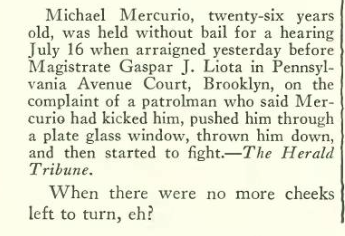
One of those after-article tidbits (do they have a name?) from a randomly selected issue, of 1935:
Sunday Song:
-
I thought the Schweblin short story was brutal, but the illustration accompanying it is superb. Also, to me at least, doesn't in the least go with the story. Odd that I'm reacting more strongly these days to the artwork than to the prose or poetry. At least since Anthony Lane's essay on Byron, which surely made my top 10 of the year (and nobody else's, probably).
Add a comment: