The Reading Is the Curse: On "The Mortal Coil Shuffle"
What happens when a deck of cards is also a comic book?

Despite the fact that it appears to be Very Much My Shit, I hadn’t yet sat down with a full volume of writer W. Maxwell Prince and artists Chris O’Halloran and Martín Morazzo’s Ice Cream Man. This might have been due to the presence of a lot of creepy-crawlies in the preview pages I saw from the first volume, because, well, most bugs creep me the hell out. I did read a couple of short comics that the creative team and some friends of theirs published online in the early days of the pandemic, and I liked what I saw there.
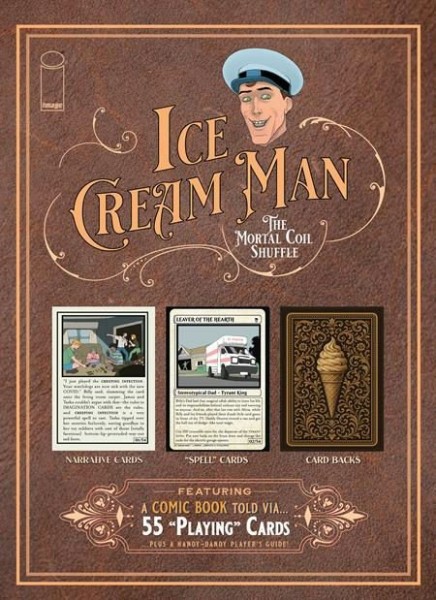
A few months ago while visiting family in the Garden State, I stopped by The Geekery and noticed something unique near the cash registers: an Ice Cream Man story — The Mortal Coil Shuffle — published as a deck of cards. I can’t resist a good formal experiment, and so I forked over some cash for it, went home, and dug in.
The back cover — well, the back of the box — makes a few things clear from the outset, including that this is, first and foremost, a comic book. It’s not meant to be shuffled or rearranged. (Though I’m sure some enterprising reader has figured out a way to do so.) What’s interesting here is the way that the turning over of a card echoes the mechanism of turning a page, which can be used to great effect in physical comics. (I am still a little scarred from the way Larry Hama and Marc Silvestri revealed the Hunter in Darkness in Wolverine #34.)
That isn’t the only way that The Mortal Coil Shuffle blends form and content. The story told in these 55 cards focuses on the disintegration of a family, due in part to a father’s gambling addiction. Making the literal action of reading this story tie in with the way one character experiences his downfall has the disquieting effect of connecting you, the reader, with a tragic character’s ebbs and flows. The closest experience I’ve had to this is probably from reading Grant Morrison and Doug Mahnke’s Ultra Comics #1 — which is still far removed from what Maxwell, O’Halloran, and Morazzo are doing here.
Some of the cards here are designed to echo playing cards, while others blend comic book panels with narration akin to Magic: The Gathering cards, with instructions to match. (“You are minus 1 father. Though he was never really ‘there,’ was he?”) Others fit the format in other ways: when a husband and wife split up early in the story, one early card takes the form of a divorce lawyer’s business card. Later in the story, individual pages will take the form of a credit card, a Tarot card, and several playing cards.
O’Halloran and Morazzo’s art clicks into place well, even in the smaller format. There’s a panel of a man holding up his finger and saying, simply, “Uno!” that manages to feel both naturalistic and ominous. The format of this story also allows the artists to demonstrate their range: there’s one card that evokes the Rider-Waite-Smith tarot deck, while the following card features that same card in the hands of a character drawn in the series’s more familiar style.
At its core, this is a horror story, and while The Mortal Coil Shuffle contains no phantasmagorical creatures or ominous revenants, there’s plenty of disquiet found in its cards/pages/cards. Combine the story being told with an inventive approach to telling that story and you have a compelling whole — even if it might lead to some sleepless nights and existential crises.

