Permutations of an Investigation: On “The One Hand & The Six Fingers”

There’s a moment of deep narrative dissonance early in the story of The One Hand & The Six Fingers, and what’s most notable about it is the way it isn’t commented upon at all. The story is, at its core, a science fiction procedural, about a hard-living detective on the trail of a serial killer. With one significant exception, the technology looks like it could be set at any time in the last 25 years. That the city in question is called Neo Noveno is an interesting flourish, but overall, the location is familiar. It could be the world outside your door, more or less.
Except that very early on, a narrative caption tells the reader that the year is 2873. While the characters in the story don’t comment on it, it’s difficult to read this in 2026 and wonder about a future in which very little about society or technology has changed in 800 years. (Isaac Fellman’s novel Notes from a Regicide does something similar, albeit in the context of a very different story.) Encountering this is jarring, and the memory of it continued as I made my way through the story. Eventually, I began to wonder if it was a typo, something that might be corrected in a future edition.
Spoilers: it was not a typo.
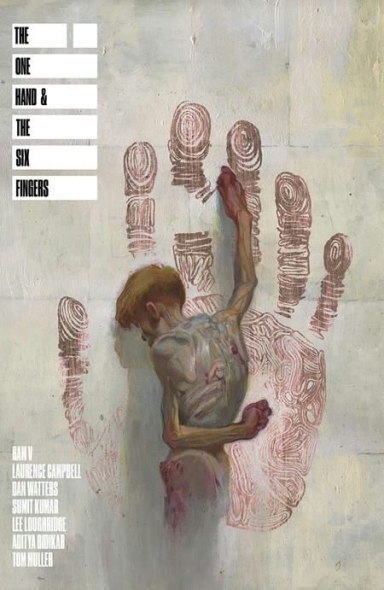
The trade paperback I hold in my hands collects two different series: The One Hand, from writer Ram V and artist Lawrence Campbell, and The Six Fingers, from writer Dan Watters and artist Sumit Kumar. Both are writers whose work I have enjoyed elsewhere, so my expectations for this one were high. Each half of the story follows a major character: at the center of The One Hand is Ari Nasser, a detective who is literally in the process of retiring from the police when we first meet him. The Six Fingers, meanwhile, follows Johannes Vale, a student who may or may not be continuing in a series of murders that detective Nasser solved. Twice.
There’s a general sense of something very wrong about this society, but what? Early in the book, we see Nasser in the midst of what appears to be a doomed romance with Nemone — except that Nemone is actually some sort of android, and synthetic people are relatively widespread in Neo Noveno. Otherwise, we’re still in around a circa-2000s level of technology — cars, planes, phones, and so on — with the added twist that not all of the people walking through this city are flesh and blood. Or perhaps they are; one of the questions eventually posed by the series is the extent to which advanced synthetic beings can be made to emulate human anatomy.
Nasser’s pursuit of the One Hand Killer leads him to track Vale, whose work with irradiated materials has altered his body, giving him a vestigial sixth finger. This isn’t quite a whodunit; Vale has gaps in his memory, blackouts that coincide with some of the crimes Nasser is investigating. Instead, this is more of a whydunit — a crime story told from two perspectives. Arguably three, as Ada — an art curator who assembled an exhibition reacting to the killings — emerges over the course of the narrative as both a prominent figure in her own right and a more reliable guide to the happenings of Neo Noveno than either Vale or Nasser.
The visuals of each half of the story are one of the biggest places where the two halves of this book contrast. Sumit Kumar’s figures are energetic and slightly distorted; at times, I was reminded of Jason Howard — kinetic without feeling cartoonish. Lawrence Campbell’s art, meanwhile, abounds with shadows and small panels. Given that one of the hallmarks of the One Hand Killer’s work is a series of glyphs, that the page layouts of Nasser’s story echo this seems fitting. Maybe it’s the nature of the story, or maybe it’s a reflection of Nasser seeing patterns everywhere, whether or not that’s earned.
The One Hand & The Six Fingers layers mysteries on top of mysteries. Even after a few readings of it, I’m eager to go back into it for another pass. One part procedural and one part paranoid thriller, this experiment in storytelling works ominously well — and left me glancing over my shoulder, nervous that the world around me hadn’t shifted while I wasn’t looking.

