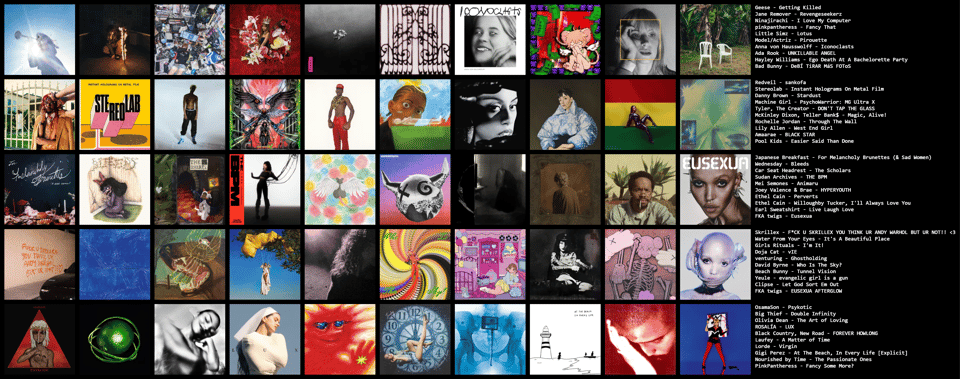
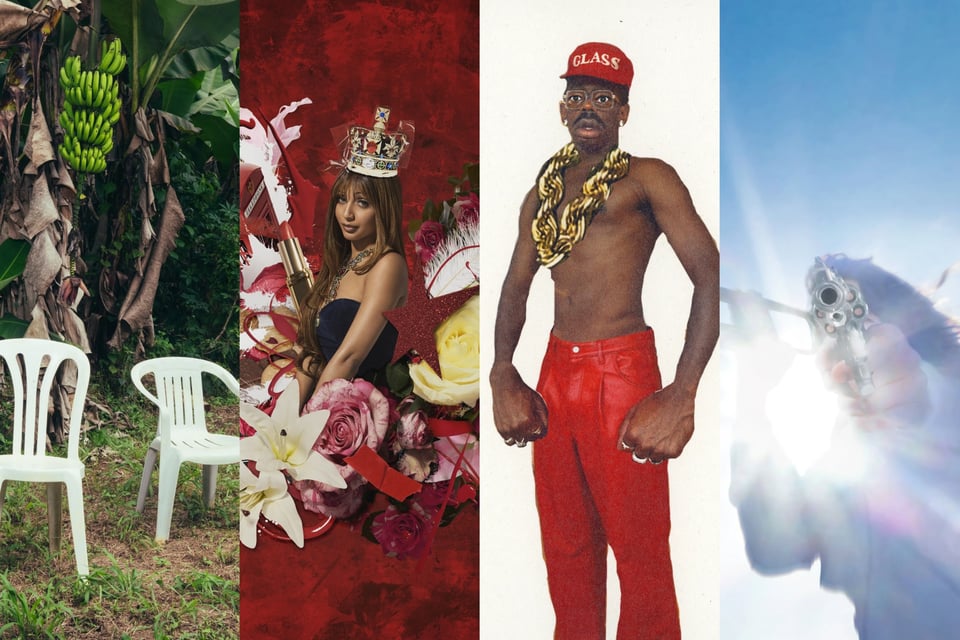
My Favorite Album of Each Month of 2025
Over the last two years, I’ve made a tradition of writing about my top 10 favorite albums of the year. It’s been a good excuse to plug the music I like, participate in the one thing that everyone who talks about music HAS to discuss every year, and frankly, get me off my ass and write something. But this year I haven’t really felt the desire to put my favorite albums into a list format. That’s not to say there haven’t been great albums from 2025, far from it, but I just haven’t felt any excitement at the prospect of trying to construct a solid 10 favorite albums from the year. So I want to do something different.
In 2023, I started watching these videos from music youtuber The Man In Me where they compiled a list of the Most Iconic Album of Each Month from the 1960s to the 2010s. My brain has always been very good at retaining dates and making timelines of events, so these videos really stuck with me, even if they were simple lists with no added commentary. I started compiling lists of my own, sorting out what I found to be the most iconic album of each month from the last 65 years. It’s obviously an incredibly subjective exercise, but one I found a lot of joy in. Once I completed these lists (and MULTIPLE honorable mention lists because you should never underestimate a bored autistic person), the logical conclusion was to, y’know, go through and actually listen to all of these albums.
So that’s exactly what I’m doing. Every few days or so, when I have 30 minutes to spare, I’ve been listening to one album from every month of the 1960s, and I plan to go all the way to the present day, whatever that may be by the time I’ve gone through every album (considering I’m still working through the 60s, it should take a while). It’s been a good way to expand my background knowledge of pop music from different eras, but has also sort of rewired my brain in terms of thinking more and more about the timeline in which music comes out. I’m always curious to see how music is changing, and I love seeing the way music evolves throughout a given year through the lens of what albums came out in a certain month.
All this to say, instead of posting a standard ranking of my favorite albums of the year, I want to highlight my favorite album of each month instead. I figure it’s a more novel way to highlight my favorite music of 2025 and spotlight some albums that may not have made my top 10 list otherwise. This isn’t a perfect system, and some of my favorite albums of the year get snubbed in this format, so I’ll also have a loose top 50 albums list at the end for those curious!
January
Bad Bunny - Debí Tirar Más Fotos
We really should appreciate more that, by many metrics, Bad Bunny is the biggest pop star alive. The big winner of the late 2010s Latin trap boom, the Puerto Rican native has become an ambassador for all kinds of Latin genres, garnering massive commercial and critical success with projects like YHLQMDLG and Un Verano Sin Ti. He’s also become one of our most outspoken pop stars, speaking out against the treatment of Puerto Rico from the U.S. government, against gentrification and in support of the preservation of culture, and in support of transgender people. He’s also a professional wrestler. That doesn’t really have anything to do with this album it’s just fucking cool. There’s a strong argument to be made that Bad Bunny is the defining pop star of the 2020s, and his critical acclaim reached new heights with the release of his sixth studio album, Debí Tirar Más Fotos.
Spanish for “I Should Have Taken More Photos,” DTMF is Bad Bunny’s most overtly political work to date, focusing on many of the subjects of his activism in a strikingly blunt and focused way. I’m not gonna act like an expert, or even a novice, on the struggles of Puerto Rico. I am an extremely white non-Spanish speaker with no real proximity to Puerto Rican culture whatsoever. The fact that the themes of this record come across as clearly as they do through the cultural and language barrier is a testament to the artistic success of DTMF.
While much of the album is focused on interpersonal relationships and working through a breakup, an equal portion is dedicated to shining a spotlight on the structural issues facing Puerto Rico, whether that be neglected, crumbling infrastructure or the overbearing tourist industry causing the island to lose much of its cultural heritage. The end of the album gets even more explicit, with the harrowing “Lo Que Le Pasó a Hawaii” drawing parallels between the colonialism that’s occurred in Hawaii and how Puerto Rico finds itself in the same precarious situation as a U.S. territory. The album is capped off by the title track, with Bad Bunny lamenting the loss of the Puerto Rico he grew up in and the people that made that time special, wishing he had taken more photos to remember them by. It’s a poignant and touching climax to a moving album overall.
Genre bending has been a part of Bad Bunny’s output as long as he’s been putting out music, but DTMF takes this to another level, with the album seamlessly combining contemporary Latin music and traditional Puerto Rican genres. There’s the opener “Nuevayol,” a reggaeton tribute to the Puerto Rican communities of New York, the house and electronic elements of singles “El Clúb" and “EOO,” the salsa-infused lament of “Baile Inovidable”, and “Lo Que Le Pasó a Hawaii” part of the Spanish-influenced jíbaro genre. There’s a lot of variety on display here, and the live instrumentation throughout the album keeps things upbeat and engaging all throughout. I’m also a big fan of the song structures on DTMF, with expert, hooky pop songwriting combined with songs that are truly allowed to breathe and evolve freely throughout their runtime. Take “Café Con Ron,” an upbeat plena song about community and drinking coffee and rum that allows itself the space to slow down in the middle of the track before the party starts back up. It’s just one example of the loose and adventurous songwriting present throughout this entire project. DTMF is a massive achievement for Bad Bunny, a high watermark for modern Latin pop as a whole, and we’re incredibly fortunate to live in a world where an artist as audacious as Bad Bunny can stake his claim to be the biggest pop star in the world.
February
Ada Rook - Unkillable Angel
It’s impossible to talk about Unkillable Angel without talking about Black Dresses. They were a duo consisting of Ada Rook and Devi McCallion, active in the late 10s and early 20s, making harsh yet catchy noise pop about the horrors of existing in a cruel world that seemingly had no space for you, but finding comfort and strength in each other. As a high schooler dealing with mental health and gender issues, learning more about my true self and finding myself in a more unsafe position for doing so, their furious and hurt yet comforting music meant a lot to me. The duo had a short, turbulent history, with the stress of interpersonal issues piling on top of the problems that come with being publicly trans and vulnerable women on the internet, leading to their eventual disbandment. In many ways, Unkillable Angel is Ada Rook sifting through the rubble.
The personal details Rook touches on throughout this project are a big part of its emotional appeal, don’t get me wrong, but they also aren’t something I want to linger on too long. The tldr is that Rook and McCallion were in a relationship as well as a band, and both of those things have ended. Rook bares her soul on many of these tracks, discussing the toll the relationship took on her mental state and how it impacted her self image and ability to take care of herself. It can get very intense, particularly on the late album highlight “holding your sleeping body,” which goes to such personal places I feel like I shouldn’t even be listening to it. While the subject matter of this album is pretty harrowing, particularly if you’ve ever had investment in Black Dresses, it was ultimately Rook’s performances and production that kept me coming back to Unkillable Angel.
Rook has always been an impressive vocalist, bringing a grit and intensity that you’d expect from a metal or screamo album more than in electronic music, and that unique voice serves her well all throughout this project. Every ounce of anger and pain is conveyed brilliantly, the emotion pouring through on tracks like “RAT KID LIFESTYLE” and “CLOUT STRIFE.” The harsh electronics in the production are a perfect accompaniment and go a long way in forming Rook’s unique place in the electronic/industrial scene. What I really love is just how poppy and melodic her songwriting is, a trait that drew me into Black Dresses nearly a decade ago and continues to resonate with me in her solo work. The best example of this is “BURY YOURSELF,” a song that’s equal parts bouncy and enraged. An electropop banger with a big emotional release, it’s a kiss off to the toxic relationship that she is unable (or unwilling) to put any more effort into, which became one of the most cathartic songs of 2025 for me.
Cathartic may be the best way to describe this album as a whole. 2025 was not a good year to exist in the world, particularly not as a vulnerable minority in the United States, and I spent much of the year looking for some sort of outlet to let my stress and frustration out. I found that outlet in the trove of harsh, intense dance music that came out throughout the year. Whether it was Rook, or artists that nearly made this list like Model/Actriz and Machine Girl, or artists that DID make this list that we’ll discuss shortly, I found catharsis in the harsh textures and infectious beats of music like the tracks on Unkillable Angel, and this cathartic record is one I’ll cherish forever because of that.
March
Japanese Breakfast - For Melancholy Brunettes (And Sad Women)
I was definitely late to the Japanese Breakfast train, not fully on board with their dreamy, heavily textured indie pop until 2021’s Jubilee, an album I often cite as my favorite of that year. Going in a happier and more accessible direction than their previous work, I was enraptured by Michelle Zauner’s catchy pop songwriting and the fittingly jubilant energy she brought to tracks like “Be Sweet” and “Savage Good Boy.” Eagerly awaiting the follow-up, I also found an appreciation for the more atmospheric focus of the group’s first two albums, particularly 2017’s Soft Sounds From Another Planet. When we did get that follow-up, it was in the form of For Melancholy Brunettes (And Sad Women), something of a comedown record that fits in a nice middle ground between their previous two records while still pushing their sound forward.
Melancholy Brunettes retains the pop songwriting mould of Jubilee and the atmosphere of Soft Sounds, allowing these songs to breathe in a way I find really enjoyable. “Honey Water” is an early highlight, ending in a giant, shoegaze-y wall of sound that fully engulfs the listener, and lead single “Orlando in Love” is drenched in dreamy textures as it tells the story of a man dissatisfied with his marriage and fantasizing about other women. Alongside these are jauntier, more immediate tracks like “Mega Circuit” and “Picture Window” that have been stuck in my head for nearly a year now. The latter in particular showcases the album’s divergence in sound from Zauner’s previous work, taking the album in more of a country direction. Far from a country or alt-country album, Melancholie Brunettes still gains a lot of its identity from the use of pedal steel and an overall dustiness to its production, with instrumentals that feel very organic and lived in. Hell, the sole guest artist on this project is Jeff Bridges of all people, who brings an old, haggard energy with his deep, raspy voice to “Men In Bars” late in the tracklist.
As stated earlier, Melancholy Brunettes is a comedown record, diverging from the joy of Jubilee for a more weary and reserved tone for Zauner’s writing and storytelling to sit in, a sound fitting of its title. There’s an intimacy that can be found in even the fullest, loudest moments on this record, as the sadder parts of romance are explored throughout the tracklist. It really does feel like a sister record, or a response record, to Jubilee, and even if this doesn’t have the immediate hooks and bright instrumentation of that album, I’ve been able to appreciate Melancholy Brunettes’ more laid-back and somber tone in its own way, effectively showcasing the range of Michelle Zauner’s songwriting and expanding instrumental palette.
April
Jane Remover - Revengeseekerz
Few artists finally clicked with me in 2025 to the extent that Jane Remover did. Being a fan of hyperpop and the adjacent abrasive, maximalist waves of electronic pop that gained traction in the late 10s and early 20s, Jane Remover was on my radar for years before their third studio album dropped this spring. She was somebody I respected and certainly wanted to get into, but for whatever reason the emo-digicore genre-mashing of Frailty and more straightforward shoegaze of Census Designated never compelled me all that much, very much on my end more than theirs. With a discography already so varied, I wasn’t sure what I’d need Jane to do for me to finally become a fan. It turns out the answer was simple: crank the maximalism up as much as possible.
Revengeseekerz, more than anything, is Jane taking their prodigious production skills (they’re only 22!) and pushing their sound to the absolute limits. In a way, it’s a culmination of every sound they’ve explored so far, a return to their sample-heavy dariacore and digicore roots of their 2021 output with added guitar rock influence they’ve started incorporating in more recent work, with much of the album consisting of walls of guitars and digital noise coming together in an overwhelming cacophony of sound. This combination is particularly exciting if early 2010s EDM was a foundational musical movement for you (like it was for me), as Jane even incorporates elements of dubstep and hardstyle into tracks like album-highlight and tour namesake “TURN UP OR DIE”. All of these electronic and rock elements work together to create some of the most riotous, overstimulating music you’ll hear all year, whether that be in the tantalizing buildup of “Experimental Skin” or dancefloor banger “Dancing With Your Eyes Closed”.
This album charts a path forward for Jane as well. Instead of merely sitting in their past influences, Revengeseekerz is full of influence from hip hop as well, both in sonic texture and attitude. This album is just as much an experimental hip hop album as anything, particularly in the vein of noisy producers like JPEGMAFIA. It makes a lot of sense when you learn that they conceived of this album while opening for Peggy on tour last year. The album’s only feature is noted Peggy collaborator Danny Brown (more on him later), and sounds pulled from trap and rage can be heard all throughout the project. This influence isn’t limited to the sound of the album, however. Revengeseekerz is an album where Jane processes their rise in fame over the last four years, and she uses rap as their vehicle to explore the excess, hedonism and loneliness that comes with fame, as the genre has a long history of doing. This is perhaps best showcased in album closer and lead single “JRJRJR”, where Jane lays bare their insecurities about their music, fanbase, and relationships, feeling isolated and wondering if reinventing herself yet again will fix these issues. It’s all set to a thundering rage beat, seemingly doing everything it can to overpower the lyrical sentiment.
Revengeseekerz is a tour de force of production and songwriting, cleverly burying its themes of mental health and loneliness under catchy pop melodies and cacophonous instrumentals, and it couldn’t have come at a better time for me. Jane describes this album in a Paper magazine interview as being a “blind rage” album, a cathartic release aimed at anyone and everyone that hurt them in their rise to fame. I may not be a rising electronic music star, but I certainly felt a lot of blind rage throughout 2025, and this endlessly replayable album was a major help in releasing that constant tension I’ve felt all year. As discussed in the Ada Rook segment, harsh and abrasive electronic music was extremely therapeutic for me in finding a way to channel the rage I’ve felt just existing as an American trans woman in 2025, and I felt more catharsis from Revengeseekerz than any other album released this year. A towering achievement.
May
PinkPantheress - Fancy That
PinkPantheress is one of our great pop stars. Her brand of sugary sweet dance-pop has already proven highly influential in the half decade she’s been releasing music, and she’s showing no signs of slowing down. Her 2023 album Heaven Knows contains her crossover smash Boys A Liar pt. 2, but more importantly, proved to be a major step forward in her skills as a producer. Tracks like “Another Life”, “Nice To Meet You” and “Capable Of Love” showcased an increased confidence and an expansion of her sound, taking bigger swings and going bolder with her atmosphere and sonic palettes in a very exciting way.
The 2025 followup, Fancy That, feels like a mix between the confident Heaven Knows and her era-defining 2021 debut To Hell With It, going back to smaller scale electronic music with a stronger embrace of her influences than ever before. Right from the cover, it’s clear that Fancy That is indebted to UK culture, particularly the incredible dance music that’s come out of the country over the years. The project hones in on sounds associated closely with the country, primarily UK garage, and the influences from artists like Fatboy Slim and Basement Jaxx, who is sampled on the project, is clear.
PinkPantheress’ voice, songwriting and production skills are all perfectly suited for this environment. Her delivery brings a lightness that enhances already fun tracks like lead single “Tonight” and the Sugababes sampling “Nice To Know You”. Her ever-improving production skills, along with co-producers like Askel Arvid and Count Baldor, also get to shine, with straightforward dance tracks elevated by more textured, layered production, perhaps best showcased on opener and breakout hit Illegal. Anchored by a sample from Welsh house duo Underworld, the song is infused with a lighthearted clubby atmosphere that allows both Pink herself and her influences to shine. Fancy That is just an excellent sounding record. It brings the best elements of PinkPantheress’ previous work while going in a new, unique direction that still allows this 20-minute project to stand out and give listeners a better understanding of who PinkPantheress is as an artist and where she’s coming from.
I’d also be remiss if I didn’t shout out the remix album, Fancy Some More, that dropped in October. Like most remix albums it’s a bit uneven, but I really admire the concept of a two-disc remix album, one focused on pop remixes and one focused on electronic remixes. It’s a great way to showcase the two sides of who PinkPantheress is as an artist. It may not be the remix that became a crossover hit, but if you listen to anything from Fancy Some More, make it the Bladee remix of “Stateside”, which is just insane.
June
Little Simz - Lotus
You would think that Little Simz has nothing left to prove. She has 10 years and 5 albums worth of excellent rap music under her belt. Massive respect within, and outside of, her genre. Arguably the most consistently acclaimed rapper from the UK, regardless of gender. To a generation of terminally online rap fans who would rather die than listen to a woman’s music, she is the exception. She could justifiably be resting on her laurels at this point in her career. And then she got ripped off.
Early in production for what would be her 6th studio album, Lotus, Simz and her longtime collaborator Inflo had a massive falling out, with her eventually suing her former producer and writing partner for nearly 2 million pounds in loans he owed her. This situation left Simz confused, betrayed and untrusting, but also lit a creative fire underneath her. The album became a dissection of her relationship with Inflo, putting her feelings of deception from someone she believed was in her corner into her art, and proving to herself that she is great at what she does. Her bragging and self-love on tracks like “Only” and “Lion” hold extra weight as they sit within a tracklist full of self-doubt and inner turmoil, reaffirming her worth and the value of who she is and the work she’s put in to get here.
Her falling out with Inflo looms large over Lotus, but it’s intertwined with examinations of poverty and the world around her on the introspective “Peace” and the loose “Young” that puts us in the perspective of a youthful, impoverished British woman trying to make the most of her circumstances. On “Free” she muses on what love and fear mean to her, and the contrasting ways they can close us off or set us free. “Blood”, a massive highlight, sees Simz collaborating with Wretch 32 as they trade bars back and forth from the perspective of siblings who’ve grown distant and whose struggles culminate in a sometimes viscous, sometimes understanding heart-to-heart over the phone.
Thankfully, her bad experiences with Inflo did not stop Little Simz from filling this album to the brim with collaborators. Her chemistry with Wretch 32 is incredible, and R&B singers like Obongjayar, Lydia Kitto, Moses Sumney and Sampha add incredible texture to the album with their hooks sprinkled throughout. And the production from Miles Clinton James is rich and vibrant, full of live instrumentation that really compliments the tone of the album. My personal favorite moment has to be the beat on “Enough” driven by what sounds like a toy piano?? It’s a total banger.
Lotus is a triumphant album, proof to both Little Simz and the rest of the world that she really is a lotus, a true artist able to create beauty out of terrible circumstances. It’s a colorful, expansive and exciting artist, one who has nothing left to prove and yet will continue to prove herself anyways, and it’s my favorite rap album of 2025.
July
Tyler, The Creator - Don’t Tap The Glass
If you read my best of 2024 list you know that I’m a big fan of Tyler, The Creator in general and view his album Chromakopia as one of his best and most important projects up to this point. It was his most vulnerable project to date and used the production stylings that have served him well throughout his career to take a look at his life in a way I absolutely loved, and I wasn’t alone in this opinion. When Chromakopia released at the tail end of 2024, it represented a new commercial peak for Tyler nearly 15 years into his career, being his third straight album to debut at #1 and giving the rapper his first three top 10 hits, alongside the acclaim from fans and critics he’s grown accustomed to. With such a rich, sprawling album under his belt, and an equally extravagant tour to promote it, there were no expectations for any new music from Tyler for the foreseeable future. And yet this whole time he was crafting yet another pivot in the form of Don’t Tap The Glass.
Released on short notice at the height of summer, Don’t Tap The Glass is maybe the first album in Tyler’s career where he scales things back. Unlike the lofty ambitions of albums like Cherry Bomb, Flower Boy and Chromakopia, the thesis statement for Don’t Tap The Glass is simple. Dance, bro. Tyler dives into some of hip hop’s earliest influences on an album fully indebted to house and techno. The infectious production covers ground from funk to electro to Miami bass to New Orleans bounce in a tight, 28-minute 10-song package. It’s an incredibly easy record to put on in any mood and go on a short exploration of various dance and hip hop stylings, all made cohesive by Tyler’s distinctive Neptunes-adjacent production style.
Given the energy he brings to the rest of his discography, it’s no surprise that Tyler excels in this upbeat sonic environment, bringing an energy to his delivery and flows that meshes with the sound of this album perfectly. His in-your-face bragging on “Stop Playin’ With Me” and “Don’t Tap The Glass/Tweakin’” is infectious. His singing voice lends itself well to poppier cuts like “Sucka Free” and “Ring Ring Ring”, as well as the incredibly horny breakout hit “Sugar On My Tongue.” The sparse features on this record work as well, particularly collaborations with Madison McFerrin and Yebba on “Don’t You Worry Baby” and “I’ll Take Care Of You,” two slower tracks from the end of the album when the party’s slowing down just a bit. Don’t Tap The Glass may not have reached the critical or commercial peaks that the rest of Tyler The Creator’s work from the last decade have, but it never needed to. This was clearly Tyler making an album for himself, a concise little project more concerned with having fun than anything else. On its own terms, this album fully succeeds.
Also, massive side tangent, I feel like I should mention Hayley Williams’ Ego Death At A Bachelorette Party before we move on to August because this album is fantastic and had a very weird release strategy. All of the songs came out as singles at the very end of July, but weren’t compiled into an album until August, and she’s been consistently adding new songs one at a time every few months? So it’s kind of a July album, but also kind of an August album? I honestly like it more than DTGG but not as much as the next album and idk where to put it but I feel like it deserves a mention somewhere in the list proper so here it is. Good shit
August
Ninajirachi - I Love My Computer
I grew up on the internet. I am immersed in internet culture, and have been for a long time. My best friends are people I met on the internet. And I’m far from the only person who’s had this experience over the last 15-20 years, large swaths of my generation and the ones before and after have had foundational experiences, ones that will inform the rest of their lives, via the internet. Finding out who they are, discovering the rest of the world, via the internet. Understandably, the artists of this generation still have the urge to create art about their lives, and it leads to the question of how you can translate these digital experiences into art? This is exactly what Ninajirachi does on her debut album.
I Love My Computer is an album primarily for digital natives. It recounts a plethora of uniquely online experiences, some I’ve never even heard attempted to be turned into song, and translates them into impeccably produced electronic music. The feeling that your computer knows the real you better than anything else, the comfort and vulnerability that comes with being online by yourself, are deeply felt on tracks like “Fuck My Computer” and “CSIRAC.” It also touches on dating in the digital age and the way we can mold our online image to impress our crushes on the track “Delete.” And then there’s “Infohazard,” the song whose subject matter has stuck with me the most, as it’s told from the perspective of a young Nina trying to process the fact that she just saw a gore video. This album is not afraid to confront darker elements of an online life, and a song about such a common, universal online experience, yet one that I had never heard used as artistic inspiration, really took me aback. It really puts into perspective how much ground there is to cover when making art about the digital age, both what we see online and how it affects us.
This album is just as much about making art as it is about the internet. Standout track “iPod Touch” is an excellent electropop jam about discovering music production through the accessible technology available on an iPod, as well as how easy the internet has made it for people to use more sophisticated production software. “Sing Good,” falling near the end of the album, is a vulnerable look back on the beginning of her passion for making music, her lack of knowledge going in matched with her desire and dedication to create, even when other people didn’t see the value in it, and the role that the technology of the time played in all of it. Nina does a great job of intertwining these two main themes and making them the core of the project.
Supporting the unique subject matter of I Love My Computer is some of the best electronic music you’ll hear all year. Ninajirachi is, for lack of a better word, fucking cracked. She draws from the well of early 2010s EDM, artists like Skrillex and Zedd and the Monstercat label, and injects it with an energy and vitality all her own. It’s really interesting to compare this production to Revengeseekerz, an album with similar inspirations, and seeing how these strains of maximalist electro diverge. This album is full of upbeat, catchy pop hooks, as well as waves of harsh and abrasive walls of digital noise, fitting for a computer-themed album. “Fuck My Computer” in particular has some of the gnarliest, most metallic synths I’ve ever heard. It made me feel the same way I felt discovering Skrillex all those years ago: how the fuck do you make music that SOUNDS like this??? Ninajirachi and this album are more proof that the future for electronic music is bright, and the future for art about the internet, made by and for the people who have lived it and truly care about what it is and how it’s impacted us as people, is even brighter.
September
Geese - Getting Killed
I’m gonna try my best to not write this whole segment attempting to canonize Geese as the Next Great American Rock Band. It’s a lofty and unreasonable expectation to put on any band, one that still holds real cultural weight and can often lead to a band crumbling under the weight of expectation or rejecting the label outright, and it’s especially unfair to put that label on people so young. All I will say is that it’s been a long time since I’ve been this confident in a new rock band joining the list of all time greats.
No point in beating around the bush, this is my album of the year. Geese were a total revelation for me at the end of 2025. I first learned about them through their off-the-wall genre experiment 3D Country, where their incredible instrumental skills and the versatility of Cameron Winter’s voice were instantly apparent, but ultimately didn’t leave a strong impression on me at the time. It wouldn’t be until the leadup to Getting Killed that Geese would break through the indie rock noise for me, particularly with the shocking, abrasive, and (go figure) noisy single “Trinidad.” The strength of this chaotic song combined with the anthemic “Taxes” and apocalyptic “100 Horses” signaled to me that this was a band I really needed to start paying attention to. When I got killed at the end of September, it ended up being one of the most impactful experiences I had with music all year.
One of the best things about Geese right out of the gate is that this is a band. Winter may receive most of the hype online and in the media, for good reason (if his solo project Heavy Metal had come out this year it would be a lock for a spot on this list), but it’s essential to give guitarist Emily Green, bassist Dominic DiGesu, and drummer Max Bassin their flowers. So much of the appeal of this band comes down to Green’s emotive lead guitar work and Bassin and DiGesu’s impeccable rhythmic dynamic. Geese are what I’d call a jam-adjacent band, one or two steps back from the free-flowing improvisation you’d expect from other animal bands like Phish or even Goose, but every member is incredibly skilled at their instruments and it allows them the space to discover the songs as they play them. Combined with their touring keyboardist and unofficial fifth member Sam Revaz, Geese are able to craft some of the most chaotic, rhythmic, outright entrancing rock music you’ll hear today. They’re assisted on this record by production from Kenny Beats of all people, giving them a grittier sound compared to the clean production of their first two records. He strikes a great balance of giving every member a chance to shine, while also uniting them under the grimier mixing quality that lends a lot of texture to the tracks on Getting Killed, sounding simultaneously complex and ramshackle.
Of course, the breakout star of indie rock in 2025 is Geese frontman and songwriter Cameron Winter, bringing a dynamic range to the album that really allows this band to stand out. He can easily go from shouting his lungs out on “Trinidad” (the most insane opener of the year) to presenting a warbly earnestness on late album standouts “Half Real” and “Au Pays du Cocaine.” His songwriting chops are on full display as well, his presence being felt more than ever after taking a larger creative role in the group following guitarist Foster Hudson’s exit in 2023. With Winter at the helm, the instrumentals on Getting Killed are much more cyclical and repetitive, as heard on the title track’s mid-album centerpiece “Islands of Men” and the total jam that is “Bow Down.” Lyrically, Winter moves away from the psychedelic storyline of 3D Country into much more earnest singer-songwriter territory, again best highlighted on the despondent “Half Real” and desperate “Au Pays du Cocaine.” There’s still time for lighthearted moments however, like the jaunty “Cobra” or on the album’s funniest moment when, in the middle of the harrowing commentary of “100 Horses” Winter clarifies that “there were a hundred horses dancing… maybe 124.”
Geese are a rock band for the streaming generation, with influences and comparisons ranging from The Strokes to Radiohead to The Doors to Television to Ween, I could go on. The band are true connoisseurs and lovers of music, and it’s easy to draw comparisons to a million different acts and they all make sense. What’s so exciting about Geese’s adventurousness is they never sound like they’re retreading old ground. They’re able to take their wide array of influences, pick out little pieces of each, and mold them into a sound that’s familiar but has never quite been heard before. It’s how this album can jump from the R&B infused slow jam “Husbands” into the cacophonous rocker that is the title track, complete with a sampled chant from a Ukrainian choir. It’s clear that this is a band who knows they have a wide array of influences and want the freedom to express that how they see fit, damn what anyone else thinks. That’s another reason why I love this band so much and why they make me so excited. They're making one of the biggest splashes a band has made in years and they’re doing it with perhaps the most inaccessible music they’ve made to date.
The album culminates in its final two tracks. On “Taxes,” Winter sings of self-hatred and self-pity as the instrumental builds from a mess of anxious polyrhythms into a bright, glorious release, thanks to Emily Green’s anthemic guitar riff and Winter’s preacher-like shouts of “DOCTOR! HEAL YOURSELF!” And then there’s album closer, and my personal song of the year, the 7 minute epic “Long Island City Here I Come.” It combines symbolic, apocalyptic imagery with the determination to keep going even if you don’t know what the future holds. Musically it’s one of the strongest experiences I’ve ever had with a song, constantly building in intensity with an unrelenting driving rhythm. I get chills when Winter’s shrieking narrator compares himself kicking your ass to the fall of Jericho. I get chills when Max Bassin’s drum pattern threatens to collapse in on itself as the song peaks in intensity. I get chills when the noise drops out and Dom DiGesu gets to flex the best bassline I’ve heard all year. It’s a song that stops me in my tracks every time I hear it, one that overwhelms me in the best way possible, closer to a religious experience than any song from this year I can think of. The whole album, arguably Geese’s whole career, has been building to this moment, a staggering explosion of noise that just leaves me in awe, along with the rest of the project.
So are Geese going to save rock music? I don’t know. Probably not? These lofty expectations are unavoidable for a band with their hype, but it’s really not what makes them so special to me. What Geese is doing is making rock music, using the pieces that previous generations of rock musicians gave them, making rock music for young people by young people. I am young, and I think the music they make is really cool. Whatever happens, it’s exciting to know a band like Geese exists. I have no idea where they’re going, here they come.
October
Anna von Hausswolff - Iconoclasts
One of the year’s biggest surprises for me, Anna von Hausswolff was an artist I had very limited exposure to before listening to her sixth studio album Iconoclasts. Her epic and imposing 2018 album Dead Magic was perhaps my first introduction to neoclassical darkwave in high school, and it was decidedly Not My Thing. I think part of it was that I just found the album cover creepy. Thankfully my taste has evolved a bit from when I was 15. The dark bombast of von Hausswolff’s music resonates much stronger with me today, and it’s never been more effective than on Iconoclasts.
This album is the sound of an artist pushing their sound to the limit, an especially effective move for an artist so anthemic to begin with. Iconoclasts is BIG, both sonically and in length, with many of its tracks nearing or exceeding the 10-minute mark. Von Hausswolff really allows the listener to sit in the atmosphere of tracks like “Struggle With The Beast” and “Facing Atlas.” Recording much of this album in churches across Sweden certainly helps in building the grandiose, spacious atmosphere this album sits in. Of course I can’t ignore how Hausswolff’s vocals contribute as well, showing off her emotive range on subtler tracks like the Iggy Pop collab “The Whole Woman”, and more intense and anthemic jams like “Stardust” (not to be confused with an album we will discuss very shortly, spoilers).
It’s fitting that such a big sounding album would focus on big emotions. “Struggle With The Beast” is a harrowing look into dealing with psychosis and how it feels to lose your sense of self in the process. “The Iconoclast”, the 11 minute standout track that feels like the centerpiece of the record for me, acknowledges the horrors and daily stresses we have to live with in the world, while she fights to find acceptance and joy in the rubble. The brightness present amidst the imposing wall of sound that is this track is really striking, and showcases a lighter side to this record that’s really moving and intriguing. The Ethel Cain collab “Aging Young Women” sees this push and pull used in the context of growing older and whether or not to start a family, simultaneously trying to make peace with the possibility of not having children while struggling with the societal pressure to do so. The gentlest moment of the record comes on “Unconditional Love,” an ode to sisterhood and partnership that features von Hausswolff’s own sister Maria, who also introduced her to Ethel Cain. Sweet!
I think it’s the bright sports within the darkness of Iconoclasts that makes it resonate so strongly with me. The optimism in the face of a fucked up world can be heard in the lyricism, as well as in Hausswolff’s passionate performances. She’s living in the same confusing, infuriating, beautiful world as the rest of us, and she has a lot of big feelings about that. Being able to translate those feelings into these towering achievements of songs, conveying so much with her minimalist lyricism and maximalist compositions, makes Iconoclasts one of the most moving and cathartic listening experiences of 2025.
November
Danny Brown - Stardust
It’s something of a miracle that we have Stardust at all. Danny Brown has struggled with substance abuse for most of his life, making great art out of these circumstances that nevertheless didn’t end his struggles, and in 2023 he planned to quit music altogether when entering rehab. It was in rehab when Brown really dove into modern electronic music and hyperpop, and rekindled his love of music through artists like 100 gecs, Frost Children and Underscores. Following Brown’s public life for the last few years, it’s been clear for a while that he has a lot of love for this scene, and Stardust simply would not exist without it.
I know it was a bit of a controversial move for Danny Brown to bring on these digicore and hyperpop artists and incorporate this largely electronic sound into this project, but as a fan of both Brown and most of the artists featured on Stardust, I think it works incredibly well. Danny Brown has always been an energetic rapper with a very distinctive voice, and the energy he brings to his music works really well with this maximalist sound. Not to mention the Detroit native grew up around house music, and his love for and use of electronic music in his own work feels like a way to honor his roots, particularly on the standout hip-house track “Lift You Up.” This album feels like a sample platter for young, semi-obscure electronic musicians that Brown’s more hip-hop focused fanbase may not be familiar with, artists like Femtanyl, Issbrokie, 8485 and Frost Children, whose Angel Prost gives spoken word interludes throughout the project to add to its cohesion. I understand that these artists aren’t for everyone, they can be very brash and abrasive, but then again so can Danny! And as I’ve already established, brash and abrasive electronic music was a big part of my 2025.
Stardust doesn’t just connect to Danny Brown’s stint in rehab because he discovered his sonic influences there. It’s his first album made entirely sober, and the arc of the album follows his sobriety, told from the perspective of a pop star named Dusty Star as he goes through his own struggles with addiction and learns to love music again. I think writing from this character’s perspective is a good decision, allowing Brown the freedom to explore different topics in his songwriting and go to places he may not be willing or able to when trying to write from his own perspective. Knowing Danny’s struggles with his health and motivation makes the music we do get here hit that much harder. When the album culminates with “The End,” you can hear all the work he put into getting out of the cycle of addiction as he details his experiences, and you hear the triumph in his voice as he raps about how his fans keep him going on closer “All4U.” This is an optimistic, life-affirming album, and after so many years of battling his demons, it’s amazing to hear him make it to the other side. I wish Danny Brown all the best, thank you for this awesome album.
December
Redveil - Sankofa
The story of Redveil has been one of the biggest success stories in underground rap this decade. At just 21 years old, he already has four albums under his belt dating back to 2019, and has carved out a niche for himself as a thoughtful emcee who raps over lush, layered production (which he produces himself mind you!). His consistently great output has garnered the attention of underground heroes like JPEGMAFIA and has earned Redveil a place as one of the most exciting artists bubbling below the rap mainstream.
That continued, growing success is a major element of Sankofa’s themes. His first album since 2022’s profile-expanding Learn 2 Swim, it focuses on Redveil’s increasing recognition and the impact of his relocation from Maryland to Los Angeles, a move that can be felt in both the album’s lyricism and arrangements. A lot of time is spent looking back on the past, like on “Buzzerbeater/Black Christmas,” which sees Redveil returning to childhood Christmases and gaming with his friends, as well as the shows he played as a teenager early in his career, trying to assemble a past to hold onto that he knows was far more complex than his memories make seem. “Pray 4 Me” showcases why he needs these memories to ground himself, as his mental health suffers alongside his move to Hollywood (been there!), caring so much about how he’s perceived that he checks his phone the moment he wakes up, saying that he’s “signed his own PATRIOT act.” It’s a fascinating look into the mindset of a pivotal moment in the young artist’s life.
The biggest place where the move to Los Angeles is felt is in the album’s production. Redveil has always had beautifully complex productions tinged with jazz and R&B, but was confined to working with loops and samples as he produced music in his room. The move gave him access to Los Angeles’s large community of session musicians, giving his arrangements more life than ever. Songs like “Mini Me” and “Brown Sugar” are still clearly Redveil compositions, but the live instrumentation allows him to go grander than his previous work. It’s a great evolution of his sound, retaining his core influences while expanding upon the sound palette he’s able to work with.
Sankofa is a pivotal work for Redveil. It lives up to its title, an Akan word meaning “to retrieve”, with its explorations of Redveil’s past and the memories he holds onto as he grows into an adult on the opposite side of the country from where he grew up. The influence of artists like Earl Sweatshirt, Kendrick Lamar and Saba can be felt throughout this project, as they can in all of Redveil’s work, but as he’s grown, he’s been able to define his own unique sound more and more, planting the seeds for more artistic growth in the future. Redveil knows there’s still work to be done, but with the strong body of work he’s already amassed at such a young age, I’m confident that the best music from Redveil is yet to come.