Shouting “Go Long” Is Not The Solution
Chaos Isn't Agility. Decision Debt Cripples Teams.
Decision & Policy Debt
The Hidden Tax of Design Debt.
Improvisation makes highlight reels. Coaching makes wins. Let’s talk about the hidden tax of no calls and missing playbooks.
TL;DR (for Busy Humans)
Someone has heaved you the ball unexpectedly. Under pressure you've scrambled, pushed, fought and scraped it over the line. There are pats on the back as teammates and the sidelines congratulate you, but that was improvisation. It wasn't a system.
If leaders are not making decisions, everyone is constantly scrambling and playbooks are missing-in-action, then teams rack up Decision & Policy Debt. Firefighting earns medals but burns energy fast. Neurodivergent colleagues pay that cost first, carrying extra load just to stay in the game.
At Kind Mechanics we call this design debt: the hidden tax of unclear rules.
Flip it: stop handing out back slaps for last-minute saves, call the action, write it in the playbook and review it with the team after the play.
Good coaching beats lucky improvisation.
What are we talking about here exactly?
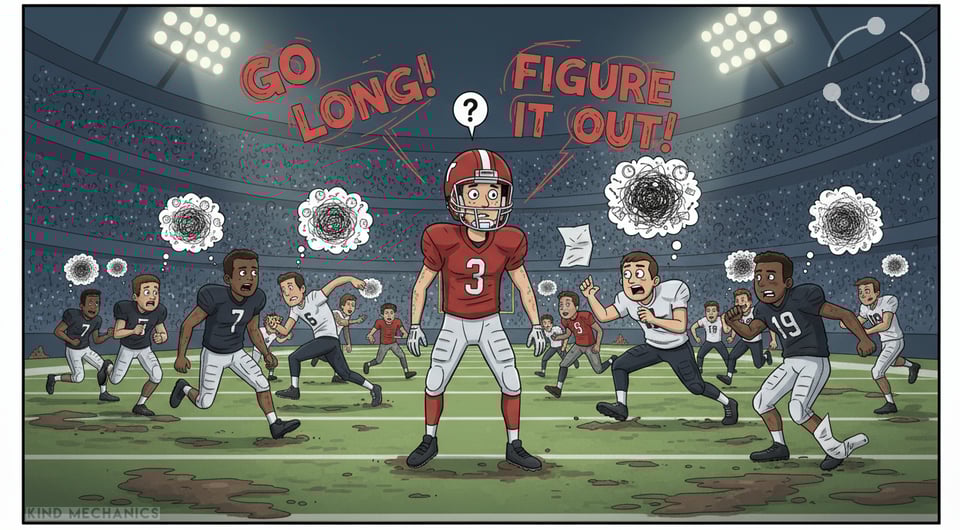
Imagine stepping into a rugby match or NFL game where the coach only gives you a position: “you’re a forward, you’re a winger” and then waves you onto the pitch.
No rehearsed plays. No clear calls.
On the field, everyone improvises. Wingers cut in-field and crash into contact, forwards drift to the edges, changes are called every few seconds. It sometimes ends well, sometimes badly, but it always ends in movement.
From the sideline the coach sees action and rewards it, especially the players who look best in the scramble.
That’s Decision & Policy Debt: leadership abdicates structure, so firefighting and improvisation are celebrated as competence.
What it costs
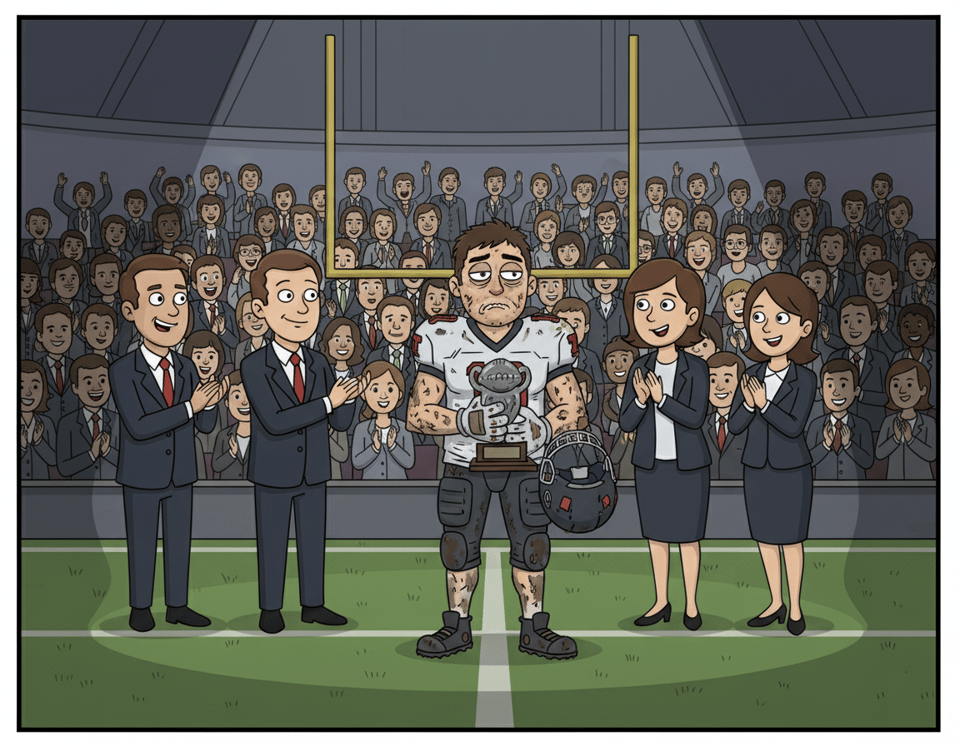
Firefighting is praised; prevention is invisible.
Crisis-response is fast-tracked; steady structure stalls.
Decision rights are unclear: who actually calls the play?
Rules are unwritten, policies opaque, changes ad-hoc.
Everyone pays the cost, but ND colleagues pay it first:
Extra mental load just to parse vague “rules of play.”
Penalised for needing clarity before action.
Burnout from having to constantly improvise on the fly.
Decision Debt in the Wild (you’ve seen these)
The Hot Potato — decisions bounce from one person to another until they drop. No clear decision-maker, no clear decision.
The Constant Audible — last-second changes keep the team guessing. Players scramble, plays collapse, and “flexibility” becomes chaos.
The Ringers — individuals improvise brilliance, but at the cost of burning themselves (and teammates) out. Heroics become the expected solution to everything.
The Phantom Rulebook — “we’ve always done it this way”… except nobody can find it written anywhere. Reasons are lost to the depths of time.
The Hero Medal — the firefighter gets celebrated for saving the day. Nobody rewards the teammate who stopped the fire from starting.
Why this hits ND folks first
Ambiguity tax — unclear calls = dozens of micro-decisions before any work starts.
Fairness load — inconsistent rules erode trust; ND colleagues often judged more harshly.
Masking cost — hiding confusion about “unwritten rules” drains energy.
As in earlier issues:
Same job, higher energy cost. That’s design debt, not a character flaw.
ND colleagues are your early warning radar for this debt. Help them settle it early and you help everyone avoid it entirely.

Five fixes for Decision & Policy Debt
1. Name the play, not just the position.
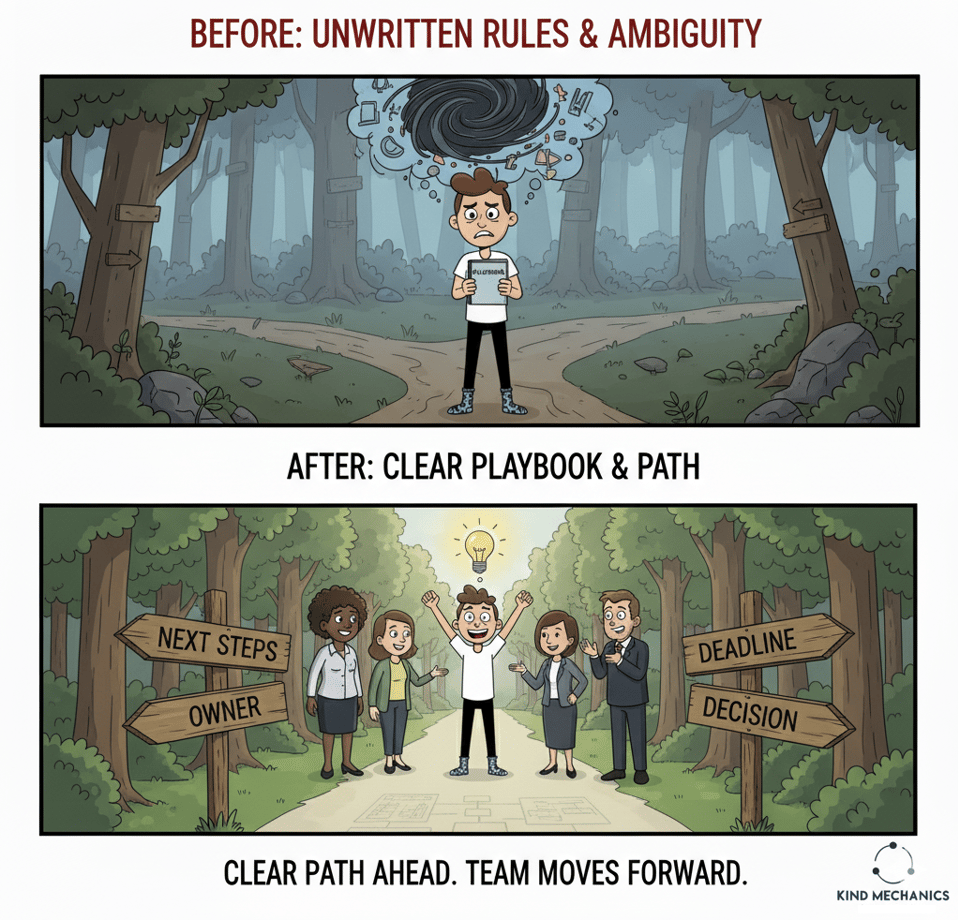
One-line decision rights: “Owner decides after input from X/Y by [date]; tie-breaker Z.”
2. Run drills, not just games.
Tabletop scenarios for likely crises → prevention over panic.
3. Write the playbook.
Short, plain-language policies. If it’s not written, it’s not enforceable.
4. Keep a change log.
Every policy change logged with date, reason, and owner. Transparency builds trust.
5. Trial new plays.
Two-week pilots instead of endless debate or permanent firefighting.
Two-Week Rollout Playbook
a) Study the game tape. Review 2–3 recent decisions: who called them? Were they logged? Did they stick?
b) Pick one pod. Apply fixes 1–3. Clear decision rights + log each call.
c) Teach the formats. Share one-line decision rights, playbook pages, change log. Model them yourself.
d) Run a Decision Review. Batch 5–8 small calls in a 30-min slot. Log outcomes.
e) Review at day 14. Keep what worked. Adjust what didn’t. Expand.
Remember: we’re reviewing the system, not grading the players.
Metrics that prove it’s working
Decision latency ↓ (proposal → decision)
% decisions logged ↑
Policy change transparency ↑
Re-opened decisions ↓
Prevention vs firefighting balance → healthier
Pocket responses to pushback
“We need to stay flexible.” → Flexibility is easier when you know the rules of play. Chaos isn’t agility. Dynamics aren’t decisions.
“Writing things down slows us.” → Not as much as re-deciding the same thing three times does.
“Roles feel too formal.” → Formality saves energy. Informality hides cost, especially for ND teammates.
“Firefighting is our strength.” → It’s also your hidden tax. Reward prevention and consistency, not just heroics.
Copy-ready templates
One-line decision rights
“Owner decides after input from X/Y by [date]; tie-breaker Z.”
Policy change log fields
Date | Policy | Change | Owner | Reason | Next review
Decision log fields
Date | Decision | Owner | Revisit-by | Link
Tabletop drill skeleton
Scenario: [describe likely crisis]
Owner: [who calls the play]
Options: [2–3 trade-offs]
Pre-commit: [criteria for escalation or adjustment]
Starter blurb to use
We’re paying down Decision & Policy Debt. For two weeks we’ll make it clear where decision rights rest, log outcomes, and test changes in small pilots. The goal: fewer firefights, faster play-calls, clearer rules. We’ll measure decision latency and re-opened contacts, not who looks busiest in the scramble.
In Closing
Improvisation gets cheers; a playbook gets wins.
If you are rewarding crisis plays and charismatic scrambles then you’re burning out your players, especially ND teammates carrying extra load just to stay in the game.
Decision & Policy Debt isn’t solved by tougher players. It’s solved by better coaching: clear roles, rehearsed plays, transparent calls. Do that, and the field slows down, the fog lifts, and the whole team saves its energy for the plays that matter.
Our next newsletter will focus on the last of our 5 Common Friction Points Digital Debt: The Tools Tax
Thanks for reading,
— Brian McCallion, Founder, Kind Mechanics
About Kind Mechanics
Kind Mechanics helps organisations pay down design debt in how they work: fewer scrambles, clearer calls, kinder defaults. I write about practical fixes that lead the way for everyone; especially neurodivergent folks.
Writing · Workshops · Culture campaigns
Clarity as the Standard. Kindness as the System. Usefulness as the Goal.
Human-readable by default.
