
#585 The Best Album of 2001, Round 5 (Elite Eight) Match #121: Wilco vs. Gillian Welch

Hey folks!
Today’s Best Album of 2001 match is:
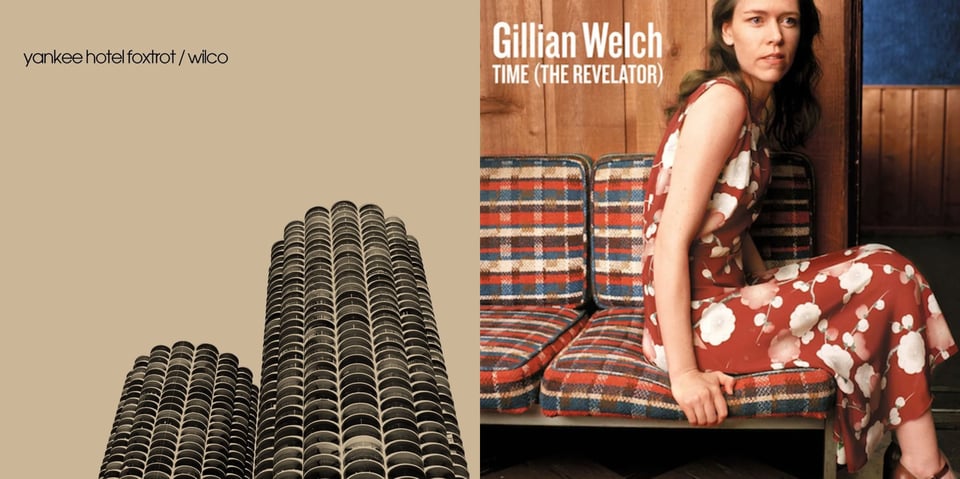
#1 Wilco, YANKEE HOTEL FOXTROT
vs.
#8 Gillian Welch, TIME (THE REVELATOR)
To vote, follow this link to the Google Form. You will need a Google login to vote. If you can’t or won’t have one, let me know ASAP (either through this newsletter, my email [[email protected]] or on the Best Album Brackets Bluesky account) and I’ll see what I can do.
In case you missed it, we are now on the Elite Eight portion of the tournament, meaning the winners this week move onto the Final Four.
Since at this level of play it’s possible to have an upset, even against the #1 seed, I will be publishing all the Designated Cheerleaders for both albums, which comes out to six DCs. Apologies for the length!
First, for YANKEE HOTEL FOXTROT, it's @asleepykisser.bsky.social. Take it away, Zenith!
Cheer up, honey, I hope you can
There is something wrong with me
In general, it’s a little hard for me to write about my middle/high school life. Much of my memory of that time is filtered through intense dissociation, depression and gender dysphoria. So I can’t really say exactly what it felt like to listen to YANKEE HOTEL FOXTROT for the first time anymore. What I can do is attempt to describe what’s it has become for me.
My first Wilco album was A GHOST IS BORN. I was always a library kid, and I spent many days scouring through the shelves picking up books, DVDs and CDs for whatever I thought I remembered the gen-xers I followed online said was good. I was immediately taken in by the plaintive singing and jam-band-y passages. I watched many live version of “At Least That’s What You Said” on the library internet computers. I found one of “my” bands. When I finally got around to YANKEE HOTEL FOXTROT, I had already listened to, burned, and memorized all the words to a few different Wilco albums. This one slot right in. I’ve cried many teenage tears listening to Jeff Tweedy sing “I shake like a toothache / when I hear myself sing”. And I felt a little less lonely when I did.My Mind is filled with radio cures
Electronic surgical words
Thank you, Zenith!
Next, it's Head Cheerleader @bsglaser.bsky.social. Take it away, Brian!
First things first: I am not here to weigh in on the 2001 vs 2002 issue, because I do not care. I am here to talk about something that's far more of a bummer.
YANKEE HOTEL FOXTROT acted as one of my main post-9/11 comfort listens. Which I guess is a small nod at the release date, but it also stretches beyond that. I lived in NYC from 2000-2007, I still work there, and I can tell you that from fall 2001 through to maybe summer 2002, everyone needed a hug, which could come via all sorts of delivery systems. And YHF did a lot of work to help work through what had happened, what was still happening, and how I felt a lot of the time.
The way the album opens, with the weird noise that sort of coalesces into a song, and then lyrics that sort of make sense but the words aren't coming out right even though they're clearly trying to say something? That's how a lot of things felt when the self-release hit in late September. You're trying to break my heart? I know. I'm right here, hiding out in the big city blinking. And I know, I know this album was written and recorded and in the can by summer 2001, so none of this stuff is a reaction. But art often meets its moment, even if it's not born of the specifics of that moment.
The sounds are moving in and out of coherence. The lyrics keep throwing off emotional sparks across the first few songs. "Cheer up honey/I hope you can." "Phone my family/Tell them I'm lost." "Moving forward through flaming doors."
And then: "War on War" Shit, that was on the news every night! "You have to learn how to die/If you want to be alive."
And then: "Jesus, Etc." Oh no. "Tall buildings shake/Voices escape/Singing sad, sad songs." "You were right about the stars/Each one is a setting sun."
And then: "Ashes of American Flags." Oh fuck, are you kidding me? The lyrics careen around, struggling to say something, then the somber musical mood crashes out to almost nothing and lands on: "I would like to salute/The ashes of American flags/And all the falling leaves/Filling up shopping bags." Yup. It felt like that. Not all the time, but often enough.
But then: Staticky noise that resolves into a buoyant drumbeat at a quicker temo. "Heavy Metal Drummer" is when we stop wallowing in the present and start living it up in the past. Suddenly this record is offering release from everything and dancing down by the landing in a different summer. "I miss the innocence I've known." Absolutely! I saw Wilco play in Central Park around this time, and when they kicked into "Heavy Metal Drummer," you could feel something pour out of everyone, all at once. It felt amazing. I still feel it in my chest like it's happening right now.
From here, the record tries to sustain the new mood, but ultimately fails. Instead of trying to break your heart over and over, "I'm the Man Who Loves You," which swipes a lyric from the first Wilco record, AM, and sounds kind of like a regular rock song. It doesn't last long, tumbling down through "Pot Kettle Black" and "Poor Places" until the latter breaks down into a swirl of noise and far-off military radio babble. Were we fighting the endless war on war yet? Most of the time things were fine, but sometimes I'd look the wrong way going downtown, and there it all was, right in front of me. I had reservations about a lot of things, but not about how YHF helped me process a weird, weird time.
Briefly back to the release year thing: The packaging, when it came out in 2002, felt crazy when you held it in your hands. I know the twin, gunmetal grey towers on the cover are in Chicago, but they were punched out against a neutral, blank background and could have been anywhere. They could have been here, singing sad, sad songs.
I know a lot of people don't like YANKEE HOTEL FOXTROT for lots of different reasons, and that's fine. But music isn't always just for listening to--sometimes it does something to or for you, and that's what the record becomes. I think a lot of people got a lot out of YHF in that moment; I certainly did, and it still brings me back to that moment and out the other side of it in under an hour. I'm grateful to Wilco for making this record and making it available across the span of 2001-2002 and unbreaking hearts just a little bit.
Thank you, Brian!
And then, it’s @joshksky.bsky.social. Take it away, Josh!
Yankee Hotel Foxtrot is full of last gasps. Many are ordinary rock ‘n’ roll heartache—what was I thinking when I let go of you? but of course it’s got the end of the American century on its mind, too. Greil Marcus was the first writer to call my attention to the parallel in the album’s opening to The Adventures of Augie March (“I am an American, Chicago born”) and that was in a curt dismissal. But Augie was just starting out. No one wants to hear that the party’s over.
I played YHF for my wife for the first time not long ago, driving back through the Valley heat from Malibu. “I wasn’t really listening to white boys with guitars when this came out,” she said. “I was dancing.” But she knew all the songs. Wilco come from American rock, but so did Pet Sounds. You can hear Brian Wilson and the Beatles’ hot pursuit of him in the opening minute of the album. Right there, after the drums bang in and the bass swings up.
Tweedy’s lyrical trick is to bash romantic yearning against American restlessness and through that mix suggestive nonsense. It yields half the time a souffle, half the time a quilt, and half the time a synthesis, to say nothing of the synthesizers. The band’s sound cracks open American rock and fills it with molten noise. It’s kintsugi but it’s not safe to touch. All these sounds have already been heard. Tape decay is progressive. The noise will overtake the sweetness someday, but we get to hold onto this moment, here at the end.
I spent a Saturday afternoon in my late middle twenties recovering from the pills and bad feelings of an “ugly and miserable night,” as my ex later described it at the end of our marriage. A friend played me his new CD. I hadn’t even heard the band before — I much later put together the familiar voice from Uncle Tupelo, which I used to play a lot out in the desert — and the record replaced a mineral that had become depleted in me. I was broken down and receptive that afternoon. Maybe I would have fallen in love with the other album on the board too, but probably not.
It’s not just that Yankee Hotel Foxtrot is the best album in the tournament. It’s not just that it’s also my favorite (how could it be any different? ask those of you with incomprehensible confidence in your own taste). It’s not even that it’s the best rock album of the 21st century. It’s that it’s the last great rock album, a tribute in content and form to the final exhaustion of a short, great art form. Its gestures and poses remain free for restaging in good rock ‘n’ roll fun, but will never again be the spirit of the age. Another great rock album may come along, but the world that makes it will be unrecognizable to even our children.
Thank you, Josh!
Now for the opposing team! First, for TIME (THE REVELATOR), it’s @aarcraft.bsky.social. Take it away, Aaron!
You can get lost in Time (The Revelator). The tight harmonies of Gillian Welch and her long time partner David Rawlings have a haunting quality even when they aren't singing of Ruination Day, the fateful day when the Iceberg hit, the Okies fled, the Great Emancipator took a bullet in the back of the head and a punk band played a two dollar show where they won't even make enough for a half tank of gas. Death hovers over this album - Ruination Day, thinking about Elvis and John Henry on the day they died, getting a Red Clay Halo in the afterlife. In perhaps the best song on the album (although it's a tough competition), the death might be of her industry because "Everything is Free" now. But she is going to do it anyway, even if it doesn't pay. Time (The Revelator) always moves on. They clean up after the two dollar show and she knows shewants to sing in a rock n roll band despite it all.
The nearly 15 minute closer "I Dream a Highway" brings this all to a head. There doesn't seemto be a way out - it's wheels inside of wheels and a call within a call - but she dreams a highway back to you over and over until you're free. I return to this song a lot - despite its length because it's a song (and album) I love getting lost in.
Thank you, Aaron!
Next, it’s @bermanmatt.bsky.social. Take it away, Matt!
The first thing you notice about Gillian Welch's "Time (The Revelator)" is the cover: All rich red-white-and-blues, a beat-up couch, a wood-paneled room straight out of the '70s, and Gillian Welch herself looking just off at something. It's a striking image, made more so in contrast with the covers of Gillian Welch's first two albums - 1996's "Revival" and 1998's "Hell Among the Yearlings" - each of which present her in a cold, Depression-era black-and-white.
You could be forgiven for thinking that color photo promised a half-century leap forward or lush expansion of Gillian Welch's stark, signature Appalachian sound. Instead, "Time (The Revelator)" goes the other direction, stripping back further to present a crisper view. This is not a faded image of the deep past - this is a past within her lived in memory, but also just as much an image of the now. And that color scheme does not lie, for this is an album of American music. Not just Americana, but songs about America: John Henry and Elvis, the Titanic and Lincoln, straight jobs and road trips, Steve Miller and an artist's struggles to survive.
The songs play as a series of spare duets, Gillian's wavering-but-ethereal voice floating upon crystalline guitar lines from her eternal partner Dave Rawlings. Most songs are two guitars, two voices, unless they drop down to one guitar and Gillian's voice alone. These are songs about saviors and America delivered with pure, simple harmony, like you'd see them do in person ("I Want to Sing That Rock and Roll" is actually lifted from a live performance at Nashville's Ryman theater). If anything, musically it's even more of a throwback to what was an already uniquely backwards-looking sound. Gospel, country, finger-picking mountain music. But lyrically not everything looks so far back - there are nods to Taj Mahal and shout outs to wanting to "sing that rock and roll."
And this is key. Where Gillian's first two albums felt like they channeled moments from the past, this one feels distinctly present - albeit a present rumination on past things, an exploration of how everything that came before has made now exactly what it is. Songs return to the theme of time as a revelator - a word repurposed here from its religious roots to mean the need for time to evaluate the worth or meaning of anything. And where before Gillian often sang as characters or folkloric story songs, here she sings mostly of herself. On the title track, Gillian sings of accusations of herself as a pretender and an imitator - an obvious nod to criticism of her for mining the sound of a dust-bowl past or playing at a character. Only time, she seems to say, will demonstrate the truth and value of the music she has created and must continue to create. "My First Lover" brings the theme of the evaluatory distance of time into even clearer view, the song less about her lover than about her inability to remember that much about him - "he gets a little hazy when I think of him now" - but she remembers the freedom of moving on and how it defined herself to herself, a "quicksilver girl," who was "not waiting for a white wedding gown."
Elsewhere, Gillian sings directly of her need to make music and put her art into a world that doesn't value it. She sings of a "fortune lady" walking beside her - whether a literal fortune teller or a promise of fortune, time still slowly revealing the falsity of her words. On "Red Clay Lover," she wonders if she will receive her gold gown when she gets to the pearly gates, but accepts that she will take "the red clay robe with the red clay wings and a red clay halo for my head." Or take "Everything is Free Now" and its far-too-prescient line about making art and who gets paid for it: "They figured it out; that we're gonna do it anyway; even if it doesn't pay."
And always there are songs of love: earthly love, godly love, the love of making music. She is always longing for "somebody who is waiting for me."
These are not songs likely to hit you on first listen. Gillian Welch builds a world that you have to slow down and sink into. But if you let yourself take that time, the timelessness of her sound can cast a spell. Two guitars, two voices, time stretching out ahead and behind you, all coming together to reveal something more, even if it is almost certainly forgotten again.
On "I Dream a Highway," Gillian sings:
"What will sustain us through the winter?
Where did last year's lessons go?
Walk me out into the rain and snow
I dream a highway back to you."
Is she singing of a lover? Of the music? Of God? Probably a little bit of all of it. There's a lot to unpack. Give this album your time and maybe it will reveal itself to you.
Thank you, Matt!
Last, but certainly not least, it’s @locraen.bsky.social. Take it away, argle-bargle!
I’m fairly certain it was one of the two, but I can’t recall if it was Bella2 or Kitchen Compatriot Jones who introduced me to the music of Gillian Welch. Well, re-introduced, perhaps more accurately. O Brother, Where Art Thou? and its omnipresent soundtrack had, of course, introduced the whole world to Ms. Welch a year before, at least for those of us who weren’t already privy to her dark and introspective Americana. But I confess that I didn’t really pay her much mind until around the time I started hooking up with Bella2.
Back then I was slaving away in a restaurant kitchen. Every kitchen is subject to its own unique rhythms, but in that kitchen, at least if Kitchen Compatriot Jones and I were around, the mornings were for alt-country. So, while “the cooks cleaned the kitchen / with the staggers and the jags,” the little CD boombox blasted the Flatlanders, Emmylou, Steve Earle, Neko, and of course, Gillian and her longtime partner and collaborator David Rawlings, who does yeoman’s work on guitar while stoically concealing himself behind Gillian’s moniker.
Kitchen Compatriot Jones had about a decade on me, and the age discrepancy, coupled with the geography of his Los Angeles and my upper Great Plains, resulted in wildly different exposures to specific artists. The Internet was still in its adolescence, after all; distance still mattered. So even though we had very similar tastes and appreciated a wide range of genres, there were confounding gaps in the musical artists that each of us knew, and we delighted in the fact that we were able to expose each other to so much new music. He singlehandedly filled in a massive hole in my musical knowledge, and hopefully I did even a fraction of the same for him. In any event, whether it was he or Bella2 who re-introduced me to Gillian, every one of her first three albums was in heavy rotation and blasting over the drone of the exhaust fans on those busy, knifework mornings. Time (The Revelator) was almost certainly the heaviest, on account of it being one of the most recently released…but also because of Bella2.
Yes, there was a Bella1. She was my high school sweetheart and my first love. She was and remains cool as shit. We still occasionally check in, as we did last year when a dear mutual friend was in trouble (likely the same friend who introduced us, to be honest). She’s married to a rad Garth, raising kids, and being crafty. I’m happy for her; though, she doesn’t really have anything to do with this…hype essay? We’ve gone a bit off course. I just thought you should know about her for context, I guess.
Bella2, however, has everything to do with this DC. She was the only person who ever straight-up ripped my heart out of my chest and grinned while she squeezed it, Temple of Doom-style. Though to be fair, she dumped me over the phone, so whether she was grinning is speculative. We didn’t date long—just a few months—but I fell hard. She was from Great Falls—where my grandparents had lived for a time—and there was something enigmatic about that. It felt like a little western town in the sky. Like, she was this hot barista rocker girl who descended from the Rockies and introduced me to so much great country music. Look, I was smitten, OK? She was smart and sardonic and irreverent, and we would spend nights drinking and chain-smoking on the roof of a building across the street from her four-plex, which overlooked downtown Portland across the river. We once watched a double-feature of movies that were filmed in our hometowns: Fargo for me, and for her The Slaughter Rule, a grim indie movie starring an embryonic Ryan Gosling. [I should note, also, that The Slaughter Rule had a criminally underrated soundtrack with a score composed by Jay Farrar that also included great tracks from Vic Chestnut and Neko Case (whose music I know for certain Bella 2 introduced me to), among many others. I will absolutely nominate it for the Best Album of 2002 Bracket, if and when the time comes.] Not long after, Bella2 flew back to Great Falls for a few days. She dumped me over the phone the night she returned to Portland. “I quit smoking cigarettes,” was one of the last things she said to me, as if I cared.
To me, Time (The Revelator) will always be a breakup album. I know that it mostly isn’t. Not really. It’s about a lot of things: folklore and myth, ruination, death, time and revelations (duh). And it illustrates those motifs through repeating characters and events: Casey Jones, April 14, Elvis Presley, John Henry, the jags, the Titanic, Abe Lincoln. Did you know that the Titanic hit the iceberg and Honest Abe was shot and a hard luck band made a pittance on a poorly attended show, all on April 14? I didn’t, until I first heard “April the 14th Part 1,” and the pseudo-reprise “Ruination Day, Part 2.” The former is the strongest song on an album chock full of outstanding songs. The latter is the weakest, and the only one that might be deemed unnecessary. Surrounding them is banger after banger, from the titular tone poem “Revelator,” to the raucous and chuckle-inducing “Red Clay Halo,” to the somber and reflective “Elvis Presley Blues,” all reverently set to sparse acoustic guitars, with the occasional banjo plucked for color.
And then there’s the 15-minute-long “I Dream a Highway,” the closer, which comprises more than a quarter of the album’s run time. In a vague approximation of Dylan’s closer on Highway 61 Revisited, “I Dream a Highway” ticks off every theme that Gillian was reaching for across Time (The Revelator) while also being, at least to me, a breakup song. Folklore and myth? Ruination? Death and time? Revelations? Yes, these are the things one contemplates after having their heart ripped out. And as Roy Orbison taught us, only in dreams can you return to a love lost.
A couple of years later I was at a wedding at the foot of the Bitterroot Mountains, about an hour south of Missoula. There I met a close friend of the bride, who mentioned that he was originally from Great Falls. I told him that I had dated a girl from there once and dropped Bella2’s name. “Oh my god, I went to high school with her!” he said. Then he made a sour face. “Ugkh, she was one of The Plastics.”
She had definitely grinned like the guy in Temple of Doom.
When I sat down to write this DC, I started to think about the timeline of when we were a couple, in early 2023. We would have met in January, I think. She definitely ended it in April. Was that break up call on April 14—on Ruination Day? Very possibly! Perhaps that’s why I relied so heavily on this album to get me over that heartbreak hump. It wasn’t the only album that fit that bill, but it was one of the few I distinctly recall listening to most.
I am happy to report that I climbed that hump pretty quickly, thanks in no small part to Gillian, and I ended up meeting my wife later that same year, in the very restaurant where I had been blasting alt- country in the mornings. KC Jones was there when we met. He officiated our wedding.
To be honest, I haven’t listened to a ton of Gillian Welch since the mid-aughts. But I’ll throw one of her albums on every now and again, and I’m always glad that I did. Revival is still, probably, objectively, the best. But Time (The Revelator) is the most personal, and it’s still the one that gets the most rotations. It’s a fucking outstanding album. If you got me drunk enough on the right night, on a roof overlooking downtown, I might even declare it the best of 2021.
Thank you, argle-bargle!
Click here to see the current results for the entire tournament, and click here to see the current results for the prediction bracket contest.
Yesterday, #11 Missy Elliott, MISS E... SO ADDICTIVE defeated #6 Radiohead, AMNESIAC, 158-143-1.
Thanks,
Kent
Add a comment: