
#564 The Best Album of 2001, Round 3 Match #107: Gorillaz vs. Jimmy Eat World

Hey folks!
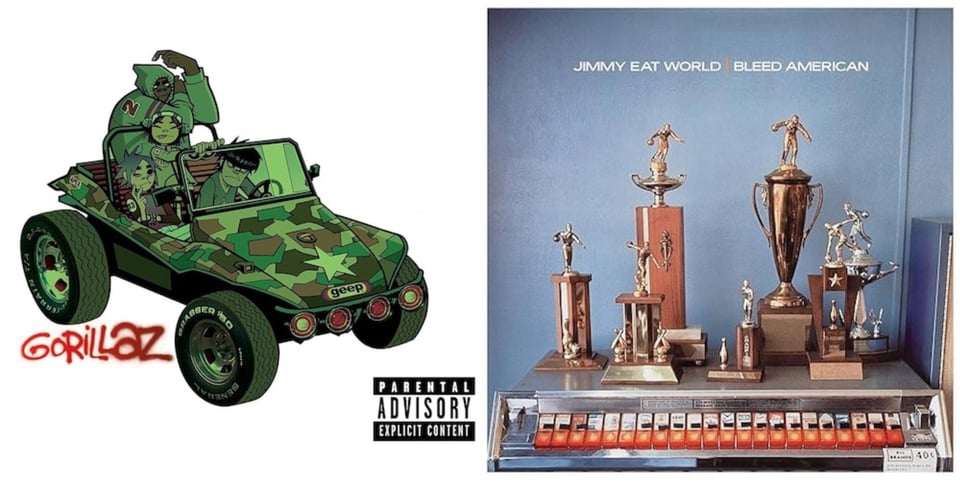
Today’s Best Album of 2001 match is:
#7 Gorillaz, GORILLAZ
vs.
#26 Jimmy Eat World, BLEED AMERICAN
To vote, follow this link to the Google Form. You will need a Google login to vote. If you can’t or won’t have one, let me know ASAP (either through this newsletter, my email [[email protected]] or on the Best Album Brackets Bluesky account) and I’ll see what I can do.
We have three Designated Cheerleaders today! We have three Designated Cheerleaders today! First up, for GORILLAZ, it's @kezme.bsky.social. Take it away, kezme!
Of the 2001 albums I bought at the time, GORILLAZ is likely the one I’ve listened to in full the most, having never really gone out of my rotation in the time since then. At the time, I came to the album the way most of us probably did – through the big singles Clint Eastwood and 19-2000 being flogged to death on radio at the time – but when I played it I found an album that was a lot stranger and more experimental than those more commercially-friendly tracks would lead you to expect.
This is of course the legend of Gorillaz – Damon Albarn wanting a side project in which he could have a free hand to explore musical ideas outside the pressures that come along with the mainstream success of Blur, a side project which ultimately ended up garnering more commercial / mainstream success than Blur itself as the 2000s unfolded. But this self-titled album comes before that success, and you can feel that freedom to experiment all the way across it, unconstrained in a way that future Gorillaz albums aren’t. This might sound like a warning, but be reassured this is all still very accessible – it’s not Fennesz, Albarn does still have a pop sensibility.
Now I’m certainly not qualified to point out everything going on musically on this album – my own music theory education being almost entirely in a classical tradition – but what I do recognise ticks a lot of boxes for me. There’s interesting samples used in a musical way, there’s a lot of playing around with time signatures – 5/4 features the lead guitar playing in 5/4 over a standard 4/4 drum pattern, and New Genius (Brother) does something similar with the cymbals. There’s deliberately dischordant intervals and notes that warble off-key, but in a way that’s clearly musical and not just cacophanous. It all reads as ‘art’, but I think without crossing the line into pretentiousness.
Speaking of art, I know this album was part of a wider project involving the animated film clips and other media featuring the “virtual band”, but I’ve personally never really engaged deeply with that part of Gorillaz (I do have their DVD projects in my collection somewhere) – I think GORILLAZ the album stands on its own as a complete work. It does work very much as an album – there aren’t really any tracks here I’d rather play on their own than as part of a full album listen. I’d consider the one or two remixes at the end, depending on the version of the album you have, as bonus tracks rather than part of the album proper, though.
2001 was clearly a time when a lot of popular music was trying to make a break with the past and figure out what the future was going to be. GORILLAZ didn’t turn out to be what the future of music looked like; it’s not even really what the future of Gorillaz ended up looking like. I don’t think that takes away from the album, though – it’s something that I’ve been listening to for more than half my life now, and easily one of the standout albums released in 2001.
Thank you, kezme!
Then, for BLEED AMERICAN, it's @andyswaff.bsky.social. Take it away, Andy!
Bleed American didn’t turn the world upside-down the way Nevermind did a decade before, but it did likewise help pave the way—perhaps unwittingly—for a wave of bands that would follow over the next decade, and it has a compelling story of triumph that makes it an easy choice to champion.
For those of us who got music mostly from the radio—as one did in the 20th century—the subgenre known as emo didn’t really exist until then. (Weezer may have provided the blueprint, as far as artists that got radio play, but they weren’t yet saddled with the label.) Discovering artists like Sunny Day Real Estate and the Get Up Kids required an internet connection or word-of-mouth, and it was in this circle that Jimmy Eat World cut their teeth. But after two albums failed to break through to the mainstream, Capitol Records dropped them (although the band were dissatisfied with the label anyway).
At a crossroads and determined to fend for themselves, they worked odd jobs to finance a self-produced album. Interestingly, it was the internet and word-of-mouth that got the music industry interested in the demos from those sessions that would result in a bidding war. In the summer of 2001, the title track from Bleed American was released as a single, followed by the album proper, but the song stalled just inside the top 20 on the Modern Rock chart. In the wake of September 11th, the album and title track were both victims of (understandable) name changes, which might have been another setback, but their second single, “The Middle”, finally broke through, beginning its climb that fall and topping the chart the following spring.
“Bleed American” (I’m told it was briefly renamed “Salt Sweat Sugar”, as I mentioned, but the CD I own still has the original title for this song, although the album is styled self-titled) is a furious, stomping slice of alt rock. If you’re a fan of their previous two albums, this introduction to the album tells you you’ll feel right at home. “A Praise Chorus” ended up being the fourth single off the album, and it hints at the growth they will demonstrate on this album, but also references (praises, even) several songs whose choruses you might recognize. “The Middle” might be their best and most famous song, and deservedly so. It’s a turn-of-the-century gem, combining an uplifting message and a singalong-ready chorus with perfectly-formulated alternative dynamics and a memorable guitar solo. It remains their lone hit to cross over to the Top 40, but a better representative of their work to the mainstream you could not find.
“Sweetness” was the follow-up single to “The Middle”, though it was actually written shortly after their previous album Clarity was released, and it’s almost as strong, built around a non-lexical repeated refrain that, again, you can’t help singing along to; it’s a masterful example of using the voice as a melodic engine in a genre typically defined by guitar-based melodies. “Hear You Me” is a power ballad dedicated to a couple of Weezer superfans who died in a car accident (and also remembered with a song from Weezer themselves). It was a candidate to be released as the last single, the band’s manager later admitting that choosing “A Praise Chorus” instead was a mistake, and even though it was not released as a single, it’s become one of their more popular songs. And, lest you think they were done lauding their heroes, they included a song about another song (“The Authority Song”), which feels wholly appropriate, and it’s not just a tribute to the act of listening; it’s a showcase of the band’s ability to lock into a groove that feels as timeless as the records they’re praising.
If you like independent/DIY artists, you can root for this album because the band financed it all by themselves, though you’d never know it from the high quality of the production (in an era where rock radio was becoming increasingly muddy and formulaic, Bleed American arrived with a crisp, mechanical precision that allowed every layer to breathe) and because they obviously respect artists like Fugazi and Guided by Voices. If you prefer classic rock titans, you can take solace in the influence of stalwarts like Bruce Springsteen and Tom Petty (and, to a lesser extent, the guitar heroes of hair metal). By focusing on lean, muscular songwriting rather than the melodrama of the time, the album serves as the perfect antidote to the corporate rock that plagued the airwaves (e.g., Staind and Nickelback). Bleed American hits the sweet spot where all of us can appreciate one of the finest albums of the year.
Thank you, Andy!
Finally, last but certainly not least, for BLEED AMERICAN, it's @chaosgoblinlc.bsky.social. Heeeeeeere's Johnny!
When you think about the greatest runs and legacies of bands from the 90s that are still active, there’s two remarkable bits that I can’t ignore: Deftones have arguably taken over Radiohead as the most influential band in that cadre, and that Jimmy Eat World is in the running for the top 5 at all.
Typing that out feels hyperbolic; it’s hard coming at Bleed American from a vantage point that isn’t clouded by nostalgia. It came out right before my 14th birthday, and once I burned my sister's copy that summer as soon as I could, it became a mainstay in my CD wallet up until high school when all my nerdy friends and I started getting into more serious and pretentious indie rock. But even after all those Pitchfork-approved bands came and went, I would still come back to Bleed American for more base reasons: it kicks so much ass, is sequenced near perfectly, and was crafted by music nerds who you could tell had a genuine love for the craft, for what loud, anthemic guitar music can do to you (fwiw, this record pays homage to bands as varied as Motley Crue and Jesus & Mary Chain).
More importantly, as the DC for this record, I want to come in and say that this record is so much more than The Middle (for me, it doesn’t even crack the top 5 on this album!). The title track, A Praise Chorus, Sweetness, If You Don’t, Don’t are all exemplary bangers. Hear You Me and My Sundown are great comedowns from their respective halves, and Cautioners is a more refined version of their softer experimentations on Clarity landing in the same territory as American Football without the jazz studies.
Admittedly, their follow-up Futures holds a closer place in my heart for its darker, often angry reflections on addiction, toxic relationships, and the uncertainty that comes with having your whole life ahead of you, but at the end of the day it's a comparably autumnal template for a formula that was refined on this record: sunny, straightforward hooks for days, a sentimental air without being too cloying, bombastically vulnerable without feeling autobiographical. This is what levels up and separates them from other contemporaries like Taking Back Sunday or Say Anything, and why I feel like this holds up remarkably well a quarter century later. This record deserves a strong run, call-and-response whoa-ohs and all.
Thank you, Johnny!
Click here to see the current results for the entire tournament, and click here to see the current results for the prediction bracket contest.
Yesterday, #15 Aaliyah, AALIYAH defeated #18 Stephen Malkmus, STEPHEN MALKMUS, 121-103-1.
Thanks,
Kent
Add a comment: