
#558 The Best Album of 2001, Round 3 Match #103: Björk vs. Andrew W.K.

Hey folks!
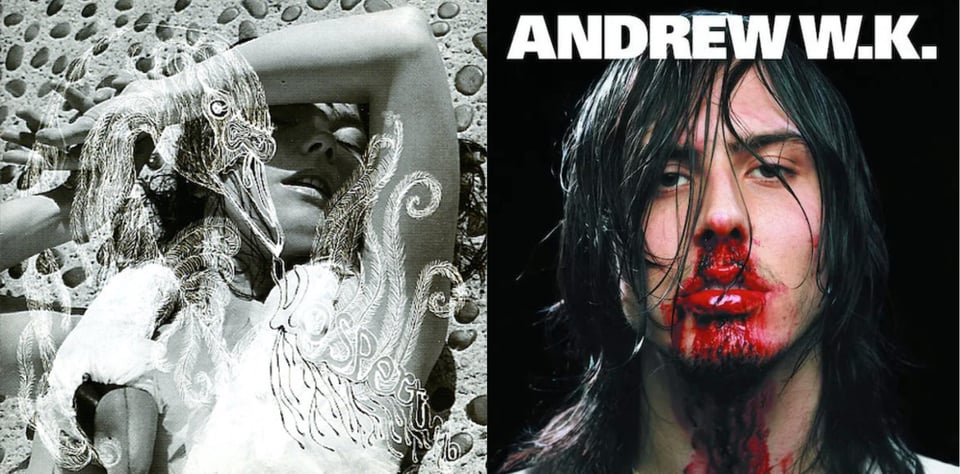
Today’s Best Album of 2001 match is:
#5 Björk, VESPERTINE
vs.
#28 Andrew W.K., I GET WET
To vote, follow this link to the Google Form. You will need a Google login to vote. If you can’t or won’t have one, let me know ASAP (either through this newsletter, my email [[email protected]] or on the Best Album Brackets Bluesky account) and I’ll see what I can do.
We have three Designated Cheerleaders today! First up, for VESPERTINE, it’s @wormsgreenrealm.bsky.social. Take it away, Rob!
Bjork’s music is so often about the embodiment in sound of things abstract or unknowable—part of why her sensibilities have proven too abrasive or strange for some—and with Vespertine she attempts, I believe successfully, to capture the sounds of love, a concept music has been intrinsically rooted in expressing for centuries and which she nonetheless gives a novel texture and feeling.
Let’s set aside the biographical detail at the heart of Vespertine (and at the unfortunate broken heart of its eventual companion album Vulnicura). It suffices to say Bjork fell madly in love with a very odd individual (someone who could match her freak, one might unsubtly describe). Vespertine is an account of the emotional, sensual and psychic security resulting from such a rapturous connection.
“Through the warmthest cord of care, your love was sent to me” she intones in the opening lines of “Hidden Place,” a song which perfectly sets the album’s sonic palette with its chirping, chopped, percussive synth sounds gradually blossoming into full-bodied orchestral and choral waves. The song finds Bjork describing a coyness at the heart of newfound affection—a small, fragile thing needing to be obscured and slowly cultivated. Love as a discrete space its participants share in solitude. A cocoon, one might say…
“Cocoon” continues the gentle chirps of the preceding track and builds on a vocal characteristic Bjork will employ throughout the album, an emphasis on breath as vocal instrument that here and occasionally elsewhere approaches the outright sensual or even orgasmic. “Who would have known…miraculous breath…to inhale a beard loaded with courage.” Intense inhalations placed emphatically and aggressively in the mix leave one with no misunderstanding as to the song’s erotic intent.
“It’s Not Up To You,” laced with cascading strings and bells, expresses the unknowability, unexpected nature, of new love; our inability to decide when and where and how one falls into the rapturous place she has just spent the opening tracks describing.
One of the album’s masterpieces, “Undo,” bridges the gap between Bjork’s synthesized avant-pop with her progenitor and eventual contemporary Kate Bush. “It’s not meant to be a strife…it’s not meant to be a struggle uphill,” she sings, alluding to and contrasting against Bush’s most iconic track. Fascinatingly, this is the song Phil Elverum will eventually interpolate and cite in his Mount Eerie song “Voice in Headphones,” a celebration of “Undo”’s power as mantra—to hear Bjork’s earnest, forceful vocal directly into your ears is to feel its physicality, her breaths, and to really internalize the words: to embrace softness, to unfold, to “be in a generous mode.” It is applicable across emotional tapestries but in context with Vespertine as a larger project it expresses the generosity required to embrace love in the face of the hardness and bitterness of heartbreak, and also the softer mode that can emerge in a hardened soul as a result of real affection.
“Pagan Poetry” is, for this listener, a strong contender for Bjork’s greatest song. Playful, intricate, percussive strings build and are joined with buzzing synths and echo-y background vocals as the lyrics recount the placeless beauty of emotional connection, and how that emotional connection is physically manifested—my favorite lyric, one I typeset and print on one of my anniversaries with my partner: “five fingers—they form a pattern, yet to be matched.” The simplicity of interlocked fingers, the simplest expression of affection, granted cosmic potency. But the greatest power, as I’ve not yet even described, is Bjork’s vocal prowess, moving fluidly from whispery nothings to eruptive belting during the song’s chorus.
This song and an interlude, “Frosti,” mark the halfway point of the hefty hourlong album, and its second half proves considerably more abstract and less overtly melodic. In structural conceit it reminds me of Hounds of Love’s Side B pivot toward collage over songsmithery; I find its successes primarily lie in its holistic ambience but I can’t deny the result is something less instantaneously impactful than the album’s first half.
The overall result of the album as an earthy, sense-first, brain-second project is true to Bjork’s overall sensibilities, which are not at their most pop-forward here but nonetheless make for a compelling listen that I think reveals its appeal with a meditative and ambient approach rather than a close-listening one. It expresses vulnerability, physical ecstasy, psychic looseness, generosity—and all at once a simultaneous loss of the self and total recognition of one’s physicality.
I wrote all of this totally off the dome with no reference to any contextual information about the album, and found upon looking at the Wikipedia page that work on the album coincided with Bjork’s work on Lars Von Trier’s Dancer in the Dark, a grim triumph that stands in stark contrast with the mundanely joyous work here yet shares a kind of workflow: where Vespertine centers domestic, bliss, cultivating a kind of operatic romanticism from simple foundations, her Dancer in the Dark music is rooted in literal ambient sounds—machinery, trains, tapping shoes—and erupts these sounds into full-on movie musical worthy bonanzas. Anyone curious about Bjork’s mindset in Vespertine (especially, maybe necessarily, if you like the album lol) would do well to explore it in relation to that film and resultant soundtrack album.
Because I’m no music expert and have a limited understanding and vocabulary with these things, I do hope Vespertine goes on in the competition and will get a defender who can speak more robustly on its musical aesthetics; for the time being, this probably super long defense from vibes alone will have to do.
Thank you, Rob!
Next up, for I GET WET, it’s me again! Take it away, me!
This is the day I've been looking forward to ever since I announced the Best Album of 2001 tournament.
Every once in a while, an album comes along that changes everything for me. It's fortunate if you get one album in a given year that becomes both a cultural touchstone and a musical best friend, something that you return to year after year, and know other people do the same.
Well, today I'm talking about three revolutionary albums of this type, all from 2001. The first one is a metal album that induces instant adrenaline from the first note, one that uses guitars to summon anarchic, destructive energy. The second one is a techno album, with a 4/4 beat like a runaway locomotive, and like the best techo albums, can make the listener feel like they could merge their heart with that of the universe. And the third is a Broadway musical soundtrack, infused with singalong melodies whose power can unite an audience into one soaring spirit.
So, three records: a metal album full of adrenaline; a techno album that grabs the heart; and a Broadway musical soundtrack that lifts the spirit. A metal album, a techno album, and a Broadway musical soundtrack. A metal album, a techno album… are you getting it? These are not three separate albums, this is one album, and it's called I GET WET. Today, I'm going to make my case with a Designated Cheerleader, and here it is.
===
Okay Steve Jobs, how serious are you about this? That should be an easy question to answer, but it isn't, really. That's appropriate, since the first time I encountered Andrew W.K. was the video for "Party Hard," and after watching this greasy-looking guy in white jeans headbang while hitting a single key on a piano, I was entirely unsure how serious he was. Sincerity? Irony? Post-irony? What the fuck is post-irony, isn't that just sincerity? I honestly couldn't tell where he was coming from, so I couldn't use that to triangulate my intellectual response. Fortunately, my gut response told my intellectual response to fuck right off. I wanted to hear it again, and again, and again.
Soon after, I went to the record store (long, 54 year old sigh) and bought the "Party Hard" import single, and then not long after, I had my friend have another friend, who was visiting from the U.K., get me the full album, which had been released in that country months prior to its U.S. release. (I don't think that friend-of-a-friend liked me much. Wait, did I ever pay anyone back for that album? Oh no.) From that point on, I GET WET has been in continuous rotation, in my CD player or on my computer, for twenty-five years.
But why, though? Yes, I think it's great, but what is it about this album? Or put another way: how serious am I about this?
===
Music has the ability to take us out of ourselves, to momentarily free us from our ego and physical existence, and potentially connect us to something greater. All music is capable of that, but I think metal, techno, and Broadway musicals (or at least those showtunes where the cast comes together to belt out a showstopper) are genres that have been sharpened to a point and geared to deliver that experience.
What W.K., ever the hedonist, asks is: Why not all three, all at the same time?
This should not wrk. You can combine two of those, but adding the third should topple the whole thing over, a musical version of the froyo toppings bar syndrome. But it does work. How?
It helps that there's generally nothing subtle about metal, techno, or Broadway musicals. All three want to grab you by the metaphorical lapels and drag you somewhere, no listener left behind. That lack of subtlety is the binding element. (And I suspect one of people's big knocks against I GET WET. ) Everything is cranked to 11. Not only are there no slow songs, I'm not sure there's anything that can be described as medium tempo. It's constant Go Go Go, a musical speedball of caffeine, nicotine and cocaine (Oops! All Stimulants). It's 36 minutes of getting caught in an Andy Capp dust cloud brawl, or being curled up in a ball inside a bouncy castle as first graders jump on you.
But there's more going on here than simple Neanderthal obviousness. Neanderthal obviousness is pretty common. (Pretty cool, but pretty common.) Less common is machine-tooled Neanderthal obviousness.
I've used this comparison before, so forgive me if you've read it already, but: sometime ago, a rock critic (possibly Chuck Eddy but I don't recall who) once described The Strokes as five guys trying to sound like one guy, and The White Stripes as two people trying to sound like a hundred. On I GET WET, W.K. is one dude trying to sound like a thousand. I'm not knowledgeable enough about studio recording to full understand it all, but it sounds like nearly everything, but especially the guitars and W.K.'s voice, are overdubbed to the max, layers and layers and layers. It's the kind of thing that if pushed too far results in shoegaze.[1] W.K. and his production team hold back just at the precipice, which might be the one place on the album they don't just launch off into the open air, Thelma and Louise style. The drums have been recorded to sound like punches from a meaty hand, the snare and the kick drum nearly indistinguishable, just different kinds of bass. They're played by Donald Tardy of the legendary death metal band Obituary, but they have a snap-to-grid quality, like a drum machine. That's the techno I'm hearing — however fight-or-flight the treble gets, the four on the floor keeps the listener grounded.
If it was just guitar and drums, it would be a fantastic techno-metal album — which is probably why the piano/symphonic keyboard is there, and why it counterintuitively hits so hard. I don't think we generally consider the piano an instrument of noise — obviously, it can be in the right/wrong hands — but one of melody, going back at least as far as, I dunno, Mozart. It cuts through the stomp and the metal. Even when it's used more like a percussive, rhythmic instrument, like the headbanging ellipsis in "Party Hard," the sound of it creates a third point of interest that creates productive friction against the other two sounds, like the four points of the chair that mesmerizes the circus lion.
The overall effect is that, despite being played by humans like Donald Tardy, it doesn't sound like it; it sounds like it was performed by a single cyborg Kenny Loggins from the future. (This is likely one of the other big knocks against it.) Nothing sounds organic, everything sounds artificial, with the lone exception of the sweaty, pungent vocals. You could pick out something from nearly any song, but my favorite examples show up in "Party Hard": the robotic intro and backgrond chants, and the moment at 2:18 when everything drops out inhumanly, then rushes back in with a digital wind, all within a second.
Machine-tooled Neanderthal obviousness is uncommon, but can be found in a number of places. (It's usually called "electronic body music.") Even rarer is intensely melodic machine-tooled Neanderthal obviousness. And this, for me, is where I GET WET reaches escape velocity.
I realize this is about as personal a reaction can be, but I find the songs on I GET WET — the melodies, the choruses, the hooks — stickier than flypaper. W.K. could've been content to simply open up the pit and rock our fucking block off, but he wants us to sing along as well. Surprisingly often, W.K. will turn on a dime from devil-horn chants to soaring choruses, as if cribbing from Freddie Mercury. (It just now strikes me that while I find I GET WET to be sui generis, which I talk about below, Queen is most certainly a progenitor.) But even here W.K. is being tricksy, in that he presents these catchy hooks in a (again, counterintuitive) throaty soccer hooligan roar, a kind of democratizing move ("I can shout, too!") that I think helps explain why these songs burrow their way under the skin. This heavy melodicism, of course, is where my Broadway musical comparisons appear.[2] Is it such a stretch? I genuinely think a jukebox musical could be constructed around these songs (and some slower songs from other albums, lest the audience become exhausted after twenty minutes). You'd just want to make some alterations to the lyrics.
About that: A brief word, since it was brought up on Bluesky (Hi, Christopher!). No, they're not good. Nonsensical, even. What even is going on with "I Love NYC"? (This is certainly the last big knock against it.) Not to be That Guy, but I would suggest that this is a feature, not a bug. Yes, the lyrics on "Ready to Die" (and also "I Get Wet" and "Girls Own Love") could be described as sinister and disturbing… if you take them out of context. That context being, Guy who headbangs while hitting one piano key. I'm not a mind reader, so I don't know why, exactly, his lyrics here are so often very weird. But, seeing how he stopped writing stuff like "we made a sacrifice/and now we get to take your life" just as soon as he became known as a positivity guru, I have an idea. I think W.K.'s overall project when writing and recording this, as a brand new artist with no history, was simply expressing a kind of anti-establishment, rock & roll persona, someone who doesn't follow the rules ("partying"). Being a little edgy is part of that, but I don't think those lyrics really mean much to him other than the vibe they carry. When he started getting famous and interviewed, I think that's when what he was really trying to do became visible to him, and his "philosophy of partying" came into being. (To be clear, I don't think his positivity guru phase was a scam — in fact, I think it's probably closer to who he really is.) Regardless, my best example is a negative one: what later W.K. songs gained in coherence and meaning, they ultimately lost in power. Personally, I'll take "Ready to Die."
===
There's a legendary game designer in the TTRPG industry who, in 2001, was active on a forum I frequented. Someone asked him about this album, and I remember his reply, or at least the first part: "I don't like pastiche." This struck me at the time as a kind of "odd, but whatever" kind of comment. Now, I have two similarly negative, yet irreconciable, reactions: that's evidence of bad taste, and I GET WET isn't pastiche. The first one we can chalk up to difference of opinion and is outside the scope of this Designated Cheerleader anyway. The second one just seems obvious to me, evidenced by simple listening. What other album sounds like this? If it's pastiche, then it's pastiche in the way all rock and roll is pastiche.[3]
I think I GET WET is a great album, a synthetic, syncretic masterpiece, a slab of robometal, as if Daft Punk produced Henry Rollins, but a million times better than that could ever be. I think it might even be unique. To go further, and to its credit, I think it might even be a conceptual dead end. Where does one go after this? Where could one go? [4] That's not a deficit. That, for me, makes it the best album of 2001.[5]
So, yeah. I think I'm serious about this.
===
[1] Which is why some of my favorite black metal is the kind that slips into shoegaze, but that's neither here nor there.
[2] And here's where you mentally insert the sound of screeching tires, as I begin to realize, mid-writing, that maybe I've misspoken. Although there are, to my ear, definitely elements of Broadway musicals on this album and his other work, I'm wondering if the third element I'm hearing is actually Christian music, particularly praise. This dovetails with W.K.'s penchant for self-help/positive thinking tropes that are nascent here but become more pronounced in later albums. According to Wikipedia, "He has recalled early family trips to midnight mass as having had an enormous impact on his love for music," so this kind of checks out. Let's not even get into the dour Biblical imagery of his 2021 COVID/divorce album, GOD IS PARTYING.
[3] It's entirely possible that this legendary game designer didn't like rock and roll either because it's pastiche, that he's like that David Cross Mr. Show "TV is a nickname" character. I dunno, never found out.
[4] W.K. kinda-sorta tried to repeat it on the 2003 follow-up THE WOLF, but he messed with the formula, losing the overdubs (I'm assuming so that what was on the record was similar to what he sounded like in concert) and dropping the tempo on a number of tracks. I like it a lot, but if THE WOLF was W.K.'s debut, I doubt we'd be talking about it in the Best Album of 2001 tournament.
[5] Okay, technically, it's co-#1 with Life Without Buildings' ANY OTHER CITY, another piece of sui generis musical art. (lol, slapping those two together, it doesn't get more full of gender than that.)
Thank you, me!
Finally, last but definitely not least, for I GET WET, it’s @saga.iam.bi. Take it away, Saga!
Click here to see the current results for the entire tournament, and click here to see the current results for the prediction bracket contest.
Yesterday, #13 Rilo Kiley, TAKE OFFS AND LANDINGS defeated #20 Bob Dylan, "LOVE AND THEFT”, 129-123-1.
Thanks,
Kent
Add a comment: