
#540 The Best Album of 2001, Round 2 Match #90: Yeah Yeah Yeahs vs. Life Without Buildings

Hey folks!
Today’s Best Album of 2001 match is:
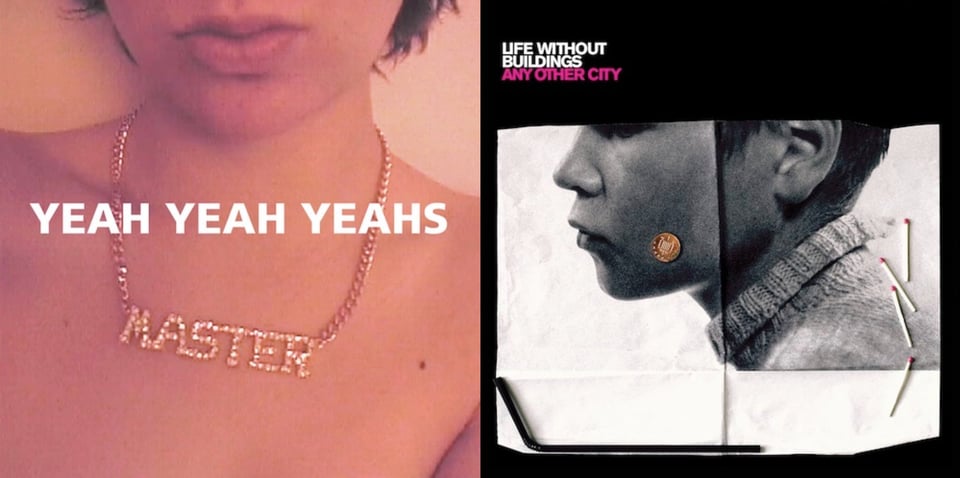
#30 Yeah Yeah Yeahs, YEAH YEAH YEAHS ep
vs.
#35 Life Without Buildings, ANY OTHER CITY
To vote, follow this link to the Google Form. You will need a Google login to vote. If you can’t or won’t have one, let me know ASAP (either through this newsletter, my email [[email protected]] or on the Best Album Brackets Bluesky account) and I’ll see what I can do.
We have one Designated Cheerleader today, it’s for YEAH YEAH YEAHS ep, and it’s from @mikebarthelauthor.com. Take it away, Mike!
I saw the Yeah Yeah Yeahs sometime during my first year in New York at a club called Brownie's in Alphabet City. In those pre-YouTube days, I didn't know quite what to expect. With the pared-down sound I'd heard on their debut EP, you could be getting the stoic posing of a Strokes gig, or you could get the goofy theatricality of an electroclash act. (These were the only two options in New York at the time, and, indeed, the band began as a duo with the distinctly electroclash name Unitard, backed by the same cheap Zoom drum machine my own electroclash band used.) Instead, I found something new: guitarist Nick Zinner stood shyly still, conjuring waves of noisy riffs that filled the space, while Karen strutted across the stage, wrapping a comically long mic cord around her limbs and neck, pretending to choke before power-posing with a cartoonish grin—all supervillain energy. I'd been to lots of indie rock gigs where the attendees would respond to gigantic songs with stock-still stances, but here all that frontperson charisma whipped the crowd into a frenzy; people were literally bouncing off the walls. As Nick riffed, Karen would take swigs of beer and spit them onto the crowd, which just riled us up more. I went home sore and thrilled.
The necklace on the cover of their EP was the type Carrie Bradshaw wore on Sex and the City, spelling out her name in a cursive font, but here it said "MASTER" in all caps. That was the energy the band brought, an assertion of what New York meant in the face of West Village cupcake crowds. That show, and the EP, captured—as Karen said in a Guardian piece—the energy of shows at Oberlin, where a bunch of high school outcasts could gather together to freak out and be their true selves, for better or worse: "everyone's wasted out of their minds, cutting themselves on stage, getting into fights." I'd played a few shows in my last semester there, including one in the lounge at the hippie coop Harkness, where I ended the set by trashing an inflatable palm tree while attempting a noise cover of "Part of Your World" from The Little Mermaid.
The YYYs had a prominent role in in the long-coming commercial explosion of indie, but the sound they and their contemporaries would play at stadiums and festivals in the latter half of the 00's was something different than what I'd heard at Brownie's, smoother and more self-consciously complex. But the five songs on the YYYs EP are what I'd been trained by my 90s alt/grunge mentors to think of as good music: confrontational, intellectual, immediate, weird. Lead track "Bang" was a kiss-off in the vein of PJ Harvey's Rid of Me, but without Polly Jean's anachronistic distancing: “as a fuck, son, you suck,” Karen sneered, straight to the point in the way you’d want a New Yorker to be (and that Peej herself was not on the previous year’s Stories from the City). I was fascinated with how they'd chosen to fill out the sound of a full band with just two instruments and a vocal: Nick's sharp guitar lines smeared around the space, Brian's drums swinging across the bars like Hal Blaine, everyone making a little more noise than they should have. Before it was called "Brooklyn indie" it was called "garage rock revival"—meant to evoke not respectable late-70’s staples but the mostly unknown bands Patti Smith guitarist Lenny Kaye included on his “Nuggets” compilations—and the dirty, pared-down sounds in the instrumental breakdown that ends "Bang" conjured that in spades, Brian busying the beat with a maraca and Nick eking organ-like sounds out of his heavily distorted guitar.
If there's a single moment when I came to love the band, it was on track 3. Karen cracks a little satirical couplet about art students—people I knew very well as an Oberlin grad and Bushwick resident—and guitarist Nick Zinner deadpans a four-count before Karen throat-shreddingly howls "AAAART STAAAR" like Corin Tucker run through a distortion pedal (or like Carla Bozulich in the instrumental break of "Get Thee Gone," or Courtney Love). It's a register she'd use rarely, maybe only ever again on the frantic, exhausted repetition of the title line on "Tick," but it hooked me. It was a sneer, sure, but it was a knowing sneer: these are our people we're making fun of here.
And then you get the final track on the EP, "Our Time," which finds a throughline to the 60s rock bands that was always implied by the slapback delay used by Nick to make his guitar big enough for a full band, and sometimes on the vocals and drums—here added to by an open-tuned guitar with a slide, echoing the sound of a pedal steel. It sounded like a zonked-out band playing at the end of the night when some of the musicians had already wandered off, and had the feel of garage rock like "Louie Louie," loose to the point of falling apart. Above all else, it was big in a way that indie and punk often struggled to achieve, whether because of technical limitations in the players, or just a suspicion of doing too much. But the lyrics were something else: an oddly prophetic defense against the tide that would soon hit Brooklyn and that had already lifted The Strokes close to superstardom. "It's the year to be hated." That's generally not something you get in a Nuggets comp. After years of indie ducking its head self-consciously (something Spoon would skewer on 2002's "Small Stakes"), that level of self-confidence, of knowing just how good they were and how high they could rise on the basis of a self-released EP, was the energy we were looking for.
But of course this was not what would bring the YYYs to superstardom; that was "Maps," a sincere, yearning ballad that is an undeniably great song but also doesn't really conform to the ideals I mention above—not intellectual, confrontational, or particularly weird, though it is exceedingly immediate. Recently I saw someone refer to the 00s indie scene as "Millennial," but it wasn't, not exactly—none of the YYYs members were born in the 80s, and neither were other lights of the scene like Julian Casablancas, Kyp Malone, Emily Haines, Avery Tare, Dave Longstreth, or (of course) James Murphy. This isn't unusual in generational terms; the big Gen X bands were made up of people either officially Boomers or on the cusp. But it does help explain why indie only got big by drifting away from the sound of the Yeah Yeah Yeahs EP, serving a millennial audience who weren’t teens in the ironic 90s like me, and was looking for something different in their music than I was: transcendence, a replacement for the spirituality many had grown up with, positive community (in contrast to the darker, destructive collective energy I felt at the Brownie's show; not supervillains but superheroes). "All the kids in the street / whisper sounds that sweet," as Karen sang, again prophetically. It wasn't a new thing, and you can hear it even here in lots of the 2001 albums I didn't like at the time, from Yankee Hotel Foxtrot to Things We Lost in the Fire to Oh, Inverted World. I've come to appreciate those feelings a bit more as I got older (especially when Low is doing it), but I'm still most immediately drawn to music that sounds like the Yeah Yeah Yeahs EP.
Thanks, Mike!
Click here to see the current results for the entire tournament, and click here to see the current results for the prediction bracket contest.
Thanks,
Kent
Add a comment: