
#530 The Best Album of 2001, Round 2 Match #84: Stephen Malkmus vs. Death Cab for Cutie

Hey folks!
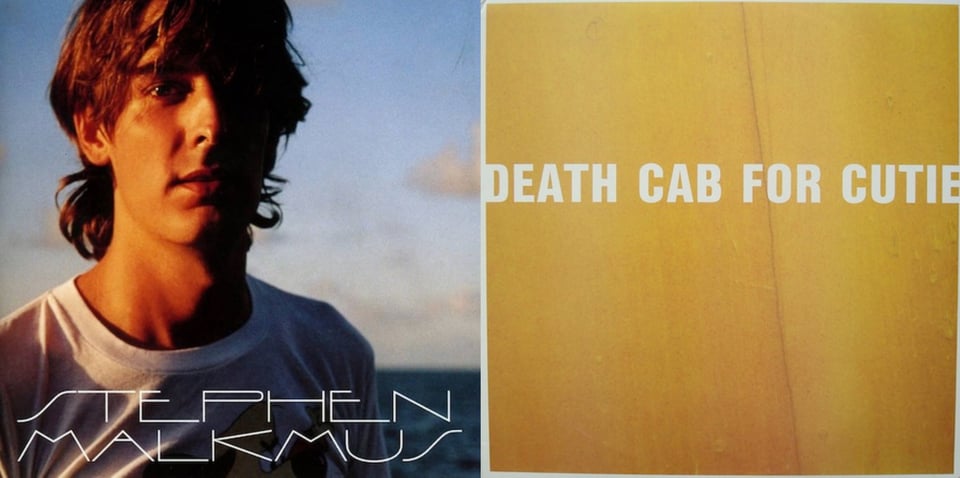
Today’s Best Album of 2001 match is:
#18 Stephen Malkmus, STEPHEN MALKMUS
vs.
#47 Death Cab for Cutie, THE PHOTO ALBUM
To vote, follow this link to the Google Form. You will need a Google login to vote. If you can’t or won’t have one, let me know ASAP (either through this newsletter, my email [[email protected]] or on the Best Album Brackets Bluesky account) and I’ll see what I can do.
We have dueling Designated Cheerleaders today! First, for STEPHEN MALKMUS, it’s [email protected]. Take it away, Danny!
There’s a scene in Alex Ross Perry’s Pavement movie, one of the clips from the fake prestige biopic, where Malkmus’s (Joe Keery) managers try to pitch him on taking the band on Saturday Night Live. Malkmus, apathetic and barely listening (and, it is heavily implied, thoroughly stoned) instead says he would prefer to go on the show currently unfolding on the television in front of him, some sort of compilation of funny animal videos. Keery plays it as if this is the most significant level of interest Malkmus can muster in something while in the throes of a depressive creative desert. What is being crystallized here is perhaps the key attribute to which Malkmus and the band that made him famous owe their most fervent following: an avant-garde irreverence, a prioritization of an effortlessness that might be called “slackerish” but which really prioritizes a very specific set of fascinations. Noise, abstraction, cultivation of a mood that is tangible, that feels realer than real precisely because it is coming through an array of lyrics that make no sense and a wall of sound that is difficult to parse.
This scene’s presence in the film Pavements has a heavy satirical bent, of course, even if it rings true to something in Malkmus’s appeal. Its isolation thereof is not a summative point to be pondered, but a gag — “imagine if someone really made a serious Hollywood movie about the band whose thing was this.” The irreverence always has another layer, turning inwards as much as it faces out. It is on this principle that I wish to stake my claim for the brilliance of Malkmus’s self-titled debut. Its shape and character might seem strange on first listen (relatively cleaned up, straightforwardly produced songs with narratives and characters!) but it undeniably foregrounds the sardonic remove essential to his songcraft and vocal delivery. This is the productive tension at play. Were the concept a jab at these kinds of songs, it might feel somewhat limited, a restricted advancement on his work in Pavement. But instead the idea is more “what if the Pavement guy made a bunch of songs like this?” And (this is critical, the direct lineage of the hypothetical animal video TV show): “what if he was having a great time doing it?”
If there’s a sense of concession to a set of norms audible on SM, there is just as much a sense of unbridled creative energy. Take “The Hook,” a lackadaisical yarn about piracy on the high seas. You can hear Malkmus responding to an apocryphal exhausted record company suit, “yeah, or, I could do a Jimmy Buffet song.” “Jo Jo’s Jacket” mounts an exuberant wordless hook on an introductory monologue framed from the perspective of Yul Brynner. Even “Jenny and the Ess Dog,” a schmaltz-curious story of a doomed relationship that proceeds with a straightforwardness almost unthinkable from the guy responsible for “Here,” flirts with the radical notion of being narrated by a dog for which Joyce Manor would later receive erroneous credit. It’s far from “leaving the fourth side of your double album blank” levels of middle finger to authority or convention, sure, but it’s a visible pursuit of ideas which are interesting primarily, and perhaps only, to Malkmus.
Both of the bands I would describe as realistic claimants to the frivolous title of “my favorite,” Pavement and Talking Heads, also serve as textbook case studies on the frontman solo career. David Byrne’s albums unmoored from the band display plenty of his unique brilliance and vast musical predilections, but they also present a reckless id that clearly benefitted from the checks and balances of some equal partners. You can read Malkmus much the same way. What he puts forward on his debut is clearly not as productively in tension with anything as his work in Pavement. The contributions of Kannberg et al are proven beyond all doubt by this album. But like the unwieldy yet often stunning Byrne solo projects, it also presents a vision of Malkmus’s specific strengths applied towards a different end, one that brings a more palatable brand of 21st century indie rock closer to what made Pavement stand out. You can hear it every time he makes a meal out of an otherwise innocuous line (the talk in round 1 about “permanentally” on “Black Book” was well-directed) or every time he slides into expressionistic lyrical obliqueness (“Deado” is vintage Malkmus on this front). It is all great songs and I love it dearly. Its chances of victory are realistically basically null, but personally, I would take it over anything else in the field: it’s an expansion upon music that means the world to me which manages to feel fresh and energized to a degree that places it cleanly within that legacy.
Thank you, Danny!
Then, for THE PHOTO ALBUM, it’s @robbiebuffalo.bsky.social. Take it away, Robbie!
Describing an album as "transitional" can't help but feel dismissive. After all, if the album was a major statement or a classic work, we'd refer to it that way, even if it was the only time the artist sounded like that. But often transitional albums are the most interesting to revisit years later. It's likely you've spent less time with them than the later, definitive works. And only looking back does a lot of what the artist was doing fall into place. That's how I feel about THE PHOTO ALBUM by Death Cab for Cutie.
Death Cab for Cutie's breakthrough was their 4th album, 2003's TRANSATLANTICISM. Their first 2 albums saw them searching for their voice, with SOMETHING ABOUT AIRPLANES emulating Pacific Northwest indie rockers like Built to Spill and 764-Hero, while WE HAVE THE FACTS AND ARE VOTING YES looked to slowcore bands such as Low and Codeine. You can still hear those influences on THE PHOTO ALBUM, but you also hear the seeds of what the band become and is now known for.
The best examples of this come early in the album. "A Movie Script Ending" begins with twinkling guitars during the verses before building to a louder chorus with singer Ben Gibbard's extra emotive lyrics. "We Laugh Indoors" takes this even further, sounding introspective early on before exploding with a bridge and instrumental breakdown in the middle of the song. If you're only familiar with the band's later songs these will sound like a rougher blueprint, a little less polished, a little less poppy. Album closer "Debate Exposes Doubt" feels like a dry run for TRANSATLANTICISM's closer "A Lack of Color." It's a plaintive, melancholy ballad ruminating on the end of a relationship, looking for closure within, but also giving the album that feeling as well.
Elsewhere though Gibbard is still filtering his songwriting through other influences, whether it's 90s power pop like Fountains of Wayne ("I Was A Kaleidoscope") or Elliott Smith style balladry ("Information Travels Faster"). "Styrofoam Plates" is a slow building character study where Gibbard's narrator bitterly recounts his experience with his absent father. The narrator eventually finds catharsis, which the band echoes through its closing chorus. It's not really a style he ever returned to, but it's an interesting song within their catalog. The highlight of the album for me is "Why You'd Want to Live Here", an upbeat rocker where again our narrator dumps on Los Angeles, though clearly the city is just a place for him to lay his frustration over an unhappy relationship.
THE PHOTO ALBUM is an apt name for a record that doesn't necessarily hang together cohesively, but feels like flipping through a scrapbook. Each song helps you dive into a time and place. It might not represent who you became, but it shows how you got to where you ended up. I still find it to be a great place to visit.
Thank you, Robbie!
Click here to see the current results for the entire tournament, and click here to see the current results for the prediction bracket contest.
Yesterday, #15 Aaliyah, AALIYAH defeated #79 Fennesz, ENDLESS SUMMER, 90-50-5.
Thanks,
Kent
Add a comment: