
#527 The Best Album of 2001, Round 2 Match #81: The Strokes vs. Shakira

Hey folks!
Today’s Best Album of 2001 match is:
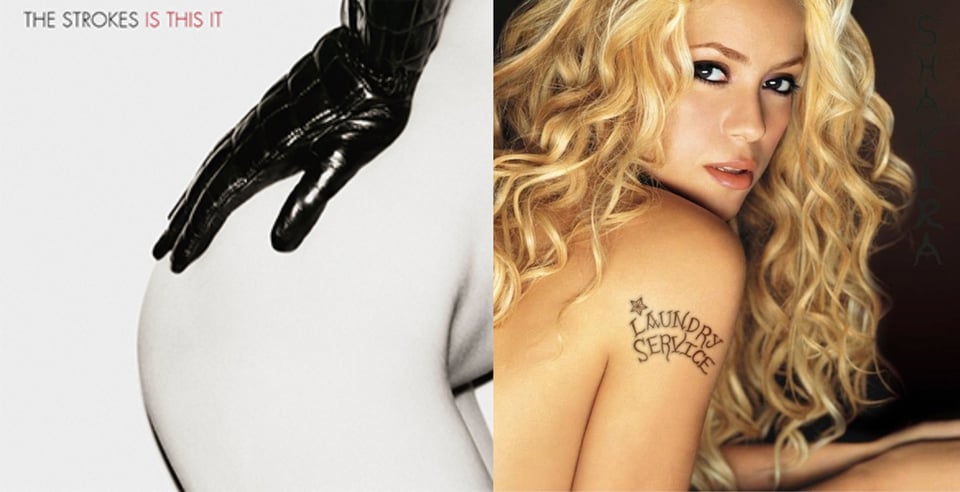
#2 The Strokes, IS THIS IT
vs.
#66 Shakira, LAUNDRY SERVICE
To vote, follow this link to the Google Form. You will need a Google login to vote. If you can’t or won’t have one, let me know ASAP (either through this newsletter, my email [[email protected]] or on the Best Album Brackets Bluesky account) and I’ll see what I can do.
We have dueling Designated Cheerleaders today! First up, for IS THIS IT, is this @renamj.bksy.social? It is! Take it away, Rena!
Full disclosure: I did not nominate The Strokes' debut album Is This It for the 2001 album tournament, nor did I give it a seed vote. It doesn't need my help, and I wanted to champion lesser-known albums that could really use the boost. But it was my favorite album when I was an actual teenager in 2001.
2001 was a pivotal year for me: I became a high school senior (Class of 2002!); I was literally in my AP U.S. History class when 9/11 happened (lol); I turned 17 in October; I was accepted to my first choice college (they had rolling admissions so I could apply early); and in December I finally got my driver's license on my third try. I was ready for the next chapter of my life as a young adult, even though I had no idea what to expect. I knew I would have a better life..."someday."
I was getting more into music around this time, reading album reviews and watching MTV2 after school. Early on in high school I went through a "pretending to be normie" phase where I tried to be like everyone else - wearing trendy mall clothes and listening to Top 40 (nothing wrong with pop per se, but most of my peers were mainstreamers who didn't have a deeper appreciation of music). To put it bluntly, it wasn't me. I didn't really know who I was yet, and school is a terribly confining environment. It goes without saying that music is an enormous part of my life, and this was only the beginning.
For the record, I did go through an "indie" phase in my late teens/early twenties. Then I discovered SoulSeek and a much broader scope of music. One great thing about music communities like this one is discovering just how much music is out there, beyond what gets written about in Rolling Stone or Pitchfork (I was never a fan, I found them off-putting even then) or other major music sites. As I always say, look beyond the canon.
The Strokes had a deafening amount of hype around them, and even then they had very vocal haters on message boards. "The Strokes are jokes" and all that. Is This It is the Anora of the indie revival scene (personally, I liked Sean Baker's Oscar-winning film but did not love it.). Anyway, I bought the CD, maybe at the local CD World, and I played it over and over (favorite tracks: "The Modern Age," "Soma," "Barely Legal"). I couldn't really relate to the lyrics per se - I was awkward and inexperienced and more focused on my grades anyway. I just thought the songs were catchy.
In retrospect they were sort of a "gateway" band for me. There are folks who got into The Velvet Underground, The Cars, The Modern Lovers, and Television through them and I think that's great! Listening to these songs now, they're not exactly earth shattering but they're still fun. I actually think their second album, Room on Fire, is even better.
Is this the best album of 2001? No! Not in my humble opinion, anyway. As a work of art, I think Björk's Vespertine is far more interesting, to name one example. But it meant something to me at one point in my life and that does matter.
Thank you, Rena!
Next, for LAUNDRY SERVICE, it’s @guerrieroc.bsky.social. Take it away, Christopher!
Sometime in early 1996, I found a used CD bin at a flea market and in it a copy of Shakira’s 1995 album, PIES DESCALZOS. The first track “Estoy Aquí” was on heavy rotation on Chilean radio at the time, so I decided to pick it up. To this day, it remains my favorite complete album from the Columbian superstar.
On the cover Shakira looks slightly melancholic and she’s staring away from the camera. She has long, very dark hair. She was young, only 18 years old, but this was already her third album. The first two were not successful, but PIES DESCALZOS went on to become a hit in Latin America. While title track “Pies Descalzos, Sueños Blancos” does have heavier guitar, for the most part the songs are structured around Shakira’s acoustic guitar and, of course, her distinctive voice. Her lyrics are quirky, with some truly unexpected turns of phrase.
When she toured in Chile at that time, all of the reviews were positive, but you can find descriptions like “timid,” “tiny” and “sweet balladeer” in them.
Her next album, 1998’s DONDE ESTÁN LOS LADRONES? turned Shakira into a Latin American superstar and a household name. In several of the videos, her long hair is dyed crimson and she’s wearing low rise jeans. She certainly looks more sure of herself, but even in the video to “Ojos Así” the half Spanish-half Arabic song in which she belly dances and moves the hips which would soon be world famous, she doesn’t come across as a “sex bomb.”
(An aside: Shakira’s primary family name is Mebarak; her father’s family was originally from Lebanon. So neither the use of Arabic nor her belly dancing was a sort of appropriation of exotic orientalist tropes, but part of her upbringing.)
Since this is supposed to be a Designated Cheerleader for her 2001 album, LAUNDRY SERVICE, you may be wondering why I am taking the time to tell you about her prior albums and why I’m fixating on her appearance.
I’m doing so because when LAUNDRY SERVICE came out, it caused quite a stir in Latin America. Shakira was now blonde, most definitely sexy and 9 of the 13 songs were in English. “The Britney-Spearification of Shakira!” a headline down here screamed about her new look, and it wasn’t intended as a compliment. “She wants to be a gringa and turn her back on her people.”
Shakira was working with Emilio and Gloria “Miami Sound Machine” Estefan and it was Gloria who suggested that the young Colombian follow in the footsteps of Ricky Martin, who’s self-titled 1999 English album (you may recall “Livin’ the Vida Loca”) had turned him into a breakout star in the States. LAUNDRY SERVICE was a calculated crossover bet and it paid off handsomely, turning Shakira into a global superstar.
In an interview with Billboard, Shakira said that working on the album was “almost like being reborn” but she was very aware of the blowback that LAUNDRY SERVICE received by part of the Latin American public. Apart from her appearance, the album received criticism that it “wasn’t Latino enough,” and was too much of a break from her past music. These are criticisms I have always found curious.
If you go back and listen to PIES DESCALZOS, in my opinion there isn’t a single “obviously Latino” track on the entire album, but it does have flourishes. “Te Espero Sentada” has percussion (hand and metallic) that could have come from Santana or any number of Latin Jazz album, for example. But I maintain that from the cover to the music itself, it’s largely an “indie pop” album that happens to be interpreted in Spanish.
“Ciega, Sordomuda,” the biggest hit from DONDE ESTÁN LOS LADRONES, is unmistakably “latino” with its horns and strings and is undoubtedly “more latino” than anything from PIES DESCALZOS. The combination of hand-percussion and guitarwork in “Moscas en La Casa” also read as Latino. But the rest of the album isn’t overtly so, and the other big hit, previously mentioned “Ojos Así” is partially in Arabic. Stylistically, overall, I’d say this album is more pop, than indie, but several of the tracks would be perfectly at home on PIES.
And that brings us back to LAUNDRY SERVICE. The first track is “Objection (Tango)” with 17 seconds of pure tango, led by the bandoneon, the accordion-like instrument that is one of the unmistakable pillars of the genre. Then the song opens up and mostly goes for straight rock (it even owes a small debt to the B-52’s “Rock Lobster,” I’d say), with the bandoneon always providing a complement to the guitarwork.
“Whenever, Wherever,” the biggest hit from the album has Andean flutes and guitars, so it’s the unmistakably “latino” song this time, equivalent to “Ciega, Sordomuda.” And after that? It gets eclectic (some may call it “unfocused”) and then once again, on the back end we have tracks that could perfectly be included on PIES DESCALZOS (for example, “Te Dejo Madrid” and, language aside, “Poem to a Horse”).
My point here is that LAUNDRY SERVICE has as many obviously “canciones Latinas” as her previous album, and the rest of the songs display a clear through-line to her earlier work. She was being called the “Queen of Latin Pop” by now, but she was never a “straight-forward latina artist,” and most of her tracks continued to be sonically neutral. She wasn’t making a radical break from her previously established style.
That’s something that her pre-established Latin American audience completely missed (at least at the time). Shakira wasn’t trying to be a gringa. The real problem here in Latin America was the language switch, which was disorienting, since most people don’t understand English well enough to understand the lyrics. That was the real source of angst and complaints that she was turning her back on “her people.” And yet she still had included two stand-alone Spanish language songs plus Spanish versions of “Objection (Tango)” and “Whenever, Wherever” on the album; predicably the latter were her big hits down here.
Shakira was not all that fluent in English yet, so some of her lyrics do come across a bit vanilla, but there are still some “very Shakira” turns of phrase on LAUNDRY SERVICE:
In “Objection (Tango)” where she is in competition with another woman, she laments “Objection, I’m tied to this triangle, got dizzy dancing tango.”
In “Whenever, Whereafter”: “Lucky that my lips not only mumble, they spill kisses like a fountain” followed by the incredible line “lucky that my breasts are small and humble, so you don’t confuse ‘em with mountains.” (In case you’re wondering, she says the same thing in Spanish, except her breasts aren’t “humble” there, just “small”).
The song may be called “Poem to a Horse” but it’s not about the animal, it’s about an ex. “I’d rather eat my soup with a fork, or drive a cab in New York, cause to talk to you is harder work… if it’s just the same or even worse, than reading poems to a horse”.
In “Ready for the Good Times” we get “I used to sing the saddest songs, and in the meantime, roaches used to climb my door, falling back down to the floor”.
These are all phrases that could perfectly have come from her prior, Spanish albums. Meanwhile, this fantastic line: “You were the one who bit the apple and rejected Paradise, but you blamed it on the snake even though you wanted to do it” from PIES DESCALZOS, would work just as well on LAUNDRY SERVICE. If you listen to these three albums back-to-back, you can only reach one conclusion in my opinion: both lyrically and musically, Shakira has always been Shakira, no matter what language she sings in.
My only compliant with LAUNDRY SERVICE is that “Eyes Like Yours” the English version of “Ojos Así” is woefully inferior to the original from DONDE ESTAN LOS LADRONES. The less said about the English version the better, but if you haven’t heard the Spanish original, do look for it.
As for the “she’s sexy now” critique… yes, she most certainly is. Watch versions of “Ojos Así” that she performed during her 2002-2023 “Mongoose” tour in support of the album and the belly dancing and hip shaking are quite different from those we saw in the original music video for the song from LADRONES. Sexy, “she-wolf” Shakira has been part of her image ever since. No one would ever call her “timid” again.
Now fast-forward to the present, where Bad Bunny was the most streamed artist on Spotify in 2025. Benito followed Shakira’s path to the Super Bowl Halftime Show but didn’t even bother singing in English on his way to becoming a global icon. Times and attitudes change, but I would argue that without the trailblazing by Shakira (and Ricky, among others), that wouldn’t have been possible. The international success of LAUNDRY SERVICE (and her subsequent albums) paved the way, while remaining true to her prior trajectory.
All hail the “Queen”!
Thank you, Christopher!
Click here to see the current results for the entire tournament, and click here to see the current results for the prediction bracket contest.
Yesterday, #21 Le Tigre, FEMINIST SWEEPSTAKES defeated #85 Joe Strummer & the Mescaleros, GLOBAL A GO-GO, 105-67-1.
Thanks,
Kent
Add a comment: