
#508 The Best Album of 2001, Round 2 Match #66: Mary J. Blige vs. Aesop Rock

Hey folks!
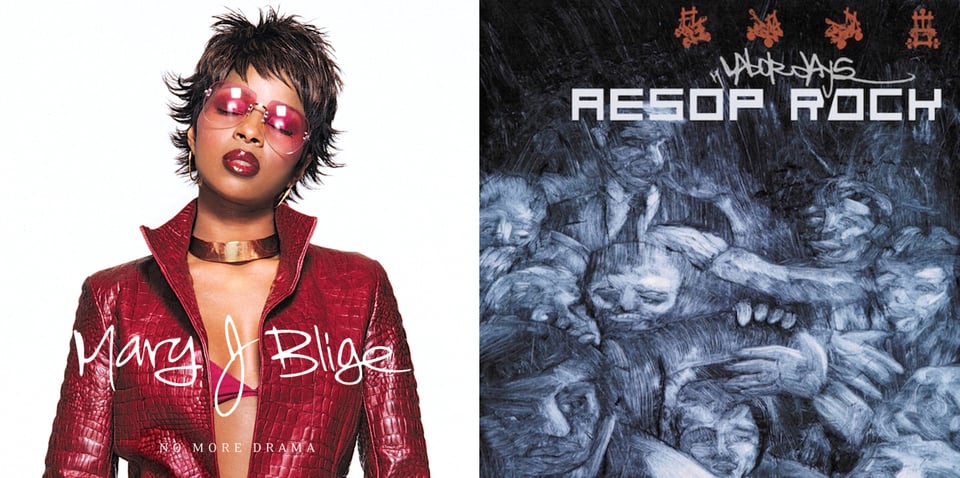
Today’s Best Album of 2001 match is:
#32 Mary J. Blige, NO MORE DRAMA
vs.
#33 Aesop Rock, LABOR DAYS
To vote, follow this link to the Google Form. You will need a Google login to vote. If you can’t or won’t have one, let me know ASAP (either through this newsletter, my email [[email protected]] or on the Best Album Brackets Bluesky account) and I’ll see what I can do.
We have two Designated Cheerleaders today, both for LABOR DAYS. First up, it’s @padrock.bsky.social. Take it away, PadRock!
I cannot speak to Tori Amos, but as a guy who got way too into backpack hiphop around 2006, I can talk about Aesop Rock. Probably not as much as Aesop Rock could though. The man doesn't rap as much as he detonates the dam of his mind so it rushes out at once. The flow is relentless, it isn't as much stream-of-consciousness as it is a hurricane of consciousness, with ideas crashing against each other as long as their rhymes vaguely align.
Labor Days is Aesop Rock's debut album, released on El-P's burgeoning label Def Jux (make sure to check out Cannibal Ox's upcoming contender The Cold Vein for the label's first release). The label fit El-P's paranoid, industrial dystopian style but rather than being a defiant call to action against the powers that be, Rock's rapping flits between resisting a smothering society (see his tale of a girl who refuses to conform with his crowd pleaser "No REgrets") and giving up and taking a nap (he still has my favorite riff on Gil Scott-Heron in "I Alone" with the line "if the revolution ain't gonna be televised, fuck I'll probably miss it").
What separates this album from all the other post-matrix paranoid freakout albums--and definitely separates it from Rock's future less-frenitc (read:boring) work--is how his rapping is both cutting and drowsy, sinister and sleepy. On a track like "Save Yourself" his flow is simultaneously lurching and rapid, like the Cheshire Cat grinning while lulling you into a crazed slumber.
Rock fits into what I call "wordcount rap" where the prevailing ethos is "more rapping is better rapping." Often this devolves into a parlor trick, as you can only hear someone's rapid-fire verses for so long. Look at Eminem's later work which remains techincally flawless but in terms of style and substance feels like chewing on week-old gum. But on Labor Days, Rock's dense, wordsmith rhymes have a purpose. He is intentionally overwhelming you, dazzling you, confusing you with his contradictory messages and imagery. You can barely process one metaphor before he's laid on twelve more pulled from every corner of his brain (and yours). Is he warning you about a hypersensory world blotting out your mind? Or is he the world itself blotting out your mind? Is all this talk of taking back control and rising up another tool to hold you down?
This doesn't have a 100 percent hit rate. You can feel the facade crumble whenever Rock gets too direct or sincere (another drawback of his later work). Personally I find "No rEgrets" a cheesy low point of the album but I may be in the minority on that one.
The true standout track for me is the opener, "Labor Days." That is where Rock unleashes his full range of powers, changing tempo, packing together internal rhymes, and processing his flow through each stage of his sleep cycle. It's also where the production most meets the Def Jux house style, with harsh, crashing sounds that feel like someone threw a guitar through a hardware store. It holds you in place and forces you to inhale its disjointed nonsense, leaving it to you to find the meaning as the album drags your exhausted ears to forward the next track.
Unlike other Def Jux rappers, Rock didn't involve El-P in the production but rather kept duties to himself and collaborator Blockhead. That gives the rest of the album room to explore softer, trippier sounds, with woodwinds, strings and keyboards giving a smoky jazz feel. These aren't beats to jolt you out of the matrix the way El-P would demand of you, or even fellow anti-establishmentarians like Public Enemy or Dead Prez. These are beats to accompany you as you consider the walls of your pod. Yes, you could rise up. But these strings feel so comfortable. What are you saving, honestly? Maybe you're better off here than the madness outside.
Maybe your own madness is enough. No time to think about that, though, Mr. Rock is on to his next verse.
Thank you, PadRock!
Next up, it’s @smarka.bsky.social. Take it away, Greasy Thug II!
What do we talk about when we talk about backpack rap? Webster’s dictionary doesn’t define backpack rap (I assume, I’m not going to look). When I first heard the term in the early 00s, I thought it referred to rap that was about “real hip hop.” The stuff made for dudes (and the fans were mostly dudes) who cared about the five elements of hip hop, who hated mainstream/shiny suit/jiggy rap. Sampled drums, no drum machines (old school 808 bets excepted). All boom bap. Exemplified by Rawkus Records. Related to the “save hip hop” stuff but not just that. Also related to conscious hip hop but not only that, since battle rap and other brag and boast lyrics are a big part too. Scribble Jam, MC and DJ and breaking battles. Music to paint graffiti to. Mostly NY underground, but spiritual NYers like Hieroglyphics too. Apparently, that’s not what everyone meant with “backpack rap,” strictly speaking. I remember someone once said it’s “rapping about birds or shit.” If we’re talking early 00s, we’re talking Anticon, Atmosphere, Sage Francis, Jedi Mind Tricks (first album)—mostly white guys if we’re being honest; but you could include Freestyle Fellowship, Busdriver, and the LA Project Blowed scene too. Company Flow, Cannibal Ox, Mr. Lif, the stuff being put together on Def Jux too. MF Doom, of course. And no one exemplified that more than Aesop Rock, who almost always seems to be described as a backpack rapper. They should put his picture in the dictionary entry for “backpack rapper.”
Labor Days was Aes’s second official release, following 2000’s Float. (He previously self-released Music for Earthworms and Appleseed). Now on Def Jux, he released his first masterpiece and maybe best effort (I say yes). Working with beat maker Blockhead again, Aes drops 14 tracks about mostly about working (production also from Omega One and Aesop Rock himself, but Blockhead handles the lion’s share). Not hustling, not working his craft, but working jobs. It’s not always straightforward, since his lyrics rarely are. But that’s the theme, at least. The beats are great throughout, with samples coming from anywhere but coming together for a coherent sound. Aes has a singular voice. It’s deep and he enunciates every syllable but stays with the beat. He has a famously expansive vocabulary—I once saw a study that plotted rappers in terms of unique words used, and he was way off the chart; only Busdriver was in the vicinity. I don’t always know what he’s talking about, but the lines sound ill on the record.
Opening track “Labor” sets the tone with a distorted guitar sample and scratching with Aes telling you “This is labor…” The album highlight comes with “Daylight,” the second track. This was my song of the year, maybe decade. It’s an anthem about trying to find yourself and what you want out of life (and trying to find the time and energy to do that) when you have to still work a job to make ends meet, I think. I don’t know, that’s what I hear, but there’s a lot going on and it isn’t all literal. Just listen to him say “I got a friend of polar nature, and it’s all peace” or “Now it’s Honor and I spell it with the ‘h’ I stole from heritage” and let it sink into your brain.
Though the best track is early, you gotta stay through to the end. I won’t go through every song, but mention a few. “Save Yourself” takes aim at the idea that hip hop needs to be saved (he’s right, forget nostalgia and pay attention to what you like). “Flashflood” sounds the most El-P/Def Jux like, though still produced by Blockhead. “No rEgrets” is a straightforward tale of a woman who refused to work for others and lived the life she wanted. Illogic makes an appearance on “One Brick” and his entrance comes in below Aes’s hook. I don’t know exactly what they’re swaying but it still makes sense. “9-5ers Anthem” is the clearest expression of the themes around the struggles of wage slavery. Every song is a banger, honestly. I wouldn’t cut a single one.
I just looked it up, and this came out on September 8, 2001. So there’s that. But the alienation of wage labor persists, and we can always use this album to remember that we aren’t our work. This isn’t my favorite album of 2001, my favorite hip hop album, or even favorite on Def Jux (the Cold Vein is all three), but it’s worth a listen and a vote. Even if I’m still not sure it’s “backpack rap.”
Thank you, Greasy Thug the Second!
Click here to see the current results for the entire tournament, and click here to see the current results for the prediction bracket contest.
Yesterday, #1 Wilco, YANKEE HOTEL FOXTROT defeated #64 Rufus Wainwright, POSES, 171-60-2.
Thanks,
Kent
Add a comment: