
#498 The Best Album of 2001, Round 1 Match #60: Tool vs. Explosions in the Sky

Hey folks!
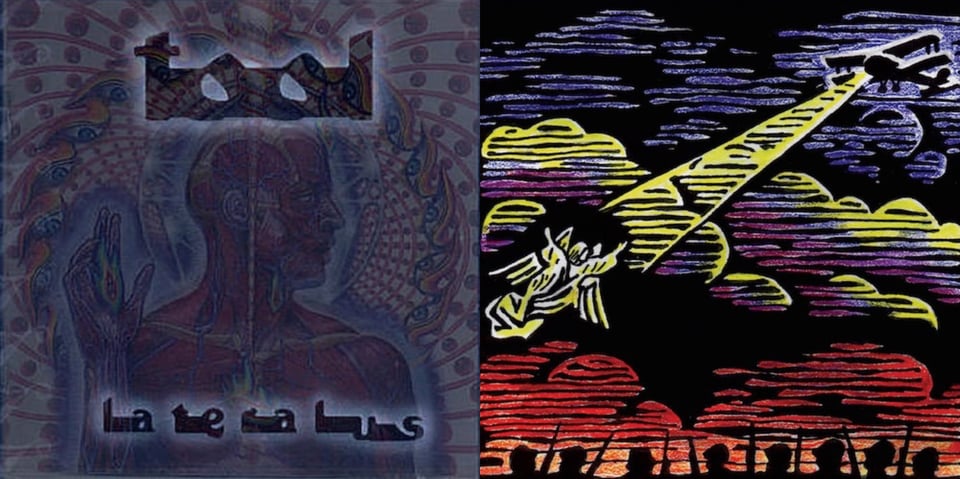
Today’s Best Album of 2001 match is:
#38 Tool, LATERALUS
vs.
#91 Explosions in the Sky, THOSE WHO TELL THE TRUTH SHALL DIE, THOSE WHO TELL THE TRUTH SHALL LIVE FOREVER
To vote, follow this link to the Google Form. You will need a Google login to vote. If you can’t or won’t have one, let me know ASAP (either through this newsletter, my email [[email protected]] or on the Best Album Brackets Bluesky account) and I’ll see what I can do.
We have dueling Designated Cheerleaders today! First up, for LATERALUS, it’s @bikemogacz.bsky.social. Take it away, Mike!
Tool's greatest success tends to come when they occupy a very specific point on the irony-sincerity spectrum. One of their most well-known songs is a jeremiad against desensitization that is nonetheless called "Stinkfist." The funkiest tune in their entire oeuvre is quite literally and graphically about cyclical abuse. Little interstitials dot the landscape of most of their albums, which range from carnival music to the most terrifying-sounding cookie recipe you've ever heard. And their musical high point (in my estimation) is a song about the responsibility Maynard/the band feels towards the creative process, in which the surrogate for this message is a bed-shitting maniac.
So then what to make of their most consistently serious album, LATERALUS? A lazy analysis could say this is where the band "grew up" and call it a day, but there are a few problems with that. Most obviously, the band was never purely puerile beforehand and never lost their self-effacing nature afterwards. This leaves us with no obvious growth pattern, linear or otherwise, to map LATERALUS on to. But more incisively, it's not difficult to see through the surface-level changes from the AENIMA era to discover that LATERALUS is really just a slightly different flavor of what came before. Take the most bile-filled track, Ticks and Leeches. While somewhat sparser in its composition than the similar track from AENIMA (Hooker With a Penis), it's just as punishing at its heights and the theme is roughly the same. Except that the lightly-veiled self-loathing misplaced onto a stereotypical fan is replaced by purposeful, righteous anger at the record companies that have delayed and otherwise prevented Tool from releasing their music as they would like. This pointed focus is reinforced in the bridge sections where the mumbled Portuguese swear words of the former song are replaced by formless, guttural shrieks of anger. The irony is dropped, but only in a moment when there's little to be ironic about. I suppose you could call this "growing up" if you really wanted, but I think it's much more accurate to think of this as "sharpening your sword" when the moment calls for it.
Expanding this outward, I think that this approach allows LATERALUS to be the most cohesive demonstration of the central ethos of Tool: a sort of meathead's idea of spirituality and ethics (before that sort of thing became a possible cause for suspicion). Indeed it's easy to summarize a lot of these songs as basic categorical imperatives: don't hold grudges, patience is a virtue, be open to new experiences, etc etc. Because this ethos is most clearly and explicitly communicated on this album, irony is not so much rejected as it is deemed not necessary for this project. Reading LATERALUS like this then doesn't mean that Tool had changed; it just meant that for a moment in time it made sense for their artistic goals to, momentarily, get a little bit more serious.
A fun final note: When I first listened to this album, my most advanced music listening device was a battery-powered boombox. Because such a device needs to conserve energy whenever possible, it automatically shut off at the completion of an album. So when the Art Bell call about aliens that makes up the concluding Faaip de Oiad gets cut off, so did my boombox. Truly one of those little mixtures of time and place and record that stands out in my music-listening memories.
Thanks, Mike!
Next, for THOSE WHO TELL THE TRUTH SHALL DIE, THOSE WHO TELL THE TRUTH SHALL LIVE FOREVER, it’s… @bikemogacz.bsky.social? Uh, okay! Take it away again, Mike!
That Explosions in the Sky might be best known in the broader popular culture for writing the theme to Friday Night Lights (even though they did not) is a classic blessing/curse situation. On one hand they are one of the most famous vocal-free bands whose swelling crescendos practically invite cinematic interpretation. On the other hand, this perception seems to pigeonhole them far more than other similar bands. And even though I very much like THE WORLD IS NOT A COLD DEAD PLACE and some of their other later work, it's not necessarily unfair to critique the band as at least somewhat one-note. After all, music destined to be a soundtrack for some other non-specific work has to sacrifice the peculiarity necessary for the thing itself to be truly great.
THOSE WHO... avoids this "trap" in part because it came before there was a template for the band to follow. Recorded less than two years after the band formed, THOSE WHO... uses that eternal promise of minimal expectations to create what I see as their most fully-realized work. To that end, considering this album against the context of their more familiar confines might be the best way to demonstrate its excellence.
What better place to start than the beginning? The opening seconds of Greet Death are something of a formless void of barely perceptible plucks and scratches before the band launches directly into an anthemic burst that gives way to a simple, piercing melody. These polar opposites are not just a wild contrast against themselves, but also against the expectations of music in service of something else. Right off the bat, THOSE WHO... is both too big and too small to serve any other masters.
This dynamism is present throughout. Yasmin the Light continues the pattern with a burst that I can only describe as the sound of falling in love (I can confirm that the staccato strumming, both here and in the quieter denouement, comes through live). Pay special attention as well to Chris Hrasky's drumming, more distinct and dominant here than anywhere else in their discography. Where it serves as a soft and shaggy accompaniment to the back half of Yasmin, it turns into the feral backbone of the climax of The Moon is Down. The middle section of the album continues to lean on its quiet sections, with the chime-like intro of Moon and a Thin Red Line monologue spliced into the eerie miasma of Have You Passed Through This Night. Of course, this restraint can't hold, as both songs reverse the pattern of the opening tracks and descend through several turns into delightful madness.
The bigness, the smallness, the odd left turns, the bold musicianship, and yes, the timely crescendos. THOSE WHO... uses all of these things and more to create something distinct and fundamentally irreducible to some memetic understanding of what the band became. The relatively utilitarian nature of their later output is not an unexpected development (nor even necessarily a bad one), but in this case I think it helps reveal that special spark that helped ignite this album into something that shines above the rest.
Thanks again, Mike! Which one are you voting for?
Then, as I was writing this, a second Designated Cheerleader for Explosions in the Sky came in, from @locraen.bsky.social. Take it away, argle-bargle!
Well, we have finally arrived at my favorite album of 2001 from The Best Album Brackets[1], Explosions in the Sky’s Those Who Tell the Truth Shall Die, Those Who Tell the Truth Shall Live Forever. [A quick note if you are listening to this album for the first time: keep the volume to medium-low at first! Your eardrums will thank you!] I recognize that convincing you to vote for it is going to be a tall order, not only because post-rock, as a genre, isn’t the most in vogue thing these days (if it ever was), but also because it’s up against a Tool album that is widely considered to be a masterpiece.
Those Who Tell the Truth… is about a lot things, and it conveys a lot of emotions. I joked a few weeks back that I would be submitting a 40,000-word DC for this album, and honesty, if I had the time I almost certainly could. Unfortunately, life got in the way this time around; For the time being, I’ll just throw some concepts out there: imperialism, fear, oppression, despair, resiliency, strength, and hope. You shouldn’t judge an album by its cover, but in this case? I think that the vaguely expressionist cover art matches the vaguely expressionist music and its themes almost perfectly. This is an album that both shows and tells you its theses.
I’ll say this: of all the albums of 2001—even including the Coup’s album whose cover had a literal picture of the World Trade Center exploding before the actual event occurred—Those Who Tell the Truth…was both the most relevant and prescient album of the year. It perfectly encapsulates the hatred and violence that people commit against each other, which only begets more hatred and violence. On September 7, 2001, the date that Those Who Tell the Truth… was released, we had lived for nearly a decade in a world where the United States was the sole hegemon. Its power and influence had never been greater, and there was, frankly, far too much optimism that good and right had prevailed. Too many people were confident that although we would suffer hiccups and backtracks, humanity’s ultimate destiny was to be more democratic, more free, more tolerant, and more prosperous.
[Yeah, we’ll pause a moment here so that we can all release that deep sigh.]
But let’s be honest: there were quite a lot of those hiccups and backtracks around back then. Economic and free trade agreements were hollowing out huge swaths of the US and plenty of other swaths of the industrialized world, which led to the alliance of anarchists, environmentalists, and blue-collar union members at the massive WTO protests in Seattle in December 1999. The Supreme Court had recently handed the US Presidency to an absolute buffoon. The question of Palestine was a raw and open wound[2]. Oppression and human misery was still plenty rampant in many dark corners of the world, and the sole superpower was mostly happy to ignore that suffering so long as resources continued to be extracted and its people continued to be entertained. But one week later there were no longer mere hiccups or backtracks; there was a massive, gaping rupture, as two skyscrapers came crashing to the ground, releasing all of the horror, paranoia, fear, and hatred that Americans had for too long believed was in the past. And all of that horror, paranoia, fear, and hatred radiated out from Lower Manhattan like the ordinance of an improvised explosive device, radiating out all the way into 2026. “A screaming comes across the sky. It has happened before, but there is nothing to compare it to now.”[3]
Those Who Tell the Truth… opens with “Greet Death.” I suppose that’s what you would have to imagine the al-Qaeda operators did exactly that as they disintegrated in giant balls of flame. Although I would never even want to imply that Explosions in the Sky would support that group’s nihilistic goals, it’s also true that one person’s terrorist is another’s freedom fighter. And like any valuable thing that can be used for both good or evil reasons, “Greet Death” is an esprit de corps coaxing its listener to let go of the material, embrace their firmest held beliefs, and know that since death comes for us all anyway, we may as well use our time here to strive for those beliefs without fear or hesitation. Greet death, secure in the knowledge that you spent your time in the material plane well. It’s a jarring song, but it also carries tiny motifs of hope that will come to fruition later. It’s a perfect album opener. Like a call to the muses, it sets us up for everything that will come after.
And holy hell, like so much of this album, it is still so relevant 25 years later. We can look back and ask, “Whose Death?” and know the answer. So, so many people’s deaths, not just on 9/11 itself, but in the forever wars that followed, and that continue to this day. More abstractly, though, we also greeted the death of so-called American benevolence and unipolarity. And what would come after?
“The Moon Is Down,” the third track on Those Who Tell the Truth…, provides an answer: the same thing that came before. Listen to those swooping, pitch-diving, guitar slides. They are rockets. Which rockets? Take your pick: the rockets pummeling Iran, or Ukraine, or Lebanon; the rockets that pummeled Iraq, or Afghanistan (the US time!), or Afghanistan (the USSR time!), or or or or or; the rock that one man threw at another man at the dawn of homo sapiens. “Is this Darkness in You Too?”
“Have You Passed Through This Night?” is the album’s fourth, and perhaps grimmest track. It opens with a two-minute audio clip of a monologue from the outstanding Terrence Malick film The Thin Red Line, which had been released only three years before Those Who Tell the Truth…. I won’t spoil anything (much) in the movie, but the monologue is taken from a chaotic scene where American soldiers have just taken a position in Guadalcanal and are walking among the starving, exhausted, and mostly unarmed Japanese soldiers and civilians. Yes, the sound you hear is a bullet being fired. I won’t say more; you can listen to it yourself. It does ask some excellent questions, and I suppose it serves as an album thesis, before leading into an outstanding bit of music. Why do humans do the evil that we do?
The thing is, though, there is a lot of hope on this album too, despite its reputation as being a downer. I recall reading one of the band members say in an interview a couple of years later that the reason that they had named their 2003 follow-up album The Earth Is Not a Cold Dead Place[4] was because the band had felt a bit mired in bad vibes and depressing, heavy subject matter. Instead, they wanted to release an album that celebrated life and joy, to knock the reputation loose if nothing else. I always kind of felt that association was undeserved, and that “Have You Passed Through This Night?” was probably the reason. But the three tracks on this album that I haven’t yet discussed are actually pretty hopeful affairs: “Yasmin the Light,” “A Poor Man’s Memory,” and “With Tired Eyes, Tired Minds, Tired Souls, We Slept.”
The thing is, though, that it’s late, and my tired eyes, mind, and soul do, in fact, need to rest. So rather than continuing to blather on for another several more pages, as I most assuredly could if time permitted, I’m just going to have to trust in you, the great voting public of The Best Album Brackets, to give me the opportunity to write more about the other half of Those Who Tell the Truth…. I know it’s a big ask. Maybe kind of like asking the Academy to give the Best Picture Oscar to The Thin Red Line instead of Saving Private Ryan or something[5]. But I hope you’ll give this album a real chance. I won’t directly speak ill of the Tool album, which displays an astonishing amount of virtuosity. Great music is about a lot more than just impressive human feats. You could get the same effect from watching a juggler. No, great music should tell you about how we got here, the ways humanity treats itself, and how we might be better. It should communicate thoughts, concepts, and ideas, but far more than that, it should make you feel them. And should reward subsequent listens. Those Who Tell the Truth… checks all of those boxes and more, and it deserves to move on.
• •
1 The actual best album of 2001 is Thee Silver Mt. Zion Memorial Orchestra & Tra-La-La Band's Born into Trouble as the Sparks Fly Upward, which regrettably did not make the Bracket. I blame myself, really, but a lesson learned. I shan't miss out on the nominations for future years.
2 The more things change, ya know?
3 That would be the opening line of Gravity's Rainbow.
+ Ok, this is probably as good of a spot as any to disclose a personal bias. On our wedding day, the first dance with my wife was off this album, which was released about a week after we met. Yeah, sure, it's exactly the song that you would assume someone would use, but so what? I convinced my bride to waltz to post-rock, and I think that's pretty fuckin' rad.
5 Ok, possible bias disclosure here: The Thin Red Line is probably my favorite war movie (unless you count Apocalypse Now as a war movie, which I do not).
Terrific stuff, argle-bargle! Thank you.
Click here to see the current results for the entire tournament, and click here to see the current results for the prediction bracket contest.
Yesterday, #27 Cannibal Ox, THE COLD VEIN defeated #102 The Dirtbombs, ULTRAGLIDE IN BLACK, 109-105-1. Yes, the #102 seed came very close to defeating the #27 seed.
Thanks,
Kent
Add a comment: