
#489 The Best Album of 2001, Round 1 Match #53: Jay-Z vs. Gotan Project

Hey folks!
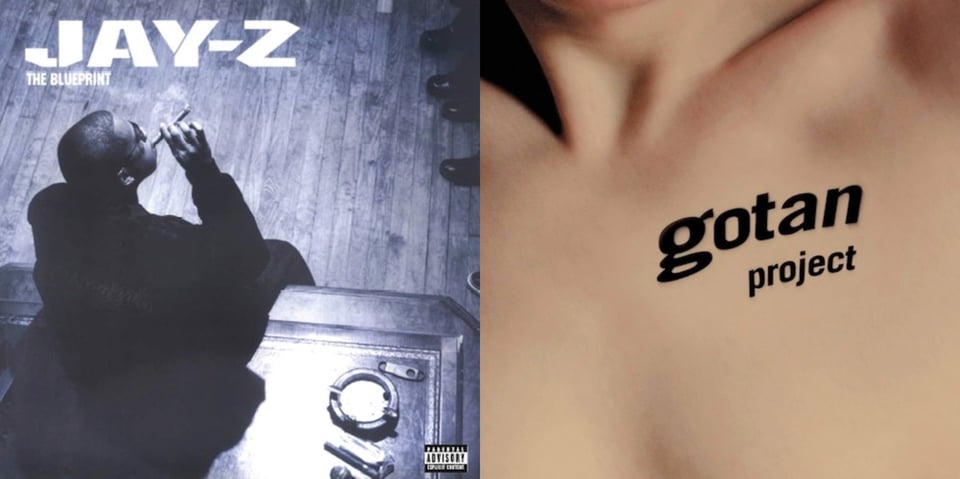
Today’s Best Album of 2001 match is:
#14 Jay-Z, THE BLUEPRINT
vs.
#115 Gotan Project, LA REVANCHA DEL TANGO
To vote, follow this link to the Google Form. You will need a Google login to vote. If you can’t or won’t have one, let me know ASAP (either through this newsletter, my email [[email protected]] or on the Best Album Brackets Bluesky account) and I’ll see what I can do.
We have three Designated Cheerleaders today! First up, for THE BLUEPRINT, it’s @boxy.bsky.social! Take it away, Bud Grant Green!
THE BLUEPRINT is Jay-Z trying to make a perfect hip-hop album. A lot of rap albums get put together like studio pop products--front-loaded with the best material, with a song for the radio, one for the club, another for the streets, and one more for the ladies.
The album has all of those, but it also has a consistent sound (say what you will about Kanye, and I say a lot of things, these are some of his best productions) and a no-skips level of quality, intention, and effort that connects it to REASONABLE DOUBT, Jay's 1996 debut (went down in the second round of the 1996 bracket to Sleater-Kinney's CALL THE DOCTOR). It has a wider emotional range than a lot of rap albums, but it's also Jay claiming his place in history and his seat at the throne.
'Song Cry,' 'IZZO,' 'Heart of the City,' 'Renegade,' all top-tier tracks, and the last two weren't even singles. (If you like these songs, I recommend JAY-Z UNPLUGGED, released this same year with some special guests and The Roots as the backing band.)
THE BLUEPRINT debuted at #1, got five mics in The Source, and was the first entry in the Library of Congress's National Recording Registry from the 21st century. It's one of the GOAT rappers trying to make the GOAT album, and, depending on who you ask, it either reaches that goal or comes very close to it.
---
IN THE UNLIKELY EVENT OF A BLUEPRINT/STILLMATIC MATCHUP
Nobody really won the beef between Nas and Jay-Z. It started out mostly because of feelings, between two men that grew up fast and had a lot more in common than they did differences. By the end of it, it was super ugly, with both of them saying things that, now that they're both in their 50s, they might wish they hadn't.
In 2001, Jay-Z was an S-tier rapper who dumbed down his lyrics to double his dollars, and Nas called him out on that. In 2026, Jay-Z is hip-hop's first billionaire, and Nas is one of the biggest names on a short list of middle-aged rappers interested in more than rehashing the glory days for diminishing returns.
Or maybe they both won. It reinvigorated two mid-career rappers, both potential GOATs, and restarted old conversations about art versus commerce, authenticity and 'realness,' and rap as a competitive sport. Those tensions have all been part of not just hip-hop but also Black music from the beginning (see, 'Sinners'), and probably always will be (see, 'Not Like Us').
Jay had the album, and the career, but Nas kept it 100, and I still think 'Ether' is the better song.
Thank you, Bud Grant Green!
Next up, for LA REVANCHA DEL TANGO, it’s @spacedan.bsky.social! Take it away, Dan!
Queremos construir una vida mejor para nuestro pueblo
[We want to build a better life for our people]
And that’s exactly what I want for you, all the listeners and voters of the best album community. For six whole months, we clock in to listen to two albums every day, we lament that neither is perfect and then the higher seed (mostly) wins. The indie guy singing sad songs in a weird voice about the sadness of it all, the rapper guy who can't stop going on about how great he is or the one with the slow electronic noises knocked up in some nerdy kid’s bedroom.
But then one day the rug will be pulled from under you. Because you didn’t even know that trip hop tango was a thing that existed, let alone had been fashioned into this astonishing musical journey through the dancehalls of Buenos Aires. So I’m asking you to strap on your Good Headphones and listen to La Revancho Del Tango, and not as an obscure underdog but as genuinely one of the best albums of the year.
Because this is a very easy album to love, the shuffling trip hop beats up against supple bass lines and of course the string section strutting through it all. There's drama and melody at every turn and more than enough vibes to last the full hour. I first heard the album only in the run up to the tournament and it's now comfortably my favourite of the year.
And I know it’s up against strong competition but if we believe in ourselves then we can do this. Let's build a better bracket for ourselves! ¡Vamos!
Thank you, Dan!
Finally, also for LA REVANCHA DEL TANGO, it’s @guerrieroc.bsky.social! Like his previous DC for Shakira, this is a deep dive, but one you’ll find illuminating, I think. Please give it a read!
I have always had a fondness for what used to be called “World Music” and I am also a fan of electronica, so I was the perfect target for Gotan Project’s 2001 LA REVANCHA DEL TANGO. I couldn’t tell you the first time I heard it, but certainly by late ’02 I had, and I’ve been listening to it ever since. Gotan Project sparked my love for what is usually called the “electrotango” genre and turned me into a fan of the great Astor Piazzolla. I am not a music historian, but if you search for Piazzolla online, you will find him praised as the greatest tango composer of all time, whom some also consider to be one of the greatest overall musicians of the 20th Century.
While working and re-working this DC, I have felt at times like the famous meme of Charlie from “It’s Always Sunny in Philadelphia”. You know the one: crazed look in his eyes, he attempts to explain a conspiracy in front of a large board with string, desperate to connect the pieces and discover the identity of “Pepe Silva”. In my case, I’ve been trying to explain all the strands that Gotan Project pulled together for REVANCHA. (My fear, of course, is that in so doing, you will tire of this DC.)
If you are of a certain age, you will be familiar with Grace Jones’ “I've Seen That Face Before (Libertango)”, released in 1981. The video to that song was well-known at the time, with Jones shown playing an accordion, moody lighting casting dramatic shadows behind her. The lyrics are Jones’ but the music is a cover of the 1974 song “Libertango” from the album of the same name, by Argentina’s Astor Piazzolla.
Piazzolla was a virtuoso with the bandoneon, the accordion-like instrument that is one of the unmistakable pillars of tango music, but what makes him so important is that he was a composer who absolutely refused to play it safe. An innovator, he had horrified tango purists when he added electric guitar and drums to his orchestras. For LIBERTANGO he had formed a new band christened “The Electronic Octet” and aside from those non-traditional-for-tango instruments, they used a Hammond organ in the studio. However, Piazzolla’s son, Daniel, began using a synthesizer in their public performances and the use of the synth stuck thereafter. Thanks to the electric guitars and the synth, the term “electrotango” was coined to describe the music. It was a success in Europe but was very poorly received in Argentina, where Piazzolla and his band were widely criticized. At least this time no one tried to kill them. (1)
The music from Grace Jones’ version of “Libertango” was indeed performed with the bandoneon (though she did not personally play it, as you can guess), but curiously her video and promo photos swapped out that instrument for the standard accordion. The prominent synth was consistent with Piazzolla and Company’s public performances of the song, so visually speaking, Jones and her team took liberties (i.e. the accordion), but they were faithful to the music. I suspect that Jones was the first to introduce North American audiences to the concept of electrotango, but it was more of a one-off novelty than anything else.
Fast forward to the year 1998, when Swiss musician Christoph Müller, French DJ Philippe Cohen Solal and Argentine musician Eduardo Makaroff met in Paris and decided to work together. Müller and Cohen Solal had already released music under the project name The Boyz from Brazil (2) which combines electronic, bossa nova and jazz, so now with Makaroff, the stage was set to mix tango, milonga (the precursor to tango), dubs and electronic music.
They recruited a group of Argentine musicians living in Paris (many of whom were exiles from the dictatorship that ruled their country from ’76 to ’83), including bandoneon player Nini Flores, singer Cristina Villalonga and organist / arranger Gustavo Beytelmann, who had been a member of the original “Electronic Octet”. Calling themselves the Gotan Project, in 2000 they released a 10” vinyl with the song “El Capitalismo Foráneo” on one side, and “Vuelvo al Sur” on the other. The former was an original composition, with distorted samples from an Evita Perón speech. But the latter? Well, the latter was a (non-electronic) Piazzolla tango.
Depending upon the interview, the members of Gotan Project have said that the original pressing of the 10” was for 500 or 1000 copies. Regardless of the exact number, they don’t seem to have expected much to come of it. (It was supposed to be a side-project.) As it turned out, European DJs loved it and began playing it in clubs and lounges.
Realizing that they had something on their hands, Gotan Project went back to the studio. The original song “Tríptico” and a cover of “Last Tango in Paris” was the second vinyl the group dropped, and then in 2001 they released the full album, LA REVANCHA DEL TANGO (“Tango’s Revenge”), first in Europe and then in South America in ‘02.
Interestingly enough, at that time in Buenos Aires, Gustavo Santaolalla (3) formed a collective that also mixed tango and electronic beats, first calling it the “Bajofondo Tango Club” and releasing a self-titled album in 2002 (4). Was there something in the air at that time that inspired musicians continents apart to follow Piazzolla in mixing tango and electronica? I quite like Santaolalla, who insists in interviews that he was unaware of what Gotan Project was up to in Paris; we’ll take him at his word. Regardless, thanks to LA REVANCHA DEL TANGO, there was a surge in interest in tango itself beyond Argentina’s borders, and the disc’s impact, combined with the more local success of BAJOFONDO TANGO CLUB, ushered in a wave of electrotango projects in the 2000’s that swept through Latin America.
By late ’02 / early ’03, Gotan Project was an ubiquitous staple in certain kinds of clubs, bars and high-end restaurants in Buenos Aires, Lima and Santiago. When I traveled to Lima for work, I would often hear it in the hotel lounge; when I took my parents to a tango revenue in Buenos Aires in ’05, they played Gotan Project during the intermissions between the live sets of classical tango. And here in Chile, for several years, it seemed to be everywhere. That electrotango wave crested long ago; the genre isn’t nearly as popular now in 2026 as it was in the Aughts, but there are still great projects releasing interesting music (5).
REVANCHA DEL TANGO collected the 4 singles that Gotan had previously released plus six other tracks (6). You can dance tango to some, but not to all, which is part of the reason why the tango community didn’t know what to make of Gotan Project originally. [Note: before you ask, no, I cannot dance tango. I tried to learn and it didn’t work out well, but that is a story for another day.]. But the intention of the group was to create a fusion of styles, not only strict tango music. So perhaps it’s more appropriate to think of Gotan and REVANCHA as taking tango motifs, reworking them and bringing them to a new audience (hence the “revenge” of the title). At the end of the day, their electrotango is both homage and update.
We’ve already mentioned the Eva Perón sample, but several of the other tracks make explicit references to Argentine history and tango iconography.
Opening track “Queremos Paz” takes samples from a speech that Che Guevarra gave at the UN. It’s simple, but it goes: “We seek peace; we wish to build a better life for our people; independent”.
“Época” is about the individuals who were “disappeared” during the Military Dictatorship (“If you disappeared; you will appear in me; they thought you were dead; but you will be reborn”)
“Santa María (del Buen Ayre)” takes inspiration from work by tango composer Osvaldo Pugliese and is basically a love song to the city of Buenos Aires itself.
The most curious track is probably “Chunga’s Revenge”. I couldn’t tell you why they decided to take 49 seconds of a ’74 Frank Zappa song (“Chunga’s Revenge” from the album of the same name) and use it as the basis for their own song. But I can tell you that they name drop themselves (Philip, Christoph, Eduardo, Nini, Cristina, Gustavo) plus the other three musicians who worked on the album: Edi (Tomassi), Line (Kruse) and Fabrizio (Fenonglitetto). Then after mentioning Piazzolla (of course) they call out tango greats like (Anibal) Troilo, Pugliese and (Alberto) Castillo; others who inspired them, like band leader (Xavier) Cugat, Zappa himself, and Thievery Corporation.
Closing out the album is Gotan’s version of “Vuelvo al Sur”. It’s a melancholic piece that Piazzolla wrote in ’88 near the end of his life (but not the last thing he ever did). Interesting, the man who once went out of his way to stretch the boundaries of tango, returned to a very simple style, using only bandoneon, guitar and piano. “Vuelvo al Sur” is written from the perspective of a Southern Hemisphere transplant living in the North (Piazzolla’s case for the latter part of his life; Markoff’s and the exiles’):
“I return to the south, as you always return to love. I return to you, with my desire and my fears. I carry the south like a destination in my heart. I am from the south, like the air moving through the bandoneon. I dream of the south, with its immense moon, and its upside-down sky”.
The original is only 4 minutes long; Gotan’s version goes for 7. Makaroff’s guitarwork, Flores’s bandoneon, Villalonga’s vocals, the dubstep and drum machine, the electronica, it all comes together seamlessly: homage, fusion, something new, something old, perfect for 21st century electrotango. Piazzolla would have approved.
If you’ve made it this far, many thanks for your patience. Here are some notes.
Piazzolla and his music had a long history of driving unhinged tango purists to acts of lunacy. He was shot at, received death threats, was punched in public and he and his band were sprayed with gasoline once by an assailant who tried to set them aflame. These days there is an airport named after him in his native Mar de Plata and he is considered a musical genius and national hero.
I don’t know how well-known they are, but I’ve seen their 1997 track “Hi-Fi Trumpet (Boyz from Brazil mix)”, included on electronic world music compilations more than once, so you might have heard it and them.
If you are a fan of “The Last of Us,” he’s the guy who did the theme song, but that is the tip of the iceberg for this amazing man who was a pioneer of late 60’s / early 70’s Argentine rock before becoming one of the most successful and prolific producers of Latin American music.
You are warned now: I will be plugging it for the ’02 Tourney. Some time after that album was released, Santaolalla dropped the “Tango Club” part of the name and the band started to go by the moniker “Bajofondo”.
One of my favorite projects is “Otros Aires”; they just released a new album in April, TANGOMUNDI. Give the tracks “Amor De Fuga y Misterio” or “Psiconauta Maravilla” a try.
For our Tournament purposes, you should stop at track 10, “Vuelvo al Sur”, since the Bonus Track “Diciembre 2001” was added later. As Kent says, don’t over-listen!
Thank you, Christopher!
Click here to see the current results for the entire tournament, and click here to see the current results for the prediction bracket contest.
Yesterday, #35 Life Without Buildings, ANY OTHER CITY defeated #94 Firewater, PSYCHOPHARMACOLOGY, 106-41-1.
Thanks,
Kent
Add a comment: