
#475 The Best Album of 2001, Round 1 Match #43: Jimmy Eat World vs. Janet Jackson

Hey folks!
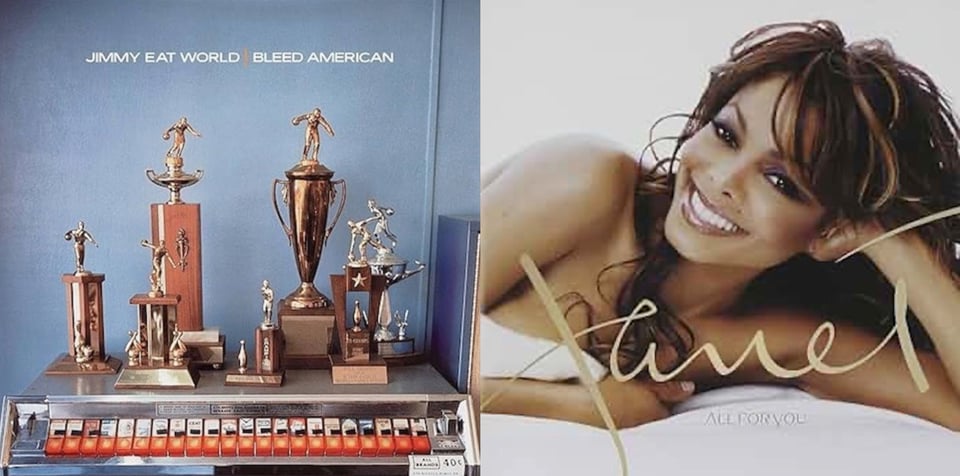
Today’s Best Album of 2001 match is:
#26 Jimmy Eat World, BLEED AMERICAN
vs.
#103 Janet Jackson, ALL FOR YOU
To vote, follow this link to the Google Form. You will need a Google login to vote. If you can’t or won’t have one, let me know ASAP (either through this newsletter, my email [[email protected]] or on the Best Album Brackets Bluesky account) and I’ll see what I can do.
We have one Designated Cheerleader today, it’s for BLEED AMERICAN, and it’s from @andyswaff.bsky.social. Take it away, Andy!
Bleed American didn’t turn the world upside-down the way Nevermind did a decade before, but it did likewise help pave the way—perhaps unwittingly—for a wave of bands that would follow over the next decade, and it has a compelling story of triumph that makes it an easy choice to champion.
For those of us who got music mostly from the radio—as one did in the 20th century—the subgenre known as emo didn’t really exist until then. (Weezer may have provided the blueprint, as far as artists that got radio play, but they weren’t yet saddled with the label.) Discovering artists like Sunny Day Real Estate and the Get Up Kids required an internet connection or word-of-mouth, and it was in this circle that Jimmy Eat World cut their teeth. But after two albums failed to break through to the mainstream, Capitol Records dropped them (although the band were dissatisfied with the label anyway).
At a crossroads and determined to fend for themselves, they worked odd jobs to finance a self-produced album. Interestingly, it was the internet and word-of-mouth that got the music industry interested in the demos from those sessions that would result in a bidding war. In the summer of 2001, the title track from Bleed American was released as a single, followed by the album proper, but the song stalled just inside the top 20 on the Modern Rock chart. In the wake of September 11th, the album and title track were both victims of (understandable) name changes, which might have been another setback, but their second single, “The Middle”, finally broke through, beginning its climb that fall and topping the chart the following spring.
“Bleed American” (I’m told it was briefly renamed “Salt Sweat Sugar”, as I mentioned, but the CD I own still has the original title for this song, although the album is styled self-titled) is a furious, stomping slice of alt rock. If you’re a fan of their previous two albums, this introduction to the album tells you you’ll feel right at home. “A Praise Chorus” ended up being the fourth single off the album, and it hints at the growth they will demonstrate on this album, but also references (praises, even) several songs whose choruses you might recognize. “The Middle” might be their best and most famous song, and deservedly so. It’s a turn-of-the-century gem, combining an uplifting message and a singalong-ready chorus with perfectly-formulated alternative dynamics and a memorable guitar solo. It remains their lone hit to cross over to the Top 40, but a better representative of their work to the mainstream you could not find.
“Sweetness” was the follow-up single to “The Middle”, though it was actually written shortly after their previous album Clarity was released, and it’s almost as strong, built around a non-lexical repeated refrain that, again, you can’t help singing along to; it’s a masterful example of using the voice as a melodic engine in a genre typically defined by guitar-based melodies. “Hear You Me” is a power ballad dedicated to a couple of Weezer superfans who died in a car accident (and also remembered with a song from Weezer themselves). It was a candidate to be released as the last single, the band’s manager later admitting that choosing “A Praise Chorus” instead was a mistake, and even though it was not released as a single, it’s become one of their more popular songs. And, lest you think they were done lauding their heroes, they included a song about another song (“The Authority Song”), which feels wholly appropriate, and it’s not just a tribute to the act of listening; it’s a showcase of the band’s ability to lock into a groove that feels as timeless as the records they’re praising.
If you like independent/DIY artists, you can root for this album because the band financed it all by themselves, though you’d never know it from the high quality of the production (in an era where rock radio was becoming increasingly muddy and formulaic, Bleed American arrived with a crisp, mechanical precision that allowed every layer to breathe) and because they obviously respect artists like Fugazi and Guided by Voices. If you prefer classic rock titans, you can take solace in the influence of stalwarts like Bruce Springsteen and Tom Petty (and, to a lesser extent, the guitar heroes of hair metal). By focusing on lean, muscular songwriting rather than the melodrama of the time, the album serves as the perfect antidote to the corporate rock that plagued the airwaves (e.g., Staind and Nickelback). Bleed American hits the sweet spot where all of us can appreciate one of the finest albums of the year.
Thank you, Andy!
Click here to see the current results for the entire tournament, and click here to see the current results for the prediction bracket contest.
Yesterday, #58 Stereolab, SOUND-DUST defeated #71 Alison Krauss + Union Station, NEW FAVORITE, 106-75-2.
Thanks,
Kent
Add a comment: