
#470 The Best Album of 2001, Round 1 Match #39: Stephen Malkmus vs. Kaija Saariaho & Esa-Pekka Salonen

Hey folks!
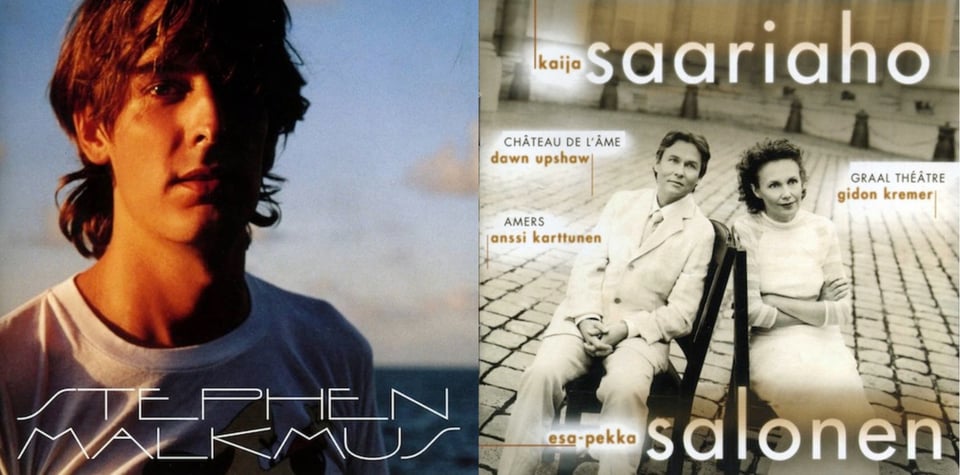
Today’s Best Album of 2001 match is:
#18 Stephen Malkmus, STEPHEN MALKMUS
vs.
#111 Kaija Saariaho & Esa-Pekka Salonen, SAARIAHO: GRAAL THÉÂTRE, CHÂTEAU DE L'ÂME & AMERS
To vote, follow this link to the Google Form. You will need a Google login to vote. If you can’t or won’t have one, let me know ASAP (either through this newsletter, my email [[email protected]] or on the Best Album Brackets Bluesky account) and I’ll see what I can do.
We have one Designated Cheerleader today, it’s from @rzigler.bsky.social, and it’s for SAARIAHO: GRAAL THÉÂTRE, CHÂTEAU DE L'ÂME & AMERS. Take it away, Randall!
When I nominated Sony Classical’s 2001 release featuring works for orchestra with soloists by Finnish composer Kaija Saariaho, Kent’s announcement of the pick said something to this effect:
“Did you read the part in the last newsletter where I said I’d rather have picks that provoke strong emotions, get me out of my comfort zone? [rzigler] said Prove it.”
I wasn’t trying to provoke. I think.
I am a classical musician (whatever that adjective means) by profession, and I wanted to include something that fit under that large and vague umbrella, but the “album” format as we generally think of it complicates that task a bit. After all, there may well have been a fantastic recording of Beethoven’s 7th Symphony released in 2001, but using Beethoven as any kind of representation of 2001’s musical landscape feels like a bit of an odd leap to me. (It’s like the Margo Guryan discrepancy X7.)
Even for more contemporary composers, the album format can be misleading. Broadly speaking, most works like this are composed for concert performance and intended to be accessed by various performers over time, with recordings as a kind of secondary medium well after the fact. This album comes at least close to fitting the bill, with three works by a single composer, all composed and premiered over the course of the previous decade.
All that said, this recording is not here on a technicality. Kaija Saariaho is among the most revered composers of the last 50 years. A 2019 BBC survey named her the greatest living composer, and the Met famously staged her opera L’Amour de loin in 2016 to great acclaim. (Somewhat embarrassingly, the first female composer to be featured in over a century.) She has a fascinating career and has produced a huge amount of incredible work, and I have genuinely loved everything I have heard or performed. So a disc of her work seemed like a natural inclusion here. Like I said, I wasn’t trying to provoke anything in particular.
Mostly.
But I’ve been reflecting on what I know about Saariaho’s career and stylistic development, and she strikes me as an artist committed to expanding her own artistic comfort zone to meet her expressive needs. In her early career, to address the frustrating variability of subpar acoustic spaces, she began experimenting with amplification. She took this a step further after studying at IRCAM, an institute on the cutting edge of electronic and electro-acoustic music and research at the Centre Pompidou in Paris, when she began analyzing the very nature of sound and writing landmark works featuring instrumental ensembles with live electronic manipulation. Saariaho uses this unique palette to evoke naturalistic soundscapes and imagined inner worlds with equal vividness The coloristic and emotional range of these works is absolutely stunning. The album in competition today, regrettably, has no electronics as far as I can tell so I highly recommend checking out her 1986 work Lichtbogen for that. Still, as Saariaho’s orchestral commissions grew larger in scope, her expert orchestration manages to retain a similar textural range, from icy severity to incredible warmth and melodicism.
For all the exploratory restlessness and travels of Saariaho’s career and compositional voice, though, perhaps her most straightforward (and Best-Album-appropriate) advice is right there in the name of a small Finnish society of composers she helped form in her early career in Finland with the mission of studying more modernist-leaning 20th-century strains of music that were under-appreciated in Finland at the time. They called themselves Korvat Auki, which translates to “Ears Open.”
Thank you, Randall!
Click here to see the current results for the entire tournament, and click here to see the current results for the prediction bracket contest.
Yesterday, in a match that was very close until literally the last minute, #79 Fennesz, ENDLESS SUMMER defeated #50 Four Tet, PAUSE, 103-101-6.
Thanks,
Kent
Add a comment: