
#464 The Best Album of 2001, Round 1 Match #34: Pete Yorn vs. Shakira

Hey folks!
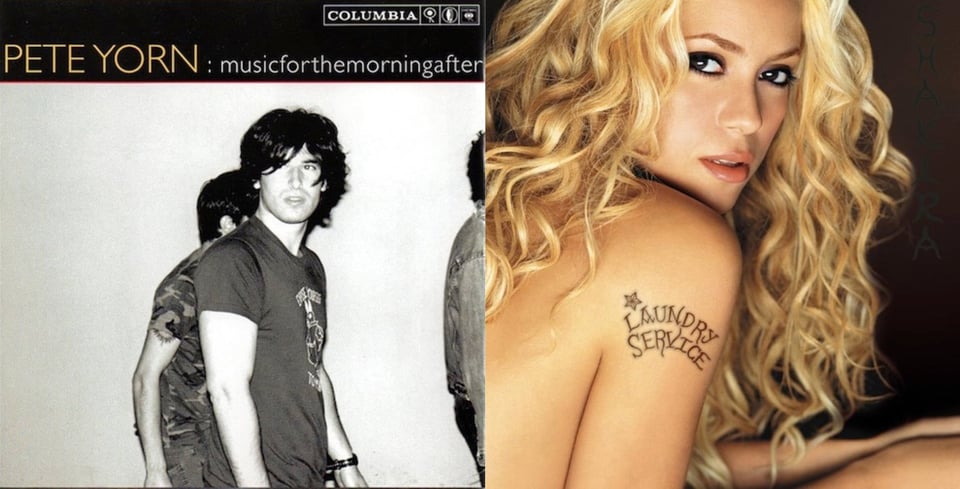
Today’s Best Album of 2001 match is:
#63 Pete Yorn, MUSICFORTHEMORNINGAFTER
vs.
#66 Shakira, LAUNDRY SERVICE
To vote, follow this link to the Google Form. You will need a Google login to vote. If you can’t or won’t have one, let me know ASAP (either through this newsletter, my email [[email protected]] or on the Best Album Brackets Bluesky account) and I’ll see what I can do.
We have dueling Designated Cheerleaders today! First up, for MUSICFORTHEMORNINGAFTER, it’s @RachelAlison.bsky.social. Take it away, Rachel!
My favorite place to buy pants is Madewell. The jeans feel pre-lived-in. Pre-broken. Everything hugs like it’s supposed to and the denim is soft as Mr. Rogers doing ASMR. Sure I have hard pants for hard pants things but generally I don’t mind using a bit of a cheat code to get my jeans to feel like I’ve owned them forever.
muisicforthemorningafter feels like you’ve heard it before even if you haven’t. Some might say that’s what makes it boring. Edgeless. Predictable. I say that’s what gives it it’s charm. It’s comfy jeans straight out of the box.
Pete Yorn’s musicforthemorningafter might be one of The Most 2001 Records in this tournament. The 90’s hangover needed transition acts to ease us all into the 2000’s properly. The Strokes did it by aping their heroes. So too did Pete Yorn. Not the wave of the future. A familiar sound from an unfamiliar face.
The 90’s had plenty of singer-songwriter men. But listening to Pete Yorn didn’t bring to mind Elliott Smith or label-mate Jeff Buckley. musicforthemorningafter was very much on Bruce Springsteen’s Columbia. You can hear The Boss the minute Yorn opens his mouth. The rasp. The conversational tone. The album kicks off with single “Life On a Chain”. The music video for this song (directed by legend Samuel Bayer) is conversational as well. Chill guy playing a chill guitar in a chill bar. You’d wanna hang there on a Tuesday night with a beer while your friend tells you a low-stakes anecdote until you nip out for a smoke.
This isn’t 90’s white guy with a guitar. But it isn’t quite 2000’s indie yet either. This is a temporary pitstop between scenes. A liminal sound for a liminal year.
The whole album is surprisingly cohesive for a young artist. Every track on musicforthemorningafter feels like it belongs to the one that precedes it without veering into overwrought concept album territory. Personally I find him most interesting when he slows it down. His voice goes almost wispy on “Just Another”. I don’t know who was lying wide awake in the garden, trying to get over their stardom, but he makes me want to know more. “Lose You” opens with some distorted audio that sounds like a TV in the apartment next door. It’s the perfect atmosphere for a matter-of-fact breakup song. The drums cut out when he says ‘Cuz I’m gonna lose ya’. This isn’t maudlin. It’s just what is.
(Matter-of-fact tends to be his vocal style. He may be a singer-songwriter but there will be no plaintive wailing. This is hookups and breakups on a high-dose beta blocker.)
“On Your Side” is my favorite Pete Yorn song. The bass feels drowsy. The low-key electronic effects remind me of when LA street lights used to still be sodium yellow. I don’t know how he did it but musically it feels like the lyrics.
I’m outside your house
2AM it’s dark
So many mistakes
Come back home from bars
It’s probably because I was 17 when this album dropped. It’s probably because I was moving to LA to start my life. Take my first forays into adult relationships. How-did-I-end-up-heres? How-much-did-I-drinks? This song, this album sounds like mistakes and bad decisions because that’s what I was doing in my life while this CD was jammed into my Discman. When I was nursing a Bacardi 151 hangover picking grass out of my hair and wondering how I broke my toe, I wanted Pete Yorn to tell me he’s on my side. Even though the way he sings it sounds like resignation. Even though he leaves at the end of the song. Yorn is intentional in his disappointment. A comfort blanket that’s slightly too short and leaves your feet cold.
I don’t think Pete Yorn ever bothered with cool. Nor was he coolly-uncool in a math rock way. He was not era-defining, genre-defining, or even part of the 2000’s zeitgeist for very long. Unlike Rufus Wainwright or noted fuckstick Ryan Adams, he was never gonna be Meet Me in the Bathroom material. He was part of the Largo crowd in the 90’s but that house belongs to Elliott Smith and Jon Brion. Yorn’s affect was lack of affect. Just a dude playing his guitar and assembling an album of 14 tracks that fit together in a wholly satisfying way.
A competent album may not be enough of a reason for many of you to vote for it. Fair. For me? The thing is I can’t pretend I can hear musicforthemorningafter with 2026 ears. I will forever hear it as I did Back Then. A beginner adult with a CD that eventually started skipping around track 6 (“For Nancy”) because I just wore the fucker out. This album wound up being quite literally Music For the Morning After. It was also the bar, the car, and 2AM on the street. That type of connection only calcifies with time. Now this album truly is the familiar friend it posed as 25 years ago. The preternaturally soft jeans that fit just right because you’ve been together so long.
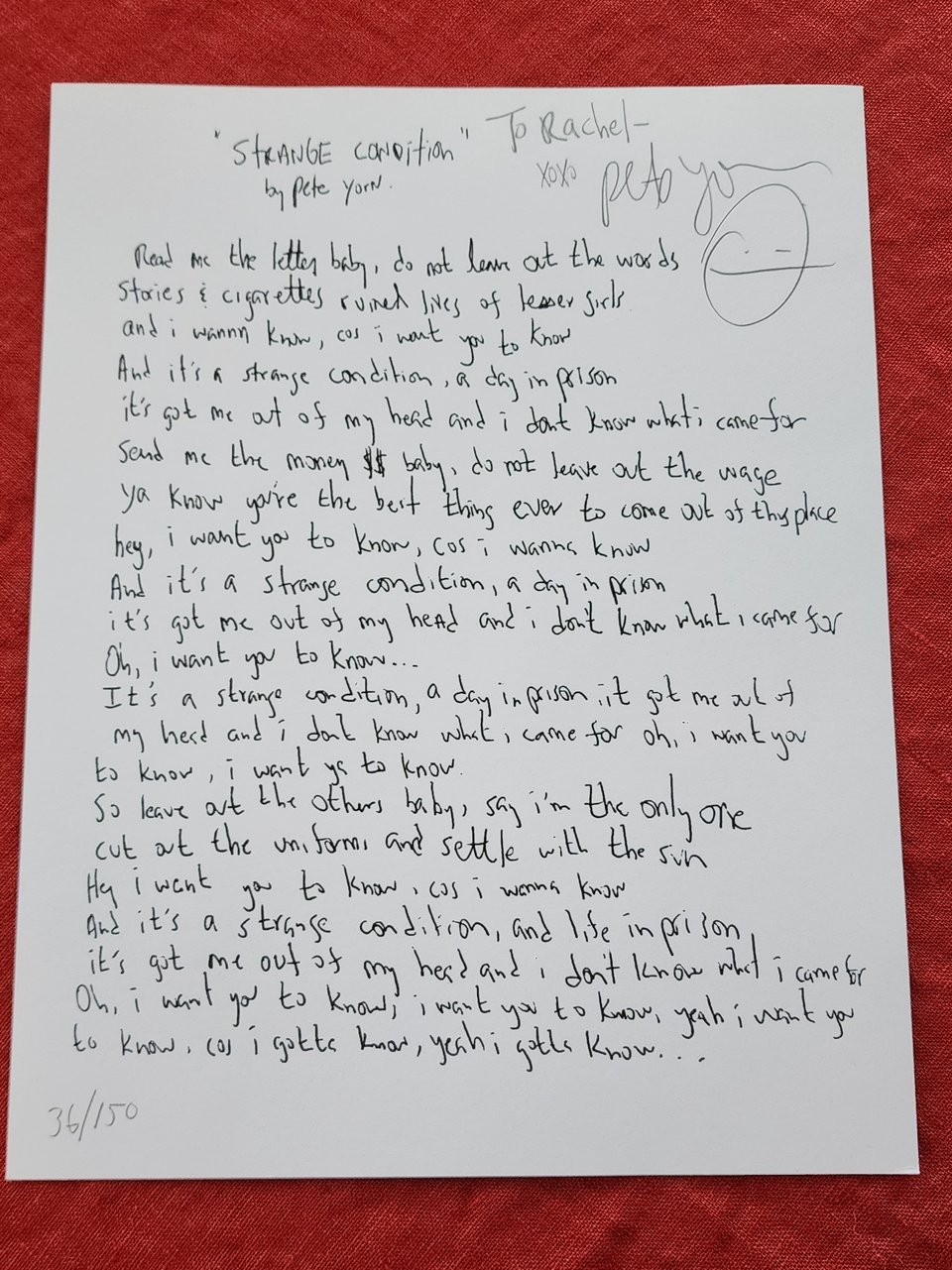
Thank you, Rachel!
Next up, for LAUNDRY SERVICE, it’s @guerrieroc.bsky.social. Take it away, guerrieroc!
Sometime in early 1996, I found a used CD bin at a flea market and in it a copy of Shakira’s 1995 album, PIES DESCALZOS. The first track “Estoy Aquí” was on heavy rotation on Chilean radio at the time, so I decided to pick it up. To this day, it remains my favorite complete album from the Columbian superstar.
On the cover Shakira looks slightly melancholic and she’s staring away from the camera. She has long, very dark hair. She was young, only 18 years old, but this was already her third album. The first two were not successful, but PIES DESCALZOS went on to become a hit in Latin America. While title track “Pies Descalzos, Sueños Blancos” does have heavier guitar, for the most part the songs are structured around Shakira’s acoustic guitar and, of course, her distinctive voice. Her lyrics are quirky, with some truly unexpected turns of phrase.
When she toured in Chile at that time, all of the reviews were positive, but you can find descriptions like “timid,” “tiny” and “sweet balladeer” in them.
Her next album, 1998’s DONDE ESTÁN LOS LADRONES? turned Shakira into a Latin American superstar and a household name. In several of the videos, her long hair is dyed crimson and she’s wearing low rise jeans. She certainly looks more sure of herself, but even in the video to “Ojos Así” the half Spanish-half Arabic song in which she belly dances and moves the hips which would soon be world famous, she doesn’t come across as a “sex bomb.”
(An aside: Shakira’s primary family name is Mebarak; her father’s family was originally from Lebanon. So neither the use of Arabic nor her belly dancing was a sort of appropriation of exotic orientalist tropes, but part of her upbringing.)
Since this is supposed to be a Designated Cheerleader for her 2001 album, LAUNDRY SERVICE, you may be wondering why I am taking the time to tell you about her prior albums and why I’m fixating on her appearance.
I’m doing so because when LAUNDRY SERVICE came out, it caused quite a stir in Latin America. Shakira was now blonde, most definitely sexy and 9 of the 13 songs were in English. “The Britney-Spearification of Shakira!” a headline down here screamed about her new look, and it wasn’t intended as a compliment. “She wants to be a gringa and turn her back on her people.”
Shakira was working with Emilio and Gloria “Miami Sound Machine” Estefan and it was Gloria who suggested that the young Colombian follow in the footsteps of Ricky Martin, who’s self-titled 1999 English album (you may recall “Livin’ the Vida Loca”) had turned him into a breakout star in the States. LAUNDRY SERVICE was a calculated crossover bet and it paid off handsomely, turning Shakira into a global superstar.
In an interview with Billboard, Shakira said that working on the album was “almost like being reborn” but she was very aware of the blowback that LAUNDRY SERVICE received by part of the Latin American public. Apart from her appearance, the album received criticism that it “wasn’t Latino enough,” and was too much of a break from her past music. These are criticisms I have always found curious.
If you go back and listen to PIES DESCALZOS, in my opinion there isn’t a single “obviously Latino” track on the entire album, but it does have flourishes. “Te Espero Sentada” has percussion (hand and metallic) that could have come from Santana or any number of Latin Jazz album, for example. But I maintain that from the cover to the music itself, it’s largely an “indie pop” album that happens to be interpreted in Spanish.
“Ciega, Sordomuda,” the biggest hit from DONDE ESTÁN LOS LADRONES, is unmistakably “latino” with its horns and strings and is undoubtedly “more latino” than anything from PIES DESCALZOS. The combination of hand-percussion and guitarwork in “Moscas en La Casa” also read as Latino. But the rest of the album isn’t overtly so, and the other big hit, previously mentioned “Ojos Así” is partially in Arabic. Stylistically, overall, I’d say this album is more pop, than indie, but several of the tracks would be perfectly at home on PIES.
And that brings us back to LAUNDRY SERVICE. The first track is “Objection (Tango)” with 17 seconds of pure tango, led by the bandoneon, the accordion-like instrument that is one of the unmistakable pillars of the genre. Then the song opens up and mostly goes for straight rock (it even owes a small debt to the B-52’s “Rock Lobster,” I’d say), with the bandoneon always providing a complement to the guitarwork.
“Whenever, Wherever,” the biggest hit from the album has Andean flutes and guitars, so it’s the unmistakably “latino” song this time, equivalent to “Ciega, Sordomuda.” And after that? It gets eclectic (some may call it “unfocused”) and then once again, on the back end we have tracks that could perfectly be included on PIES DESCALZOS (for example, “Te Dejo Madrid” and, language aside, “Poem to a Horse”).
My point here is that LAUNDRY SERVICE has as many obviously “canciones Latinas” as her previous album, and the rest of the songs display a clear through-line to her earlier work. She was being called the “Queen of Latin Pop” by now, but she was never a “straight-forward latina artist,” and most of her tracks continued to be sonically neutral. She wasn’t making a radical break from her previously established style.
That’s something that her pre-established Latin American audience completely missed (at least at the time). Shakira wasn’t trying to be a gringa. The real problem here in Latin America was the language switch, which was disorienting, since most people don’t understand English well enough to understand the lyrics. That was the real source of angst and complaints that she was turning her back on “her people.” And yet she still had included two stand-alone Spanish language songs plus Spanish versions of “Objection (Tango)” and “Whenever, Wherever” on the album; predicably the latter were her big hits down here.
Shakira was not all that fluent in English yet, so some of her lyrics do come across a bit vanilla, but there are still some “very Shakira” turns of phrase on LAUNDRY SERVICE:
In “Objection (Tango)” where she is in competition with another woman, she laments “Objection, I’m tied to this triangle, got dizzy dancing tango.”
In “Whenever, Whereafter”: “Lucky that my lips not only mumble, they spill kisses like a fountain” followed by the incredible line “lucky that my breasts are small and humble, so you don’t confuse ‘em with mountains.” (In case you’re wondering, she says the same thing in Spanish, except her breasts aren’t “humble” there, just “small”).
The song may be called “Poem to a Horse” but it’s not about the animal, it’s about an ex. “I’d rather eat my soup with a fork, or drive a cab in New York, cause to talk to you is harder work… if it’s just the same or even worse, than reading poems to a horse”.
In “Ready for the Good Times” we get “I used to sing the saddest songs, and in the meantime, roaches used to climb my door, falling back down to the floor”.
These are all phrases that could perfectly have come from her prior, Spanish albums. Meanwhile, this fantastic line: “You were the one who bit the apple and rejected Paradise, but you blamed it on the snake even though you wanted to do it” from PIES DESCALZOS, would work just as well on LAUNDRY SERVICE. If you listen to these three albums back-to-back, you can only reach one conclusion in my opinion: both lyrically and musically, Shakira has always been Shakira, no matter what language she sings in.
My only compliant with LAUNDRY SERVICE is that “Eyes Like Yours” the English version of “Ojos Así” is woefully inferior to the original from DONDE ESTAN LOS LADRONES. The less said about the English version the better, but if you haven’t heard the Spanish original, do look for it.
As for the “she’s sexy now” critique… yes, she most certainly is. Watch versions of “Ojos Así” that she performed during her 2002-2023 “Mongoose” tour in support of the album and the belly dancing and hip shaking are quite different from those we saw in the original music video for the song from LADRONES. Sexy, “she-wolf” Shakira has been part of her image ever since. No one would ever call her “timid” again.
Now fast-forward to the present, where Bad Bunny was the most streamed artist on Spotify in 2025. Benito followed Shakira’s path to the Super Bowl Halftime Show but didn’t even bother singing in English on his way to becoming a global icon. Times and attitudes change, but I would argue that without the trailblazing by Shakira (and Ricky, among others), that wouldn’t have been possible. The international success of LAUNDRY SERVICE (and her subsequent albums) paved the way, while remaining true to her prior trajectory.
All hail the “Queen”!
Thank you, guerrieroc!
Click here to see the current results for the entire tournament, and click here to see the current results for the prediction bracket contest.
Yesterday, #2 The Strokes, IS THIS IT defeated #127 Ryan Adams, GOLD, 268-21-4. (That’s not a typo. GOLD got twenty-one votes.)
Thanks,
Kent

Add a comment: