
#451 The Best Album of 2001, Round 1 Match #25: Björk vs. Nas

Hey folks!
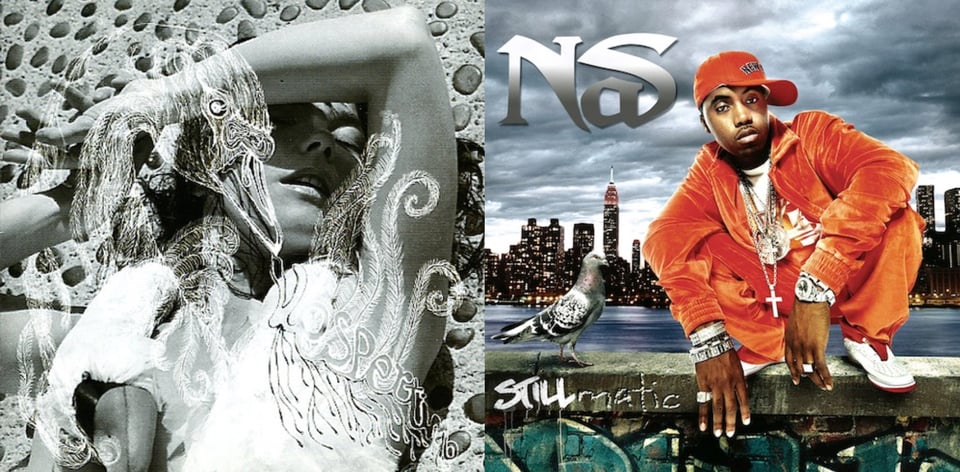
Today’s Best Album of 2001 match is:
#5 Björk, VESPERTINE
vs.
#124 Nas, STILLMATIC
To vote, follow this link to the Google Form. You will need a Google login to vote. If you can’t or won’t have one, let me know ASAP (either through this newsletter, my email [[email protected]] or on the Best Album Brackets Bluesky account) and I’ll see what I can do.
We have dueling Designated Cheerleaders today! First up, it’s @wormsgreenrealm.bsky.social for VESPERTINE. Take it away, Rob!
Bjork’s music is so often about the embodiment in sound of things abstract or unknowable—part of why her sensibilities have proven too abrasive or strange for some—and with Vespertine she attempts, I believe successfully, to capture the sounds of love, a concept music has been intrinsically rooted in expressing for centuries and which she nonetheless gives a novel texture and feeling.
Let’s set aside the biographical detail at the heart of Vespertine (and at the unfortunate broken heart of its eventual companion album Vulnicura). It suffices to say Bjork fell madly in love with a very odd individual (someone who could match her freak, one might unsubtly describe). Vespertine is an account of the emotional, sensual and psychic security resulting from such a rapturous connection.
“Through the warmthest cord of care, your love was sent to me” she intones in the opening lines of “Hidden Place,” a song which perfectly sets the album’s sonic palette with its chirping, chopped, percussive synth sounds gradually blossoming into full-bodied orchestral and choral waves. The song finds Bjork describing a coyness at the heart of newfound affection—a small, fragile thing needing to be obscured and slowly cultivated. Love as a discrete space its participants share in solitude. A cocoon, one might say…
“Cocoon” continues the gentle chirps of the preceding track and builds on a vocal characteristic Bjork will employ throughout the album, an emphasis on breath as vocal instrument that here and occasionally elsewhere approaches the outright sensual or even orgasmic. “Who would have known…miraculous breath…to inhale a beard loaded with courage.” Intense inhalations placed emphatically and aggressively in the mix leave one with no misunderstanding as to the song’s erotic intent.
“It’s Not Up To You,” laced with cascading strings and bells, expresses the unknowability, unexpected nature, of new love; our inability to decide when and where and how one falls into the rapturous place she has just spent the opening tracks describing.
One of the album’s masterpieces, “Undo,” bridges the gap between Bjork’s synthesized avant-pop with her progenitor and eventual contemporary Kate Bush. “It’s not meant to be a strife…it’s not meant to be a struggle uphill,” she sings, alluding to and contrasting against Bush’s most iconic track. Fascinatingly, this is the song Phil Elverum will eventually interpolate and cite in his Mount Eerie song “Voice in Headphones,” a celebration of “Undo”’s power as mantra—to hear Bjork’s earnest, forceful vocal directly into your ears is to feel its physicality, her breaths, and to really internalize the words: to embrace softness, to unfold, to “be in a generous mode.” It is applicable across emotional tapestries but in context with Vespertine as a larger project it expresses the generosity required to embrace love in the face of the hardness and bitterness of heartbreak, and also the softer mode that can emerge in a hardened soul as a result of real affection.
“Pagan Poetry” is, for this listener, a strong contender for Bjork’s greatest song. Playful, intricate, percussive strings build and are joined with buzzing synths and echo-y background vocals as the lyrics recount the placeless beauty of emotional connection, and how that emotional connection is physically manifested—my favorite lyric, one I typeset and print on one of my anniversaries with my partner: “five fingers—they form a pattern, yet to be matched.” The simplicity of interlocked fingers, the simplest expression of affection, granted cosmic potency. But the greatest power, as I’ve not yet even described, is Bjork’s vocal prowess, moving fluidly from whispery nothings to eruptive belting during the song’s chorus.
This song and an interlude, “Frosti,” mark the halfway point of the hefty hourlong album, and its second half proves considerably more abstract and less overtly melodic. In structural conceit it reminds me of Hounds of Love’s Side B pivot toward collage over songsmithery; I find its successes primarily lie in its holistic ambience but I can’t deny the result is something less instantaneously impactful than the album’s first half.
The overall result of the album as an earthy, sense-first, brain-second project is true to Bjork’s overall sensibilities, which are not at their most pop-forward here but nonetheless make for a compelling listen that I think reveals its appeal with a meditative and ambient approach rather than a close-listening one. It expresses vulnerability, physical ecstasy, psychic looseness, generosity—and all at once a simultaneous loss of the self and total recognition of one’s physicality.
I wrote all of this totally off the dome with no reference to any contextual information about the album, and found upon looking at the Wikipedia page that work on the album coincided with Bjork’s work on Lars Von Trier’s Dancer in the Dark, a grim triumph that stands in stark contrast with the mundanely joyous work here yet shares a kind of workflow: where Vespertine centers domestic, bliss, cultivating a kind of operatic romanticism from simple foundations, her Dancer in the Dark music is rooted in literal ambient sounds—machinery, trains, tapping shoes—and erupts these sounds into full-on movie musical worthy bonanzas. Anyone curious about Bjork’s mindset in Vespertine (especially, maybe necessarily, if you like the album lol) would do well to explore it in relation to that film and resultant soundtrack album.
Because I’m no music expert and have a limited understanding and vocabulary with these things, I do hope Vespertine goes on in the competition and will get a defender who can speak more robustly on its musical aesthetics; for the time being, this probably super long defense from vibes alone will have to do.
Thank you, Rob!
Then, for STILLMATIC, it’s by @boxy.bsky.social. Take it away, boxy!
STILLMATIC is Nas attempting a course correction. After his debut album, ILLMATIC (Best Album Brackets 1994 winner), an instant classic that's a lot of people's best hip-hop album ever, his follow-ups were more commercial, more gangsta/mafioso. Nasty Nas, the kid who rhymed about snuffing Jesus, turned into Nas Escobar, the man who rapped about sipping champagne. STILLMATIC was meant to be a return to form.
The first single was 'Got Ur Self a Gun,' with a sample from the Sopranos theme song. Flipping a too-obvious sample is an old trick (see also 'Rapper's Delight,' most of Puffy's big hits, Pusha T dropping bars over the 'Succession' theme, etc.), but it's executed well here.
The big single was 'One Mic'--defiant, defending his place in the pantheon and telling us why that matters. In hindsight, this is the song that makes STILLMATIC a classic hip-hop album.
At the time, though, that song was 'Ether,' and it's not even close. Up to this point, most of the classic dis songs were about how someone stole your rhyme style, they were a fake gangster, or, often, they started it. 'Ether' is a song about a longtime friend who squandered his gift (also, there's a lot of casual homophobia). It's the realest thing Nas ever wrote, it turned 'ether' into a verb, and it's the lyrical apex of the Jay/Nas feud.
Thank you, boxy!
Click here to see the current results for the entire tournament, and click here to see the current results for the prediction bracket contest.
Yesterday, #45 Basement Jaxx, ROOTY defeated #84 Sophie Ellis-Bextor, READ MY LIPS, 123-49-4.
Thanks,
Kent
Add a comment: