The Best Album Brackets logo

The Best Album Brackets

Archives
April 1, 2026

#429 The Best Album of 2001, Round 1 Match #8: Ben Folds vs. The Langley Schools Music Project

Best Album Brackets Logo #2.jpg

Hey folks!

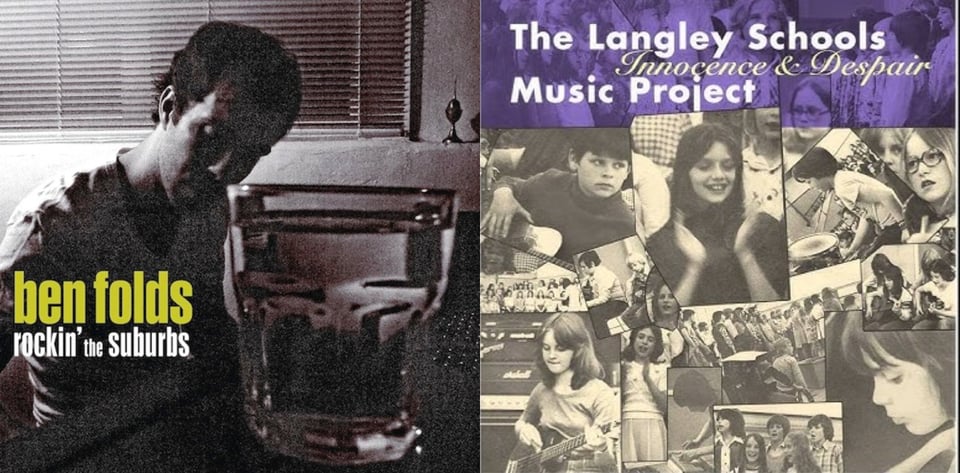
First pic: A moody black and white photo of Ben Folds, a skinny man with short black hair who has a kind of dapper look even though he's just wearing a t-shirt. He is at a piano, thoughtfully staring at the keys. In the extreme foreground, taking up most of the image, is a glass of liquid on top of the piano. Behind him is a window with horizontal blinds. Second pic: A collage of black and white photographs of children of various ages, probably around 8-12 years old. Some of them are playing instruments like guitar and bass and drums, some are clapping, some are grouped together singing.
Ben Folds, ROCKIN' THE SUBURBS vs. The Langley Schools Music Project, INNOCENCE AND DESPAIR

Today’s Best Album of 2001 match is:

#48 Ben Folds, ROCKIN' THE SUBURBS

Listen on Spotify or YouTube

vs.

#81 The Langley Schools Music Project, INNOCENCE AND DESPAIR

Listen on Spotify or YouTube

To vote, follow this link to the Google Form. You will need a Google login to vote. If you can’t or won’t have one, let me know ASAP (either through this newsletter, my email [kentmbeeson@hey.com] or on the Best Album Brackets Bluesky account) and I’ll see what I can do.

We have not one, not two, not three, but four Designated Cheerleader today. Three are for Ben Folds, and normally I’d hold off with two of those until Round 2, but we’ve already lost one 40-something seed to an 80-something seed; who’s to say it won’t happen again? So apologies for the length of this newsletter - it could get cut off.

Here’s DC #1, for ROCKIN’ THE SUBURBS, from @atcl.bsky.social. Take it away, All The City Lights!

My sense is that people have mostly made up their minds about Ben Folds. Anybody who is pretty sure that they’re just not going to enjoy “piano pop for the alternative nation” isn’t going to find anything on Rockin’ the Suburbs to change their mind. Anybody who is a fan of such things, they already count this among their all-time favorite albums. But maybe—maybe—dear reader, you are someone who heard “Brick” on the radio in 1997 and didn’t hate it but weren’t quite in the mood for a mournful ballad that day, and you haven’t given Folds another thought since. Perhaps you will be pleasantly surprised by the fast cascading arpeggios that open “Zak and Sara” and say to yourself, “Hold on, this kind of … rocks?”

Which is not to say that there are not mournful ballads on this album. There are. Several. Folds really doesn’t break any new ground on his solo debut, released two years after the breakup of Ben Folds Five. It’s still mostly piano, distorted bass, and drums. There is a sense of click-track precision and Pro Tools layering that you didn’t have when Robert Sledge and Darren Jessee were in the mix, which makes me wish this were the fourth Ben Folds Five album. But that is mitigated by the fact that this is one of the strongest collections of songs that Folds has ever penned.

Folds has always thrived doing sad-sack character studies. He outdoes himself here. Half the 12 tracks have names in the titles: Annie, Fred, Stan, Lisa, Cathy, Zak spelled without a C, Sara spelled without an H. They include lonelyhearts and suicides, forced-retiree cranks and sell-out boomers, douchey boyfriends and problematic girlfriends, including one who walks the line between clairvoyance and schizophrenia. Each one is a rich portrait, fully formed in under 5 minutes.

Let’s talk about the title track. It sticks out like a sore thumb. It is surely an effective satire of the aggro self-absorption of the era that gave us Limp Bizkit and Woodstock ’99. If these elements had come to confluence just a couple years later, Folds could have released it as a standalone iTunes single and maintained a much more consistent tone for the album. Alas.

The is the first appearance in the tournament of an album released on September 11 (there are four by my count?), and for me it was the soundtrack of those weeks following the attacks. I had been awaiting its release and had plans to go to Best Buy on my lunchbreak that Tuesday to buy a copy. My job as a reporter, even at a small-town paper, meant that I basically didn’t have a chance to breathe until Thursday evening, which is when I finally managed to pop the CD into my Discman. I sat on the banks of a river that marked the U.S.-Canadian border, listening to “Not the Same.” Even though it is admittedly a true-story song about a dude who got high at a party and became a born-again Christian, it seemed more profound in that moment. It still does.

Thank you, ATCL! Next up, it’s @msmucker.bsky.social for INNOCENCE AND DESPAIR. Since this one is in-depth, and care has been taken with the formatting, I’m going to reproduce it here as a series of images.
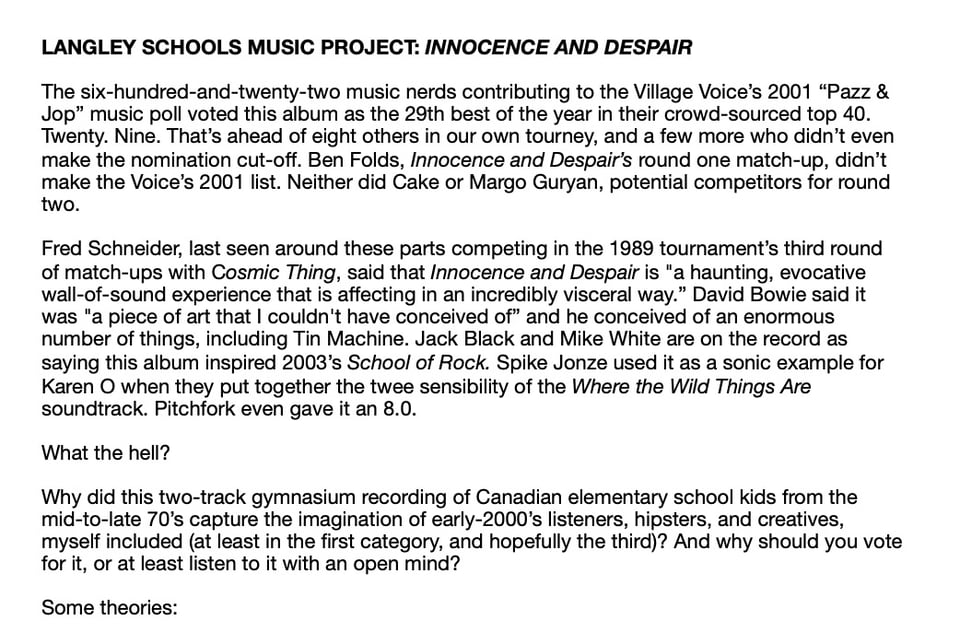
LANGLEY SCHOOLS MUSIC PROJECT: INNOCENCE AND DESPAIR
The six-hundred-and-twenty-two music nerds contributing to the Village Voice's 2001 "Pazz &
Jop" music poll voted this album as the 29th best of the year in their crowd-sourced top 40.
Twenty. Nine. That's ahead of eight others in our own tourney, and a few more who didn't even
make the nomination cut-off. Ben Folds, Innocence and Despair's round one match-up, didn't
make the Voice's 2001 list. Neither did Cake or Margo Guryan, potential competitors for round
two.
Fred Schneider, last seen around these parts competing in the 1989 tournament's third round
of match-ups with Cosmic Thing, said that Innocence and Despair is "a haunting, evocative
wall-of-sound experience that is affecting in an incredibly visceral way." David Bowie said it
was "a piece of art that I couldn't have conceived of" and he conceived of an enormous
number of things, including Tin Machine. Jack Black and Mike White are on the record as
saying this album inspired 2003's School of Rock. Spike Jonze used it as a sonic example for
Karen O when they put together the twee sensibility of the Where the Wild Things Are
soundtrack. Pitchfork even gave it an 8.0.
What the hell?
Why did this two-track gymnasium recording of Canadian elementary school kids from the
mid-to-late 70's capture the imagination of early-2000's listeners, hipsters, and creatives,
myself included (at least in the first category, and hopefully the third)? And why should you vote
for it, or at least listen to it with an open mind?
Some theories:
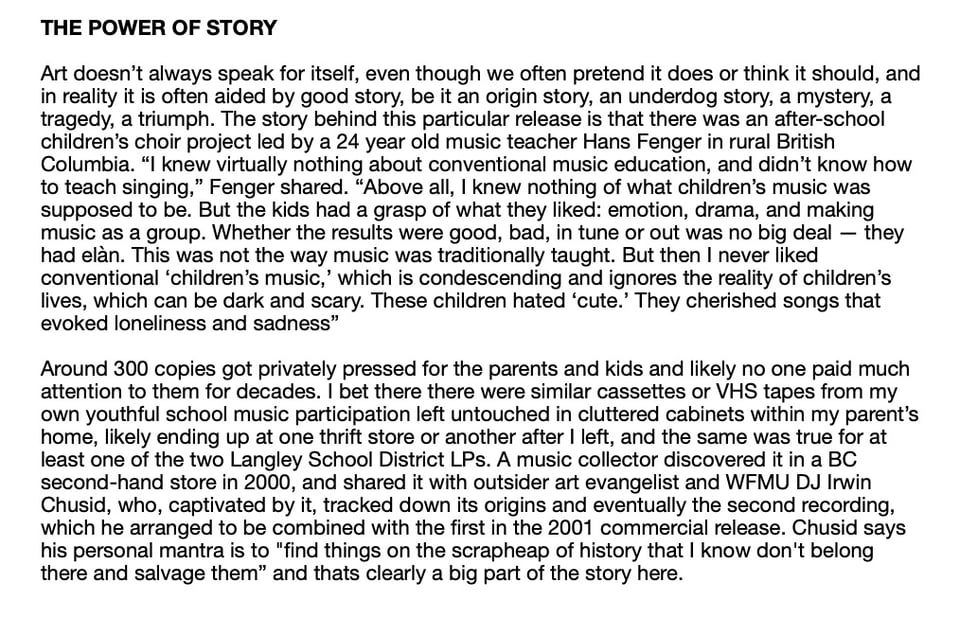
THE POWER OF STORY
Art doesn't always speak for itself, even though we often pretend it does or think it should, and
in reality it is often aided by good story, be it an origin story, an underdog story, a mystery, a
tragedy, a triumph. The story behind this particular release is that there was an after-school
children's choir project led by a 24 year old music teacher Hans Fenger in rural British
Columbia. "I knew virtually nothing about conventional music education, and didn't know how
to teach singing," Fenger shared. "Above all, I knew nothing of what children's music was
supposed to be. But the kids had a grasp of what they liked: emotion, drama, and making
music as a group. Whether the results were good, bad, in tune or out was no big deal - they
had elan. This was not the way music was traditionally taught. But then I never liked
conventional 'children's music,' which is condescending and ignores the reality of children's
lives, which can be dark and scary. These children hated 'cute.' They cherished songs that
evoked loneliness and sadness"
Around 300 copies got privately pressed for the parents and kids and likely no one paid much
attention to them for decades. I bet there there were similar cassettes or VHS tapes from my
own youthful school music participation left untouched in cluttered cabinets within my parent's
home, likely ending up at one thrift store or another after I left, and the same was true for at
least one of the two Langley School District LPs. A music collector discovered it in a BC
second-hand store in 2000, and shared it with outsider art evangelist and WMU DJ Irwin
Chusid, who, captivated by it, tracked down its origins and eventually the second recording,
which he arranged to be combined with the first in the 2001 commercial release. Chusid says
his personal mantra is to "find things on the scrapheap of history that I know don't belong
there and salvage them" and thats clearly a big part of the story here.
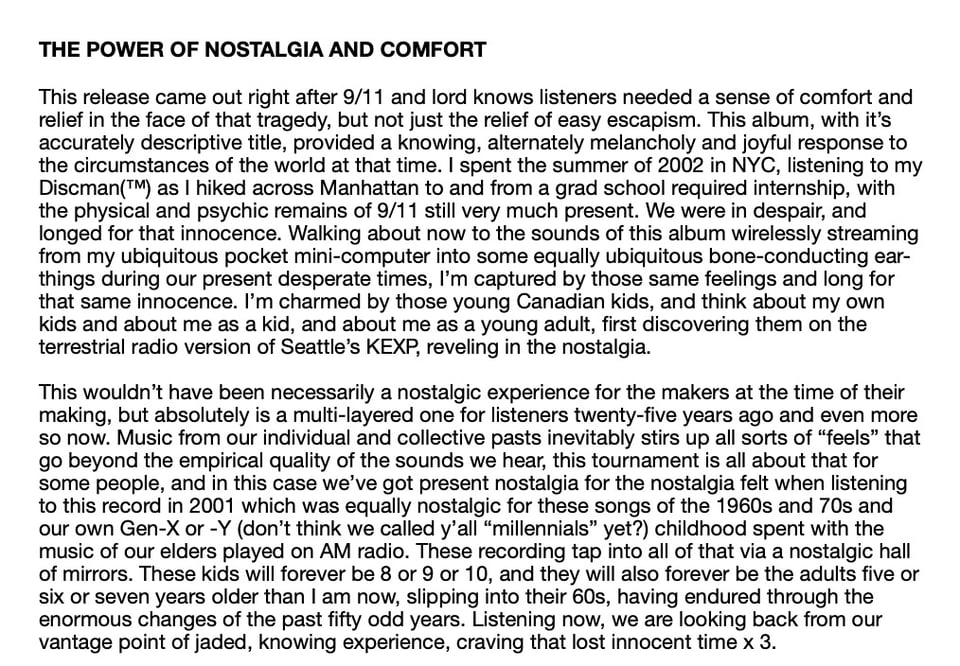
THE POWER OF NOSTALGIA AND COMFORT
This release came out right after 9/11 and lord knows listeners needed a sense of comfort and
relief in the face of that tragedy, but not just the relief of easy escapism. This album, with it's
accurately descriptive title, provided a knowing, alternately melancholy and joyful response to
the circumstances of the world at that time. I spent the summer of 2002 in NYC, listening to my
Discman(™M) as I hiked across Manhattan to and from a grad school required internship, with
the physical and psychic remains of 9/11 still very much present. We were in despair, and
longed for that innocence. Walking about now to the sounds of this album wirelessly streaming
from my ubiquitous pocket mini-computer into some equally ubiquitous bone-conducting ear-
things during our present desperate times, I'm captured by those same feelings and long for
that same innocence. I'm charmed by those young Canadian kids, and think about my own
kids and about me as a kid, and about me as a young adult, first discovering them on the
terrestrial radio version of Seattle's EXP, reveling in the nostalgia.
This wouldn't have been necessarily a nostalgic experience for the makers at the time of their
making, but absolutely is a multi-layered one for listeners twenty-five years ago and even more
so now. Music from our individual and collective pasts inevitably stirs up all sorts of "feels" that
go beyond the empirical quality of the sounds we hear, this tournament is all about that for
some people, and in this case we've got present nostalgia for the nostalgia felt when listening
to this record in 2001 which was equally nostalgic for these songs of the 1960s and 70s and
our own Gen-X or -Y (don't think we called y'all "millennials" yet?) childhood spent with the
music of our elders played on AM radio. These recording tap into all of that via a nostalgic hall
of mirrors. These kids will forever be 8 or 9 or 10, and they will also forever be the adults five or
six or seven years older than I am now, slipping into their 60s, having endured through the
enormous changes of the past fifty odd years. Listening now, we are looking back from our
vantage point of jaded, knowing experience, craving that lost innocent time × 3.
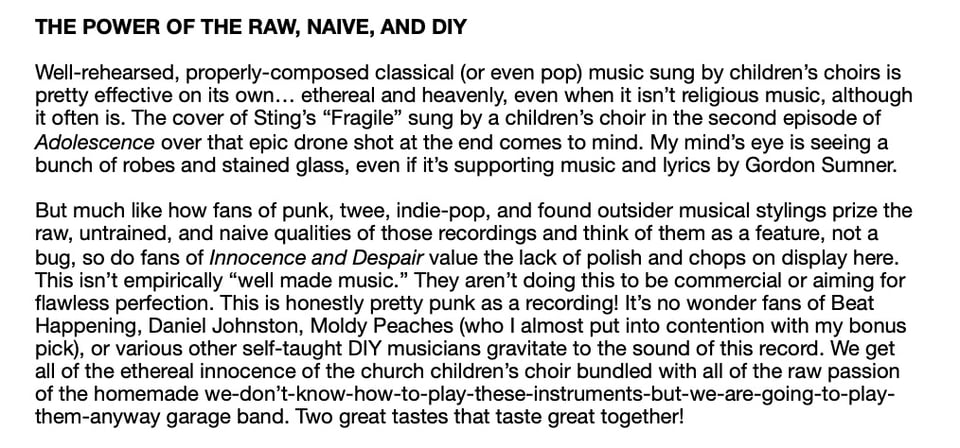
THE POWER OF THE RAW, NAIVE, AND DIY
Well-rehearsed, properly-composed classical (or even pop) music sung by children's choirs is
pretty effective on its own... ethereal and heavenly, even when it isn't religious music, although
it often is. The cover of Sting's "Fragile" sung by a children's choir in the second episode of
Adolescence over that epic drone shot at the end comes to mind. My mind's eye is seeing a
bunch of robes and stained glass, even if it's supporting music and lyrics by Gordon Sumner.
But much like how fans of punk, twee, indie-pop, and found outsider musical stylings prize the
raw, untrained, and naive qualities of those recordings and think of them as a feature, not a
bug, so do fans of Innocence and Despair value the lack of polish and chops on display here.
This isn't empirically "well made music." They aren't doing this to be commercial or aiming for
flawless perfection. This is honestly pretty punk as a recording! It's no wonder fans of Beat
Happening, Daniel Johnston, Moldy Peaches (who I almost put into contention with my bonus
pick), or various other self-taught DIY musicians gravitate to the sound of this record. We get
all of the ethereal innocence of the church children's choir bundled with all of the raw passion
of the homemade we-don't-know-how-to-play-these-instruments-but-we-are-going-to-play-
them-anyway garage band. Two great tastes that taste great together!
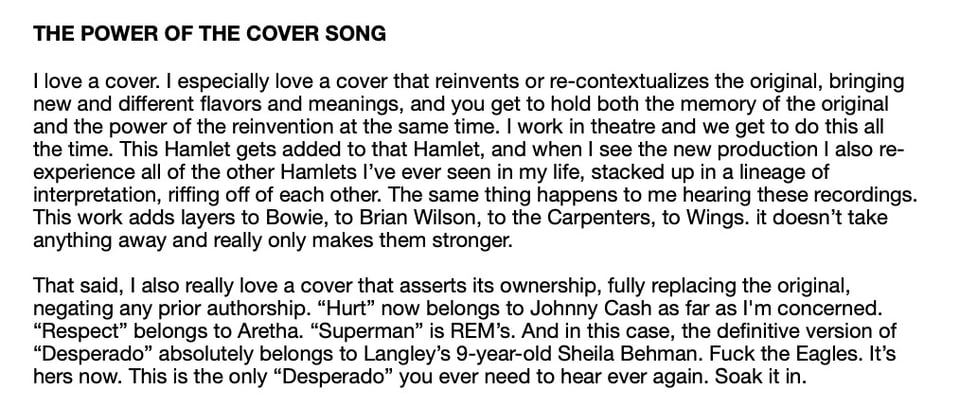
THE POWER OF THE COVER SONG
[love a cover. I especially love a cover that reinvents or re-contextualizes the original, bringing
new and different flavors and meanings, and you get to hold both the memory of the original
and the power of the reinvention at the same time. I work in theatre and we get to do this all
the time. This Hamlet gets added to that Hamlet, and when I see the new production I also re-
experience all of the other Hamlets l've ever seen in my life, stacked up in a lineage of
interpretation, riffing off of each other. The same thing happens to me hearing these recordings.
This work adds layers to Bowie, to Brian Wilson, to the Carpenters, to Wings. it doesn't take
anything away and really only makes them stronger.
That said, I also really love a cover that asserts its ownership, fully replacing the original,
negating any prior authorship. "Hurt" now belongs to Johnny Cash as far as I'm concerned.
"Respect" belongs to Aretha. ' "Superman" is REM's. And in this case, the definitive version of
"Desperado" absolutely belongs to Langley's 9-year-old Sheila Behman. Fuck the Eagles. It's
hers now. This is the only "Desperado" you ever need to hear ever again. Soak it in.
SUMMATION
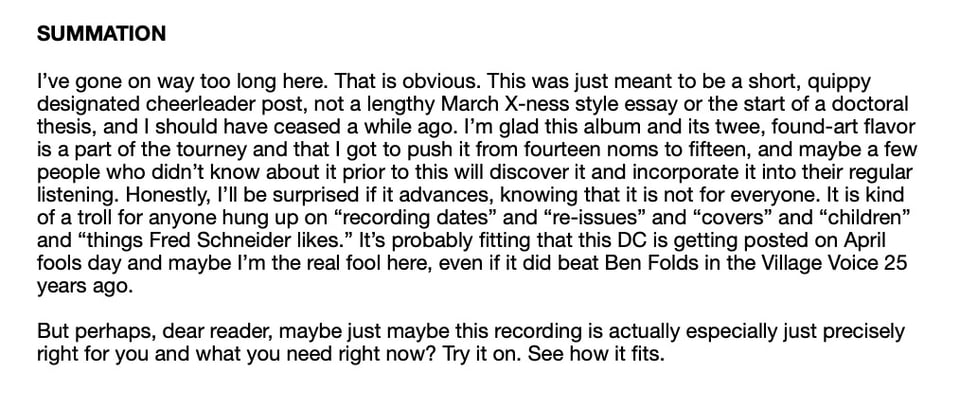
I've gone on way too long here. That is obvious. This was just meant to be a short, quippy
designated cheerleader post, not a lengthy March X-ness style essay or the start of a doctoral
thesis, and I should have ceased a while ago. I'm glad this album and its twee, found-art flavor
is a part of the tourney and that I got to push it from fourteen noms to fifteen, and maybe a few
people who didn't know about it prior to this will discover it and incorporate it into their regular
listening. Honestly, I'II be surprised if it advances, knowing that it is not for everyone. It is kind
of a troll for anyone hung up on "recording dates" and "re-issues" and "covers" and "children"
and "things Fred Schneider likes." It's probably fitting that this DC is getting posted on April
fools day and maybe I'm the real fool here, even if it did beat Ben Folds in the Village Voice 25
years ago.
But perhaps, dear reader, maybe just maybe this recording is actually especially just precisely
right for you and what you need right now? Try it on. See how it fits.

Thank you, Matthew!

Now, here’s the second DC for Ben Folds, this one by @mrfasthorse.bsky.social. Take it away, Mr. Fasthorse!

Fresh off the breakup of Ben Folds Five, the frontman produced a solo album with his "punk rock for sissies," pop piano supporting sometimes funny and often empathetic character sketches, with (occasionally distorted) bass guitar and drums handled by the man himself this time. The songs offer scenes of characters mixing larger anxieties into mundane suburban circumstances - will my boyfriend be home soon (and am I the object of unrequited love)? Can I afford this guitar amp (and is my girlfriend mentally unstable)? Do you want roast beef with fries (and was I wrong to bring another life into the world to suffer the pains of adolescence)? Do I want a cheeky tab of acid (and do I accept Jesus Christ my lord and savior)?

The album is a 60/40 mix of pop and ballads. Among the ballads Fred Jones Part 2 stands out, distilling the loneliness and sorrow baked into the forced retirement of a loyal company man, a returning character from a Ben Folds Five song. The Luckiest is a sweet meditation on the concept of soul mates, ironic for a guy who’d been twice divorced by 2001, and has tallied up two more since then. The pop songs are uptempo and catchy, with the clever melodies, soaring bridges, quippy lyrics, and piano fills that defined the niche the Five filled in pop rock in the late 90’s. The plucky bass and harmonies in the chorus of Losing Lisa to me have a little flavor of 70’s Paul McCartney, who is obviously a huge influence throughout Folds’ discography.

Not everything on the album ages perfectly 25 years on. Zak and Sara hits some now-overdone Manic Pixie Dreamgirl tropes (though at the time of its release Garden State wouldn’t come out for another 3 years). The title track itself is cringey if not problematic. A piano-based parody of Nu Metal isn’t quite elevated Weird Al territory (though Weird is a sometimes collaborator), and the racial politics of the song were probably tone deaf even for 2001 (Folds claims he’s playing a character, you be the judge). Though this was the title track and the first single, it feels more like a novelty song than a representative of an album of more mature songwriting.

Of Folds’ solo work, I give Songs for Silverman the slight edge over this one, though Pitchfork disagrees. At the very least, this Sept 11, 2001 release (no, really) album assured us that the breakup of Ben Folds Five wouldn’t deprive us of these continued introspective time capsule piano-pop character sketches into the aughts.

Thank you, @mrfasthorse!

And finally, here’s the third ROCKIN’ THE SUBURBS DC that just in came from in @robbiebuffalo.bsky.social hours before this newsletter went out. Again, I could hold it; the odds of ROCKIN’ THE SUBURBS winning are good. But what if it lost? Then I was sitting on a relevant DC I could’ve published but didn’t. I would end up publishing it anyway, but I’d rather have these “live” while the albums are, tournamently-speaking, relevant. Take it away, Robbie!

For Ben Folds' first solo album, he did something he had never done with Ben Folds Five: he titled his album after one of its songs. It was a strange choice because:

- "Rockin' The Suburbs" sounds nothing like the rest of the album and definitely sounds like something someone at a label would suggest because they wanted a "single" (I realized I am basically quoting Tom Petty's "Into the Great Wide Open" now)
- "Rockin' The Suburbs" is easily the worst song on the album. It dials up all of Folds' most irritating qualities to 11. It was dated when it was released and has only gotten more so.

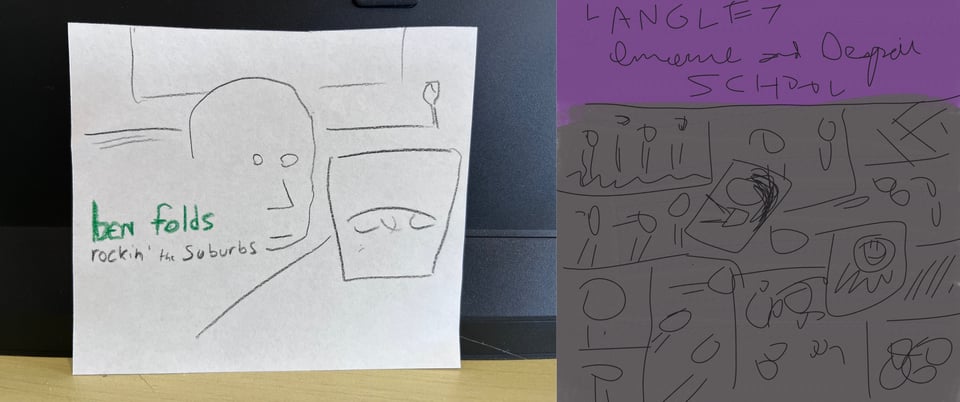
But I'd encourage people to look past this and listen to the rest of the album, which in spirit matches the cover art much more closely than the album title. This is a more pensive, restrained album, eschewing the bloated arrangements of THE UNAUTHORIZED BIOGRAPHY OF REINHOLD MESSNER for more straightforward singer-songwriter material. Six of the first eight songs include a person's name, a shift from his more self-centered lyrics from his records with Ben Folds Five. These songs focus on catching a specific moment in the lives of seemingly ordinary people.

The opening song, "Annie Waits" is one of Folds' best songs, managing to be catchy and melodic without being cloying or overworked. It sets the tone for a record where Folds trusts his core songwriting skills, bouncing from more upbeat pop-rock songs ("Zak and Sara" and "Losing Lisa") to more introspective ballads ("Fred Jones Part 2" and "The Ascent of Stan"). Maybe you'll find the sentiment of "Still Fighting It" corny but as someone raising kids now, it hits close to the bone. "Not The Same" is another of my favorites, turning the story of someone's bad trip into a soaring chorus.

When ROCKIN' THE SUBURBS was first released I enjoyed it but didn't find it grabbing me in the same way as his records with Ben Folds Five. But over the last 25 years, it's unquestionably the Ben Folds record I come back to the most. I've seen a lot of griping by some people about the more down-the-middle albums in this tournament. This will be the first (and likely not the last) DC I write supporting one of these albums. I like challenging, original music too. But ultimately I think many people underrate albums that are powered by well-written and well-performed songs. ROCKIN' THE SUBURBS is that type of album.

Thank you, @robbiebuffalo.bsky.social!

Click here to see the current results for the entire tournament, and click here to see the current results for the prediction bracket contest.

Yesterday, #17 Cake, COMFORT EAGLE defeated #112 Margo Guryan, 25 DEMOS, 136-82-3.

Thanks,

Kent
Don't miss what's next. Subscribe to The Best Album Brackets:

Add a comment:

Powered by Buttondown, the easiest way to start and grow your newsletter.