
Story Rug
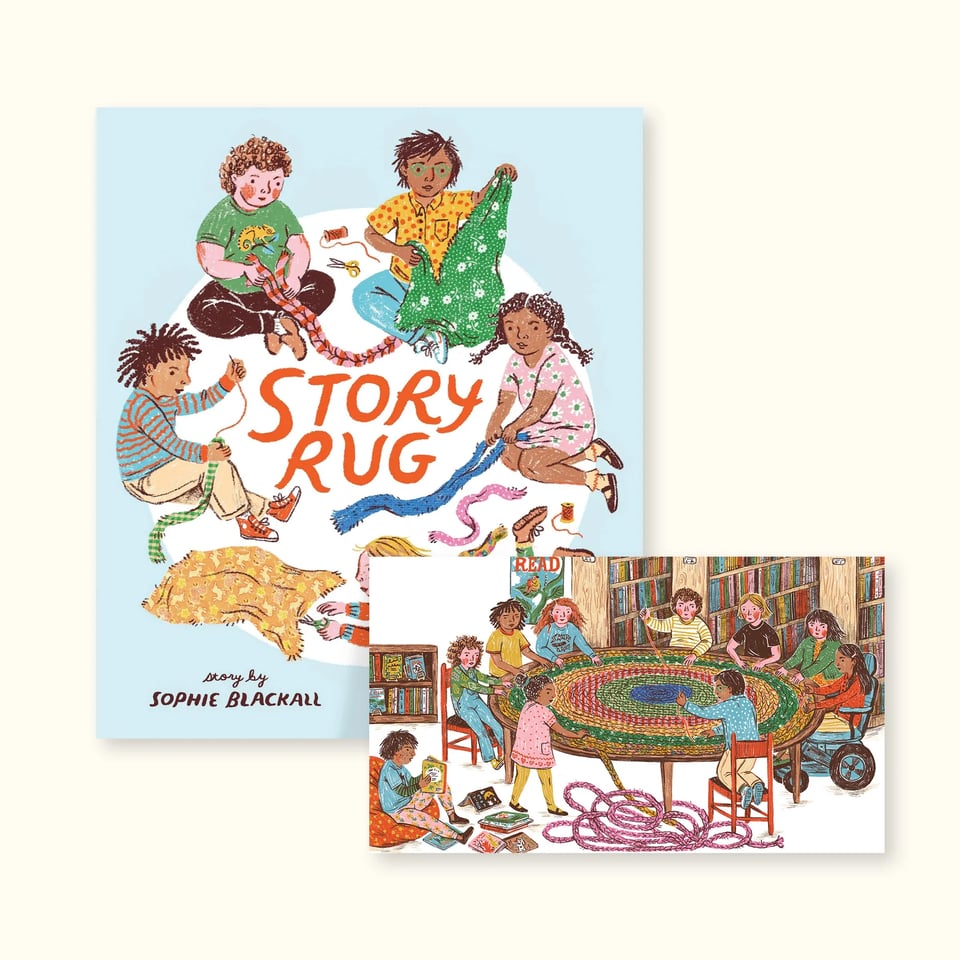
Mail came for Maeve today. A new book from one of our favourite illustrators, Phoebe Wahl, called “Story Rug”. A gift from me, celebrating a big chapter for her. It’s a story about a classroom of kids who become obsessed with braiding, but it’s also a story about about stories. How we tell them, where they live, how their materiality is made and unmade and woven together by entangled histories.
I’ve been on a winding river with work. Making hard choices that have made me confront the intersection of values, responsibilities, capacity, and identity. I recently had to ask myself, “if in 15 years Maeve comes to you asking about this time in your life, and you tell her the story of what has just happened, what do you want to happen next in the story? How do you respond? And what does that response, that next action, teach her about her relationship to herself? To the world around her?” Why is it so much easier to invoke a future perspective when making choices in the present?
Before having Maeve, so many of my inner stories were told from the past, or from the present to the past. Having Maeve, I find myself shifting to telling stories to the present from the future. So much of my doctoral research about intergenerational trauma is really about how stories move between generations. Having a daughter, my generational position has shifted and with it my psyche’s narrative voice.
Reading “Story Rug” had me thinking about the materiality of some of the my own stories and my shifting perspective within them. There was a rare thunder storm in St. John’s this week. It was scary and exciting. I held Maeve on my hip and we watched the lightening crack across the sky, perched in the open doorway of the kitchen. I told her about my great Aunt Helen, who I always think of in thunder storms. And I thought about all the parts of that story that were left unspoken in a phrase like “she had a hard life”, and all the somatic charge of experiencing this moment with my daughter, remembering my great aunt and all the stories that carry forward.
And “Story Rug” in particular, had me thinking about the things that carry our stories. The rug, the lightening. From an essay I wrote:
“Materials can capture our most intimate memories, reflecting back to us, in undulating somatic detail, the emotional vividness of the past […] These forms of mediation include verbal and nonverbal mediums, and are textured by the layering dissonances and harmonies between what is said and what is unsaid, that Foucaultian archive that accumulates between langue and corpus (Foucault & Sheridan 1972, pp. 130). Indeed, Hirsch reminds us that “the language of the family” is “the language of the body: nonverbal and precognitive acts of transfer occur most clearly within a familial space” (2012, pp. 34). Materials, as nonverbal entities, are apt vessels for the “nonverbal and precognitive” transfers amongst families.”
There’s so much to say about “Story Rug” and all it brought up for me, but I thought I’d share some of the writings on material cultures that have helped me think about the texture of intergenerational memory that I’ve loved teaching, writing with, and revisiting this week: