rejection
in her most recent newsletter, Deborah wrote about becoming an art ho and about being an artist who is married to an artist, which in practice means being a ho married to a ho.
one of the things she writes about in the newsletter is how, before we met, when i was applying to MFA programs and i got rejections, which i did from almost everywhere i applied, i would scan the rejection letters and post them to my Tumblr. i think the best one was from the most prestigious MFA program for fiction writers and poets, the Iowa Writers' Workshop,
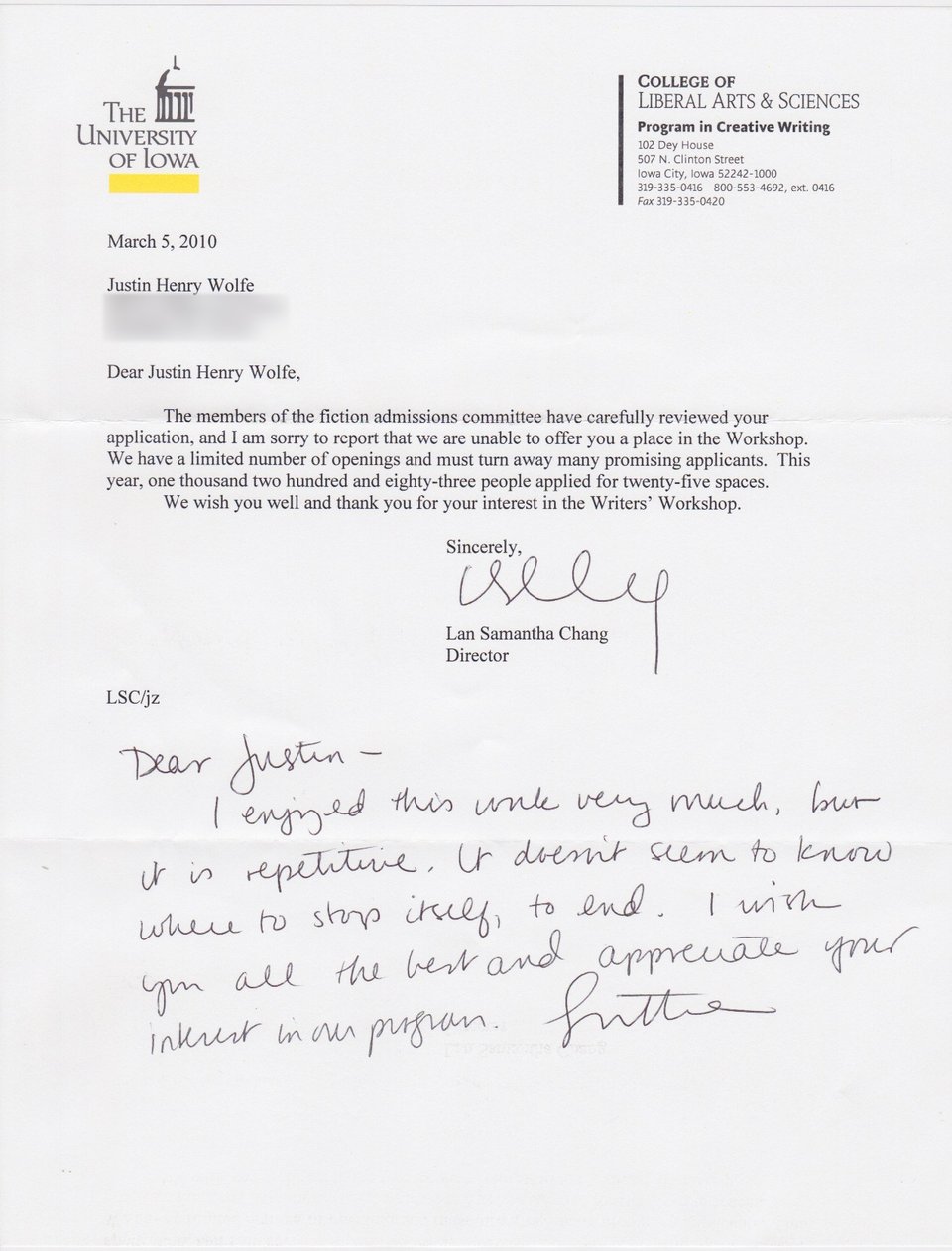
after i posted it, i remember somebody DMing me to say "wow, you should be so proud, you got a handwritten rejection from Lan Samantha Chang!!!" and i was like "sure and that and a dollar will get me a Snickers bar."
when i think about why i was posting those rejections back then, in one sense, it was just standard wallowing and depression. in another sense, i think i wanted to make my community feel aggrieved on my behalf? not to a toxic stan-army-doxxing-and-swatting level but like in the way that all of these smart cool people reading my Tumblr thought i was a great writer (that's why they were clicking the heart button!!!) and so they would feel righteous indignation on my behalf at my rejection by these ivory tower idiots and this would make me feel better about myself.
but, if i'm honest, it was mostly because i could make a post out of a rejection letter with very little work and all i wanted in life was to make more posts and most of my posts at that time took a lot of work, so i was happy to take an an easy one where i could get it, especially considering the exhausting level of labor and selling yourself required to complete each ultimately unsuccessful application (in that sense, viewed another way, i "worked" very hard on those posts). i don't think i quite have clinical poster's disease, which includes a comorbidity of smarm that i hope i don't present with, but i do have some kind of terminal condition in the same diagnostic family.
part of the reason i was even applying to MFA programs was another rejection, the year before. after returning to the US from Korea with no more coherent a career plan than i'd had before i left, i had basically pinned all my future life hopes on getting an internship at the podcast This American Life that i was sure i was a shoe-in to get and i would move to New York, where there was also a girl i had a crush on, for the summer, and then everything i kind of expected about me being a star would just kind of happen from there?
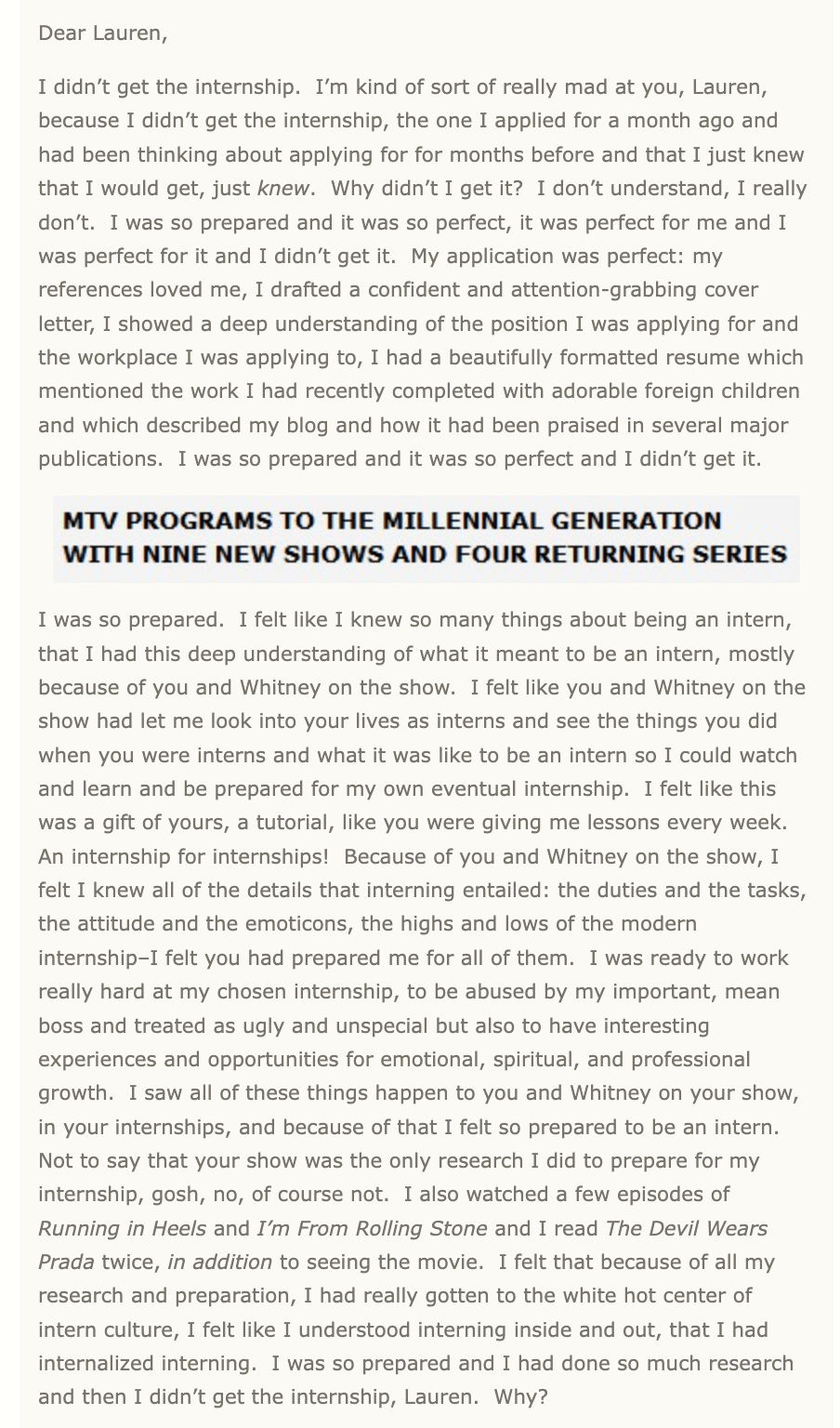
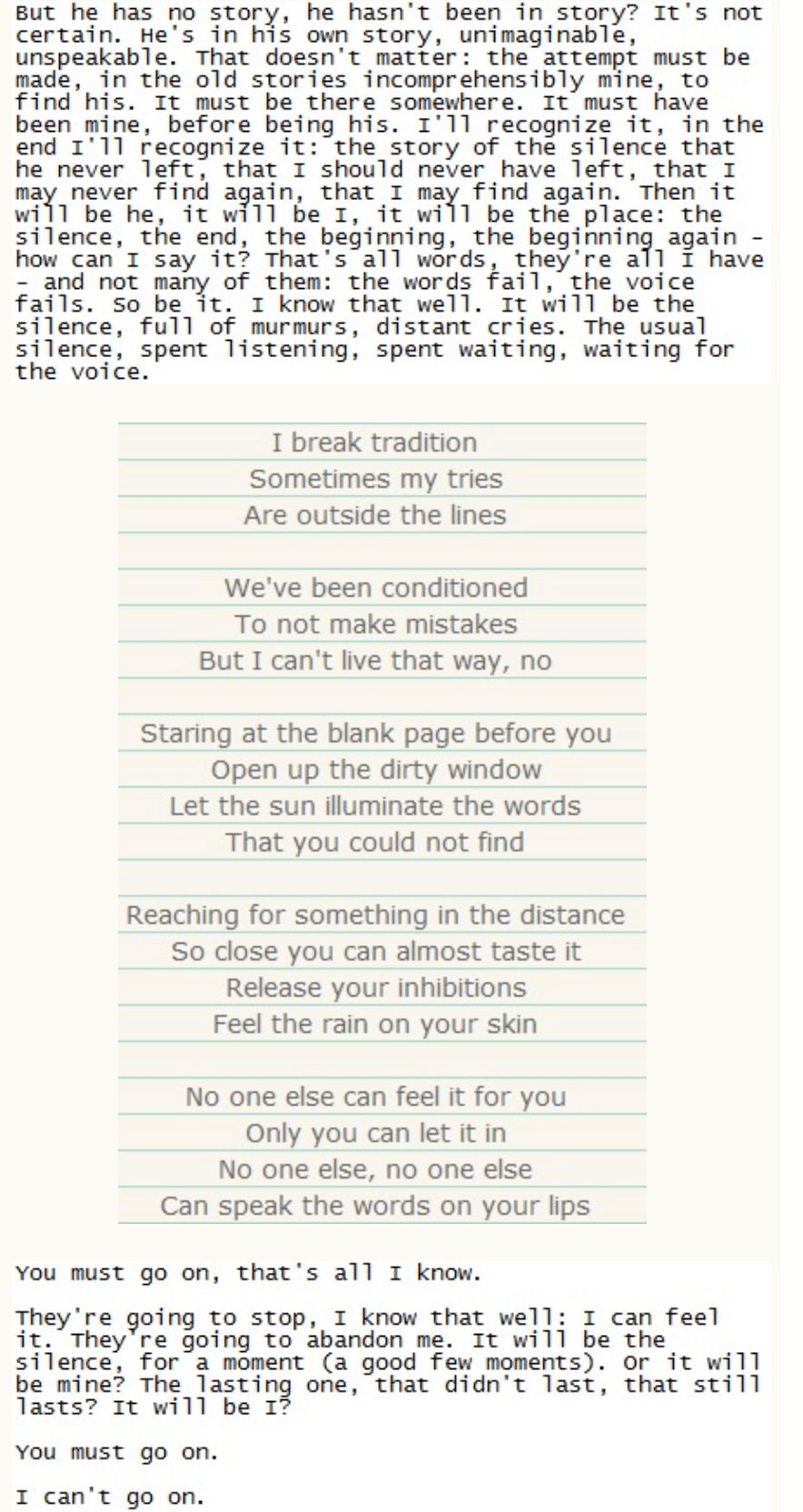
in actuality, i did not even get an interview lol. upon finding out i was rejected, already sloping off towards my breakdown, i wrote an insane open letter to Lauren Conrad about what an idiot i was (above) and how i was specifically the kind of idiot i was because of how i'd freebased the representation of intern culture on her television show. the post i wrote, in one of the most "me" gestures possible at this time, ended with a coda juxtaposing the lyrics to Natasha Bedingfield's, "Unwritten" with fragments of Samuel Beckett's The Unnamable.
(a couple of years later, a producer from TAL emailed me and said "I think you'd be a good fit on the show in some capacity. It just might take a little while to figure out what that capacity might be" and spoilers you're reading this here because i did not turn out to be a good fit on the show in some capacity! i have not really listened to the show since then, which was first out of spite and now is because that developed into a kind of psychological complex where i cannot make myself listen to "produced/written" podcasts that are more than just people loosely chatting.)
in France, university graduates can take the agrégation, a rigorous exam qualifying them as experts in their field who would work as teachers, university lecturers, or other kinds of civil servants: it is the path to being part of the academic elite, seemingly kind of like Teach For America but in a country that actually believes in the capacity of the state to do good for its citizens. the Emily Eakin book i'm reading goes through how the biggest names in 20th century philosophy were destroyed by the agrégation. Derrida failed the exam the first two times he tried; the second time, on a sweaty cocktail of amphetamines and sleeping pills, he only turned in a blank sheet of paper (and this was not some kind of point about authorship, he just froze). Claude Lévi-Strauss was also high for his exam:
In 1931, he passed the philosophy agrégation. Like nearly everyone else in our story, Lévi-Strauss recalled the experience as one of inhuman ordeal and unexpected triumph. He spent the seven hours before the oral exam violently sick from a drug—morphine? cocaine? he never knew what, exactly—prescribed for his nerves by a doctor who was a family friend. "I appeared before the jury looking like death, without having to have been able to prepare a thing, and improvised a lecture that was considered brilliant, in which I believe I spoke of nothing but Spinoza," he said later.
but unlike Derrida, he passed (the spring semester of my sophomore year, i took a gravity bong hit before the final exam in my first contemporary literature class because i was that confident in the power of my mind, so game recognize game). Lacan, one of the two most important psychoanalysts of all time, also failed the agrégation after criticizing the work of a mentor and, unlike the rest of his peers, he rejected the rejection and didn't keep trying to become a part of the official system of knowledge in that way (it didn't matter; as the book indicates, his seminars were eventually so well-attended that Althusser forced him to move them because the volume of cigarette smoke emanating from the packed lecture hall was so great it was damaging books in the library).
despite my numerous rejections, i eventually did get into two MFA programs with full funding (Alabama and Indiana). i didn't post the acceptance letters to my Tumblr, even though they would have been just as easy content as rejections, and i think in part that was because i was raised to be humble and not brag but also because i was embarrassed that these were the schools i was accepted to, in two places i had never been or thought about and and did not really want to ever go? which speaks to a flyover country type elitism in me from reading too much New York media internet at a formative time and always all my life having some Princess Diaries fantasy that i was going to become discovered as a successful and critically acclaimed artist.
eventually, i decided, pretty arbitrarily if i'm being honest, to go to Indiana. i will always be grateful for the time i spent in the MFA program there. it was my first real experience of social adulthood (in Korea and in Miami, i was a friendless loner). surrounded by smart people who were interested in the same things i was and who saw and respected my skill as a writer and a reader, as well as liked me as a person. finally, i had a Life. i really flourished and in many ways became the version of myself i wanted to be. i read and wrote a ton of stuff and learned so much. and, of course, most importantly, i met the love of my life. we started dating in a fiction workshop where the first story i turned in was completely torn to shreds by the professor. our initial texts with each other were sent the night after a particular three hour workshop in the fall which started with CD, her close friend, sitting next to me as a gesture of friendship and solidarity after CD's story had been similarly ripped a new one by the professor, and me ignoring that and rudely asking her to move because i was saving the seat for Deborah, who i had a crush on. we went on our first date later that week, to buy a birthday gift for her father.
so in some ways, the MFA program was really great and, on the other hand, it also kind of...completely destroyed my writing and creative process for several years? which, i don't want to overly romanticize my relationship with my work BMFA (before MFA) as being this perfect Edenic thing, but by the end of it, i could just never get all these other voices talking about my work out of my head, couldn't stop seeing the inside of the sausage factory while reading stories, couldn't find a pure way to love my own work in the way that, for all my problems, i truly had before graduate education. i sporadically did bits and pieces of things, mostly instrumental songs, but i wasn't able to get back to anything that felt like the relationship i had with writing before the MFA for several years, until i started this newsletter you're reading.
Deborah's newsletter has a great section about the strange mental strain you have to deal with when applying and interviewing for a job, where in order to make yourself do the hard work required to best represent yourself and possibly get the job, you kind of have to imagine a future where you have gotten it and, for a time in the interview process, kind of live in that space in your mind, as though it's real, just beyond the edge of your grasp? but this fantasy life that you build for yourself out of necessity only makes it all the more crushing if you don't get the job (and, in terms of numbers, you usually don't get the job).
Deborah's post is a lot about how rejection works within her mind, not just outside. we generally think of rejection as an external process, something that some "other" does to you in cases like a job application or submission of a poem to a literary magazine or not subscribing to your newsletter or whatever. but, know your symptom: you are always your first and foremost rejector! just like the candidate interviewing for a job who must fantasize about the job with them in it in order to be good enough to get it, when we try to make art, we have to believe in some possible future state in which the work is good and whole and complete in the way we've glimpsed in our mind's eye. however, at the same time, looking at the object before us, what we often see is all the ways in which it is lacking and inadequate and bad (there is a good Ira Glass quote about this but i'm not putting it in bc of my vendetta) and those feelings can drive us to abandon and reject it, to crumple up the piece of paper and throw it into the trash can. i think one of the essential problems of being an artist is the degree to which you feel that dissonance between the ideal and the actual in your work and what it does to you, whether the rejection in your own heart puts you into a state of paralysis or whether you can find a way back to loving yourself and the things you make (which is the first step to getting others to love them). i lost it for a while (and i'll lose it again) but i'm proof that if you keep trying, in some form or another, you can get it back*.
Elsewhere
- comics from Lena and Edith (if you're on desktop, use the (difficult to see) arrows to navigate through the panels)
- apologies to Luda but i think my favorite song with the word "ho" in it is "Shine Blockas" by Big Boi ft. Gucci
- we were walking past a little free library yesterday and Deborah spied a copy of Rejection by (Iowa graduate) Tony Tulathimutte, which she hasn't read yet, so she took it home. as someone who was completely stripped of the ability to enjoy short fiction by my time in an MFA program, this book brought me so much pleasure and laughter.
* (and that and a dollar will get you a Snickers bar, but that's a problem for another day. Deborah's hyper-prolific friend NS recently put this to her in a way that i thought was nice, which was: "the reward is the expression and everything else is extra")