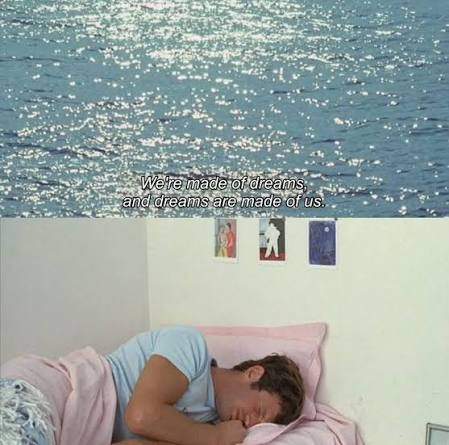
histoires du cinéma
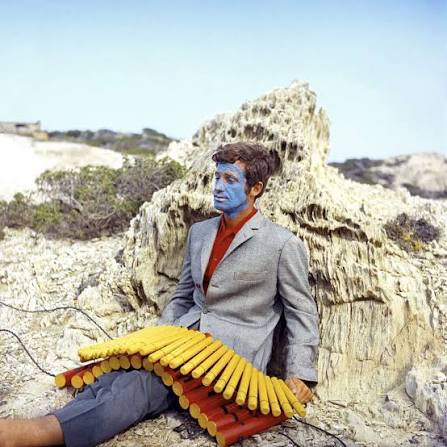
my first job, the summer between high school and college, was working at a movie theater. for the interview, i remember my mom making me wear the one shirt i owned that had a collar and buttons, which was a polyester guayabera i’d bought at a vintage store in Jacksonville. the job was fine as far as first jobs go. aside from cleaning the popcorn machine at the end of the night, which required basically climbing into a large hot glass box radiating fake butter grease and scrubbing it endlessly with a harsh cleaning product, the only thing that was ever really unpleasant for me about the job was running the cash register during peak times, which challenged both my social anxiety and limited facility with math. otherwise, i was content vacuuming carpets and cleaning windows and changing the syrup bags for the drink dispenser (we would fill little paper cups with pebble ice and then soak them in syrup as a treat for ourselves) and, more than anything, sweeping up sticky floor trash by myself in the dark as the credits of something played for the 50th time (that was the summer of Finding Nemo and i mostly worked day shifts, so i heard the song “Beyond The Sea” a lot).
i didn’t have any friends, i had not yet discovered drugs and alcohol, and i didn’t have to pay for movie tickets anymore, so i mostly saved my paychecks for school, aside from a) buying greasy slices of pizza or calzone for lunch at the Italian place in the same plaza as the movie theater and b) buying used CDs at the music store in the same plaza as the movie theater. as the end of the summer approached, though, i decided there were a bunch of movies films i needed to see in order to better myself. the previous spring, i had interviewed for and gotten one of the slots in the (relatively) exclusive film school at the large state university i was to attend with free tuition on a lottery-funded scholarship. at this point, i had, across late night viewings/DVR recordings of the IFC and Sundance channels, seen pretty decent coverage of the independent art film canon from the late 80s onward, but there were significant gaps in my knowledge i had to address to be the cineaste i thought i needed to be, so i spent more money than i ever had in my life up to that point and mail-ordered a bunch of Criterion Collection DVDs. i don’t remember everything i got, but i know at the very least it included: Breathless (Godard), Alphaville (Godard), Jules and Jim (Truffaut), The 400 Blows (Truffaut), 8 ½ (Fellini), La Dolce Vita (Fellini), The Seventh Seal (Bergman), and Wild Strawberries (Bergman).
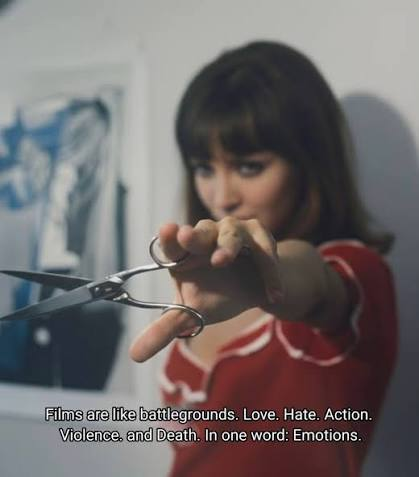
Geoff Dyer has a perfect short book, Zona, which is a liveblog of him watching and reflecting on the film Stalker by Andrei Tarkovsky. there’s a particular footnote about how we appreciate (and lose the ability to appreciate) the new in art that’s maybe my favorite part of the book. I’ve referenced and quoted it in my newsletters before, but never typed it out in full, so here it is:
It wasn’t just an LSD phase; it was also a phase of intense cinemagoing and I have no doubt that my high opinion of Stalker…no, let me rephrase that, the prominent place occupied in my consciousness by Stalker is almost certainly bound up with the fact that I saw it at a particular time in my life. I suspect it is rare for anyone to see their—what they consider to be the—greatest film after the age of thirty. After forty it’s extremely unlikely. After fifty, impossible. The films you see as a child and in your early teens—Where Eagles Dare, The Italian Job—have such a special place in your affections that it’s all but impossible to consider them objectively (you have, moreover, no desire to do so). To try to disentangle their individual merits or shortcomings, to see them as a disinterested adult, is like trying to come to a definitive assessment of your own childhood: impossible because what you are contemplating and trying to gauge is a formative part of the person attempting the assessment. Gradually, usually in your late teens and early twenties, you start to watch the major works of the medium. At first it is difficult to make sense of these alleged masterpieces: they are too different, often too boring and challenging. I did the bulk of my serious film-watching as an undergraduate at Oxford, at the Penultimate Picture Palace and the Phoenix, back in the days when there was a late screening every night. By the time I saw Stalker I was ready to sit through it even if I was not able to enjoy it. I understood enough—barely enough—of the grammar and history of cinema to see how they were being enlarged, adapted, and extended by Tarkovsky. Not that the experience could be confined to the compartment or file called ‘cinema.’ My capacity for wonder was also being subtly enlarged and changed. At the same time, however, that capacity was also being permanently limited or defined in the same way that reading Tolstoy enlarges and, by so doing, definitively limits one’s capacity for future enlargement, revelation, and astonishment in the realm of fiction. Of course you can still enjoy Tarantino after Tarkovsky, can see that he is doing something new; you can see that Harmony Korine is doing something new with Gummo, or Andrea Arnold with Fish Tank. Of course, of course. But by the time I was thirty, approximately eight years after seeing Stalker for the first time, the potential of cinema to expand perception—or at least my own potential to appreciate and respond to, to perceive such an expansion—had been so vastly reduced as to seem negligible. For people older than me the expansion had been achieved by Godard; for Godard’s generation by Wells or (though this now seems hard to credit) Samuel Fuller…For people younger than me it may well have been Tarantino or the witless Coen brothers. To them Tarkovsky may have the slightly outmoded or taken-for-granted quality that Godard had for me.
Some further refinement—or labouring—of this point is necessary. It happens that the phase of my getting into serious cinema—in my late teens and early and mid twenties, from the mid-1970s onward—overlapped with the intensely creative period of what might be called mainstream independent filmmaking, when American directors, having absorbed the influences of the European auteurs, carved out the freedom to realize their cinematic ambitions. I saw Taxi Driver when it was first released, and Apocalypse Now (and Jaws and Star Wars, which, together with the financial catastrophe of Heaven’s Gate, heralded the end of this phase.)
I saw Stalker slightly later but I saw it when it came out, within a month of its release, when Tarkovsky was at his artistic peak. I saw it, so to speak, live. And this means that I saw it in a slightly different way from how a twenty four-year-old might see it for the first time now, in 2012. So much so that the film I saw was slightly different from the one that a twenty four-year-old would see now, in 2012. Obviously the difference is not as acute as it would be if you saw a band today who were at their peak twenty years ago. The thing, the product, the work of art stays the same but by staying the same it ages—and changes. It exists now in the wake of its own reputation, not quite in the way that Citizen Kane does, not only as a monument to itself, but trailing clouds of its own glory. And it exists also in the wake of everything that has come in its wake, both the films that have been influenced by it (that’s why Citizen Kane is both ageless and incredibly old-looking; practically everything seems to have come after it) and the ones that treat it with tacit disdain and contempt (Lock, Stock, and Two—tediously—Smoking Barrels). The facts are unalterable. When I first saw Stalker, it was brand new, the latest thing. I also saw Pulp Fiction live, as soon as it came out, but I didn’t see it as I saw Stalker, when I was at that point of maximum responsiveness or aliveness, when my ability to respond to the medium was still so vulnerable and susceptible to being changed and shaped by what I was seeing. At a certain point, even if you keep up-to-date with new releases (books, records, films), even if you keep broadening your horizons, even if you manage to keep up with the latest things, you realize that these latest things can never be more than that, that they stand almost no chance of being the last word, because you actually heard—or saw or read—your personal last word years earlier.
here’s me digesting the nightmare he so poignantly described, from another newsletter a long time ago, when i was still very young:
I don't want to believe this is true and my dad just sent me an email the other day asking for a new way to download music, because the "album name + mediafire" search formula I had taught him didn't work anymore, but I feel like it kind of is true, already, for me, and I'm only twenty six (if you're much older than me, you will probably find this sentence cutely stupid ("aww, he thinks he has problems with aging!") and if you're much younger than me, you probably won't feel it as deeply yet)(or maybe not, maybe I did feel it then, too, and I just can't remember, the way sepia nostalgia makes every landscape warmer as you try to re-see it, but I don't remember feeling it). At least for some things, it feels true to me now; writing is the artistic medium that's most important to me and I feel like I still have the enlarging and perception shaping experiences with literature that Dyer describes. I don't have them as often or as intensely as I did when I was, say, in college, since I don't have the patience or time or ability to concentrate I had when I was just a few years younger, but I still have them (I've had some of them in the past year, with Dyer's books) regularly enough to keep believing.
In the other mediums, though, in visual art and especially in film and music, things are so much more closed off for me, I find. My friend J.K. and I are more into art films than the other people in our group of friends, but mostly, we've found, that means we were into film at an earlier, more formative stage in our life. Even if somewhat less so than we once would have, we still see new and interesting things—most recently Pina for me, the whole Haneke ouevre for her—and we talk about the new things to each other, but our discussions always, ultimately, inevitably seem to circle back to Fellini and Godard and Truffaut and Bresson and Bergman and all the other people who were important to us in college, the images burned so deep into our cortexes that on some level it's impossible to stop seeing them. In the spring of last year, we took a seminar about representations of art history in film together where we both saw Tarkovsky for the first time—Andrei Rublev and Solaris—and for both of us, the experience of his work, was meaningful and important, was life-changing, but the change it made to my life has limits that I don't think it would have if I experienced it, say, five years ago; the summer after that class, remembering with my closed eyes how the image of a vat of blown out molten metal swelling under a ringing bell near the end of Andrei Rublev had made me feel earlier in the spring, I downloaded a torrent of Stalker and tried to watch it; I think I made it through about ten minutes before I shut it off and went back to the Internet.
i was thinking of this passage from Zona and of Godard (though I didn’t remember that it actually mentioned Godard) because over the weekend, we tried to watch Godard’s 1965 film Pierrot Le Fou. of late, Deborah and I have been taking turns choosing movies to screen for each other. the list we draw from is loose and idiosyncratic: sometimes they’re movies that are important to one of us but not known by the other and sometimes things we both haven’t seen but always wanted to and sometimes things we both have seen and want to revisit together.
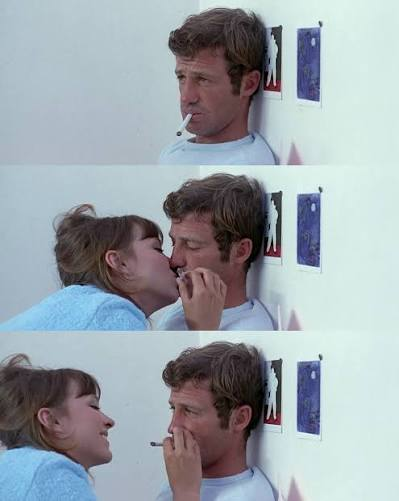
this weekend, the two best movies we watched from the list were Cruel Intentions and (the original) Dawn of The Dead. i had seen them both, though Dawn of The Dead was much more present in my memory as someone for whom cult horror was my original teenage entry point into the universe of art and world cinema. i think i had only ever previously seen Cruel Intentions in a bowdlerized basic cable version on MTV on a weekend afternoon and somehow misremembered it as including a girl getting an orgasm from a horseback riding lesson, which i kept waiting for (turns out that is from the sequel). both movies were still very enjoyable, though it was also strange watching them because of how clear it was that the television shows we both watched later for many more hours than these films stripped them for parts. Gossip Girl is just a YA-ified network TV dupe of Cruel Intentions: the tone, the thematic preoccupations, even things like the editing rhythm and score. The Walking Dead never had its characters literally occupy a shopping mall, i don’t think (i watched all 500 seasons of prepper torture porn at some point) but every other possible thing it could have borrowed from Dawn of the Dead, it did.
the movie that I stopped halfway through and said “okay, I’m calling it here” because we were clearly both not enjoying it at all and there was still an hour left and life is short, was Pierrot Le Fou. this was not the outcome i was expecting! to rewind, of my initial Criterion Closet selection the summer before college, i didn’t like a lot of the classic movies even then when my brain was (according to Dyer) most ready to receive them and also not yet rotted by my phone. Bergman felt too boring and old-timey (maybe if i had seen Persona first it would have been different with him). i liked Fellini’s visuals and his narrative slippages between dream and reality but La Dolce Vita didn’t really set my world on fire the way i had expected it to by reading descriptions of it from people whose world it set on fire at the time of release (8½ i loved, though i had the misfortune of having seen Stardust Memories, Woody Allen’s cover version of it, first and in some ways liking that more despite knowing it’s worse 💀). Truffaut was the one I was really hyped and ready to be changed by (especially after romantic dalliances with selections of Éric Rohmer’s work late night on Sundance and having a crush on a French New Wave-obsessed classmate i met at film school orientation earlier in the summer) but the films of his I saw did nothing for me at the time. in retrospect, i think maybe it’s that the directorial moves that were revolutionary in his early work had been so fully absorbed into the mainstream Hollywood cinema of my childhood and adolescence that i had already seen them a million times by the time i got to Jean-Pierre Léaud jumping into a freeze frame.
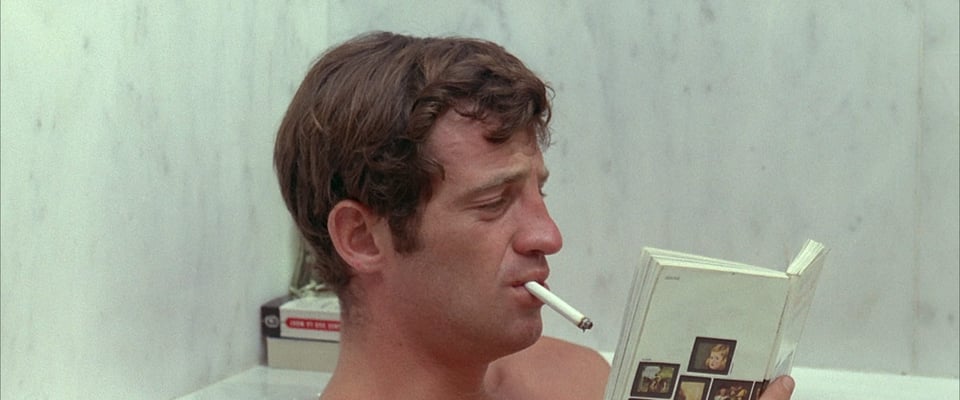
Godard, though, Godard had not been absorbed by the mainstream (other than in his invention of the jump cut, which most other directors used much more shallowly, as an effect rather than as a structure). Godard was exactly the revelation i wanted, his movies were just so fucking smart and cool. the first time I watched Breathless, a black and white film from 1960 (before the first season of Mad Men takes place!) about a guy who shoots a motorcycle cop and then hides out with an American student in Paris, my mind was blown. it was decades old but felt as vital as anything i’d ever seen: not just a rendering of a narrative, but also an essay, and also a painting, and also poetry, and also the sound of the radio, all of it coming through the broad channel of the film which was never just concerned with simple obvious naturalism. a problem i have always had with myself as a writer, even in fiction but especially in nonfiction, is that i have never been very good at being elliptical or mysterious or multivalent or polyvocal; it’s one of the reasons i’m a failed (and envious) poet. whenever you read something i wrote, you generally leave knowing exactly what i think and if someone asked you “so what was that about,” you’d have a straightforward answer (even if it might be a long one because i stuff so much shit in or an unsatisfying one because i often trail off at the end of something because i can’t fathom spending more time writing it). whereas a lot of the art i admire most and wish i felt more able to make is stuff that fills you with questions and personal interpretations, drives you to feel “wait what was that even about?” or to have like 4 possible answers to that question.
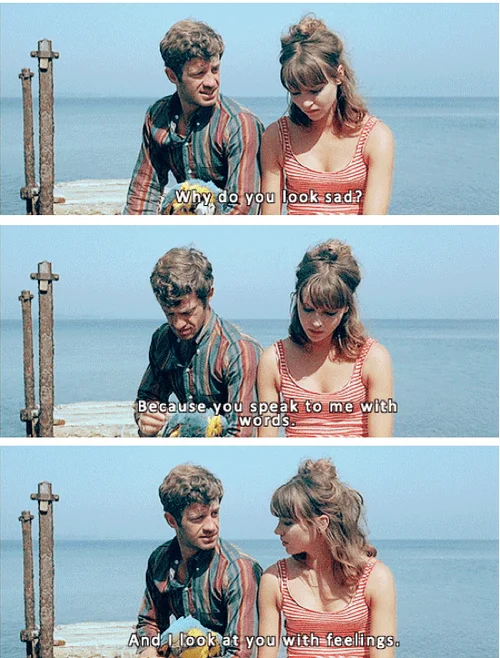
so at first I was going to show Deborah Breathless as her intro to Godard, since it’s my favorite, but then I thought (lesson: don’t think! always trust your gut!) maybe it would be more fun if it was a movie i hadn’t seen either. i knew that was risky, since even for people who like Godard, there is the Maoist period where he is not known for providing (was not trying to provide!) any cinematic pleasure (which i respect but also he will probably not have his 80s Dylan -type reevaluation). Pierrot Le Fou, a crime film set in the wake of the Algerian revolution, is from the peak period in the sixties where Godard was dropping one mind-blowing, game-changing thing after another (this comes after Masculin Feminin and before Alphaville). i had never seen it outside of a few still frames and all i knew about it was that it was really beautiful in terms of its use of Cinemascope color and was supposed to be one of the more accessible of his works.
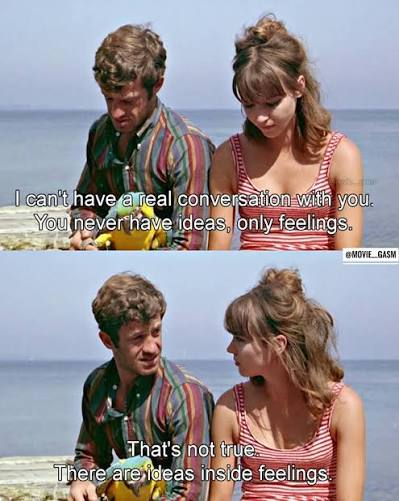
and we sat there just not liking it until i had determined that we had spent enough time not liking it and class was dismissed. for a while, it was fun letting the fragmentary stream of images and poetry wash over us, but then we were just being drowned by them. it was really beautiful in its use of color, though! Deborah described the scene where Belmondo and Karina are driving in the night as brilliantly colored lights splash over them through the sky, which was also my favorite part. of Pierrot Le Fou, Godard said: "it is not really a film, it's an attempt at cinema. Life is the subject, with CinemaScope and color as its attributes...In short, life filling the screen as a tap fills bathtub that is simultaneously emptying at the same rate." even if i can’t access it in the same way, just appreciate the flashes of color, i’m still glad the life and light bottled inside it exists and i hope there are other (younger or older) people who can better feel it.
Elsewhere
i finished and enjoyed reading A Sudden Flicker of Light: A Revisionist History of Movies by David Thomson, but IDK if i ultimately would recommend it. he has an ear for aphorism and good burns and thoughtful close readings of canonical works informed by an obviously deep well of knowledge, but the argument/book don’t really ever cohere for me? instead it’s a basket of nicely cherry-picked examples that are gesturing towards something (film as inherently on a formal level a violent and fascist and estranging and artistically inadequate medium which is perhaps not coincidentally made by violent assholes who hate people) that i don’t think is completely untrue, but idk, as rhetoric, it just doesn’t quite hit (i’ve never seen Godard’s Histoire(s) Du Cinéma, but seems like it might cover similar territory). one of the strands Thomson pulls at a few times is addressing how novels are able to represent the complexity of life and thought so much more fully than film, but his exploration that feels underdeveloped and like a less rigorous version of the (now very old) kind of formalist argument in “Art and Objecthood” about the way that traditional painted portraits interact with the viewer’s gaze in these rich contemplative ways versus the empty “theater” (his take, not mine) of minimalist sculpture. there’s also a lot of “Preston Sturges was born in 1905 in Lincoln, Nebraska” -type filler prose and he’s constantly taking off arbitrary points from filmmakers who “don’t like people” or “don’t care about people,” which like i recognize that there’s a meaningful difference between the humanistic vibes of Kubrick and Jean Renoir, but he uses the concept as though he thinks he has some kind of objective scale for measuring the soul. also in terms of lols part of the experience of the book is luxuriating in the exquisite depth of his taste in cinema and then there’s a late riff about prestige TV where he’s listing shows that represent the golden age to him and the list of six shows he chooses is “The Wire, The Sopranos, Breaking Bad, The Crown, Babylon Berlin, and Ozark” and like wow the chasm in my mind between the first three and the last three of those kinda made me doubt his qualifications to tell me anything lmao. in similar conceptual ground, imo your time would be more fruitfully spent reading The Art of Cruelty by Maggie Nelson and/or Monsters: A Fan’s Dilemma by Claire Dederer: neither of them is the same exact kind of thing as this book, but they do the things they’re trying to do better.
What life is actually like in Gaza today (as described by Jaser AbuMousa):
On the other side of things, some people have started to show some signs of civic engagement. They have started to reopen restaurants. There have been more weddings. But all of this did not cancel the fact that there is no construction material entering Gaza. There is no construction equipment to clear the rubble in Gaza. There are still a lot of constraints, even on food items like peanut butter. I was surprised to hear this directly from U.N. personnel, about peanut butter not being allowed into Gaza. So the people are striving to restore some sort of normal life, but they cannot do this because, first of all, hundreds of thousands of children are not going to school for the third year in a row, and the universities are destroyed, and there is unprecedented internal violence among the people in Gaza. I saw how people inflicted violence on each other during the war in 2014. And the magnitude of this war is much greater than in 2014, so it’s very much expected.
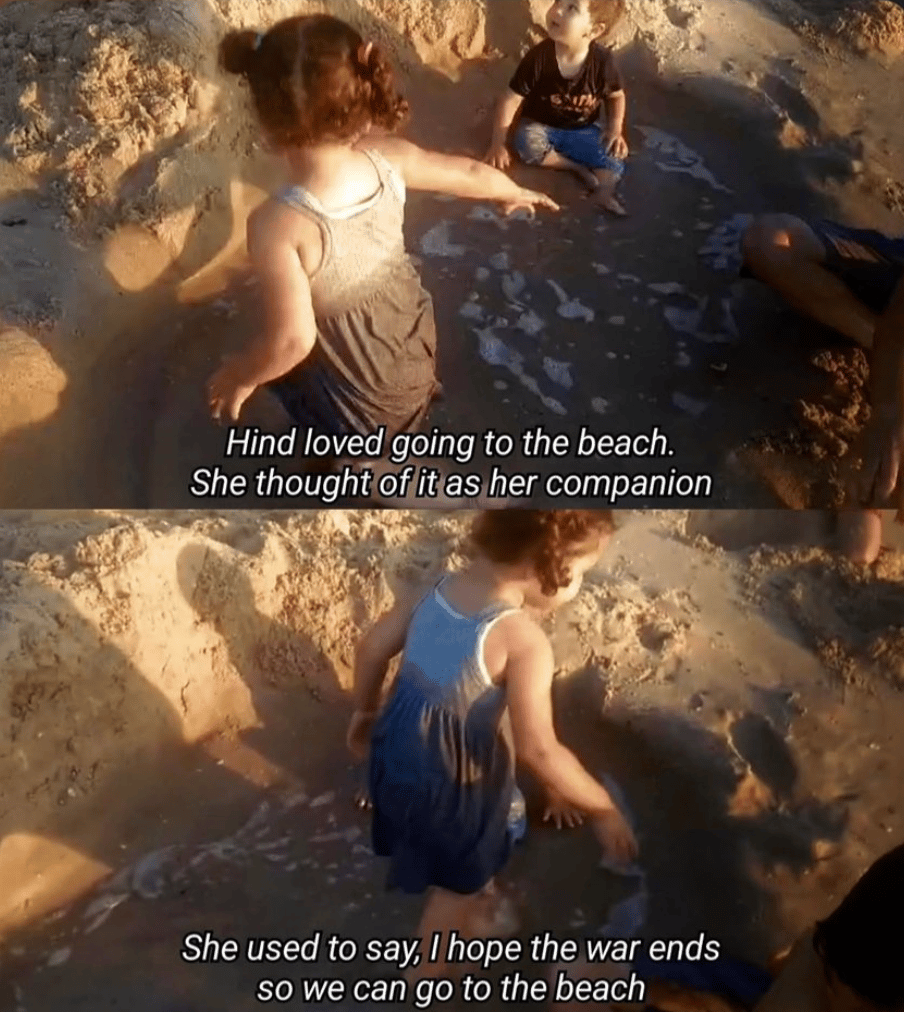
from The Voice of Hind Rajab dir. Kaouther Ben Hania