
Every vendor is now selling you a container for your organizational memory.
On September 29th, OpenAI held DevDay and released a feature called dots: personal AI agents that accumulate memory across every session. Your preferred writing style, your past research threads, the way you structure a deliverable. The demo showed a dot that surfaced a document format a user had last touched six months ago on a different project. The crowd understood immediately. Organizational memory, productized.
Within the same week, xAI's Grokbot (the enterprise AI assistant embedded in Grok's platform) announced persistent memory for team accounts. OpenClaw (an agent harness that lets organizations deploy AI workflows with custom context and memory) shipped organizational context stores as a Q4 infrastructure priority. Meta's Muse is pursuing the same category on the consumer side. Every major platform is converging on the same product: a container that holds what your AI knows about how you work.
The container arrives empty.
None of these features ship what goes inside the container. What goes inside is your organization's knowledge: your vocabulary, your standards, your strategic priorities, the decisions you have already made and do not want to re-litigate with every new prompt. That knowledge cannot be downloaded from a vendor. Nobody on your team has captured it yet, most likely. And the rollout is already underway.
This is the problem I have been watching build across every enterprise AI engagement this year, and DevDay made it visible to everyone at once. It also made it urgent. The fork in the road is happening right now, and the two paths lead to very different organizations.
1. The container race has a winner no one is routing for
The analogy that has been in my head since DevDay: before component libraries existed, design teams worked the same way. Every designer kept their own Sketch files. The tools kept getting better. Figma arrived and the tools got much better. But the inconsistency was baked in, because there was no canonical source of truth for what a button looked like or what the brand's type scale was. Each designer learned the brand principles through osmosis and training. None of that knowledge accumulated in the system. The design system was not a tool upgrade. It was a decision about what was canonical, made explicit, captured in a shared artifact, and given an owner.
The agent memory race is the Figma moment for organizational knowledge. Every vendor is racing to be the place where your org's context lives. OpenAI wants the dot. xAI wants Grokbot's memory layer. OpenClaw wants the context store. What they are competing on is the hosting infrastructure, and they are very good at it. What they are not competing on is the content, because the content is not their problem. The content is yours.
The important boundary here: the tools are genuinely useful. A dot that learns your working style accelerates individual output. The limitation is not the tool. The limitation is that individual memory and organizational memory are different things, and only one of them requires a decision that no vendor can make for you.
Your dot will learn you. It will not learn your company, because learning your company requires your company to have been captured somewhere first.
2. The fork is already happening in your org
Here is what the next six months look like if you do nothing.
Your most capable AI users, the people already in the habit, start using dots or whatever memory feature their platform ships. Each one accumulates a private context store tuned to their preferences, their working style, their past output. The dot gets genuinely good at helping that specific person. It learns their vocabulary, their clients, their patterns. This is the promised outcome. It delivers.
In this scenario, six months from now you have a hundred of those stores, or four hundred, depending on your org size. Each one is smart about its owner. Each one knows nothing about how the company works, because the company has not been captured anywhere those dots can read. There is no shared vocabulary. There is no canonical definition of what good looks like. There is no record of the strategic decisions that should shape every output. Each person's AI is a different version of the company, and none of those versions agree.
Then one of those people leaves. Their dot goes with them. Everything it learned walks out the door. The next person starts from zero.
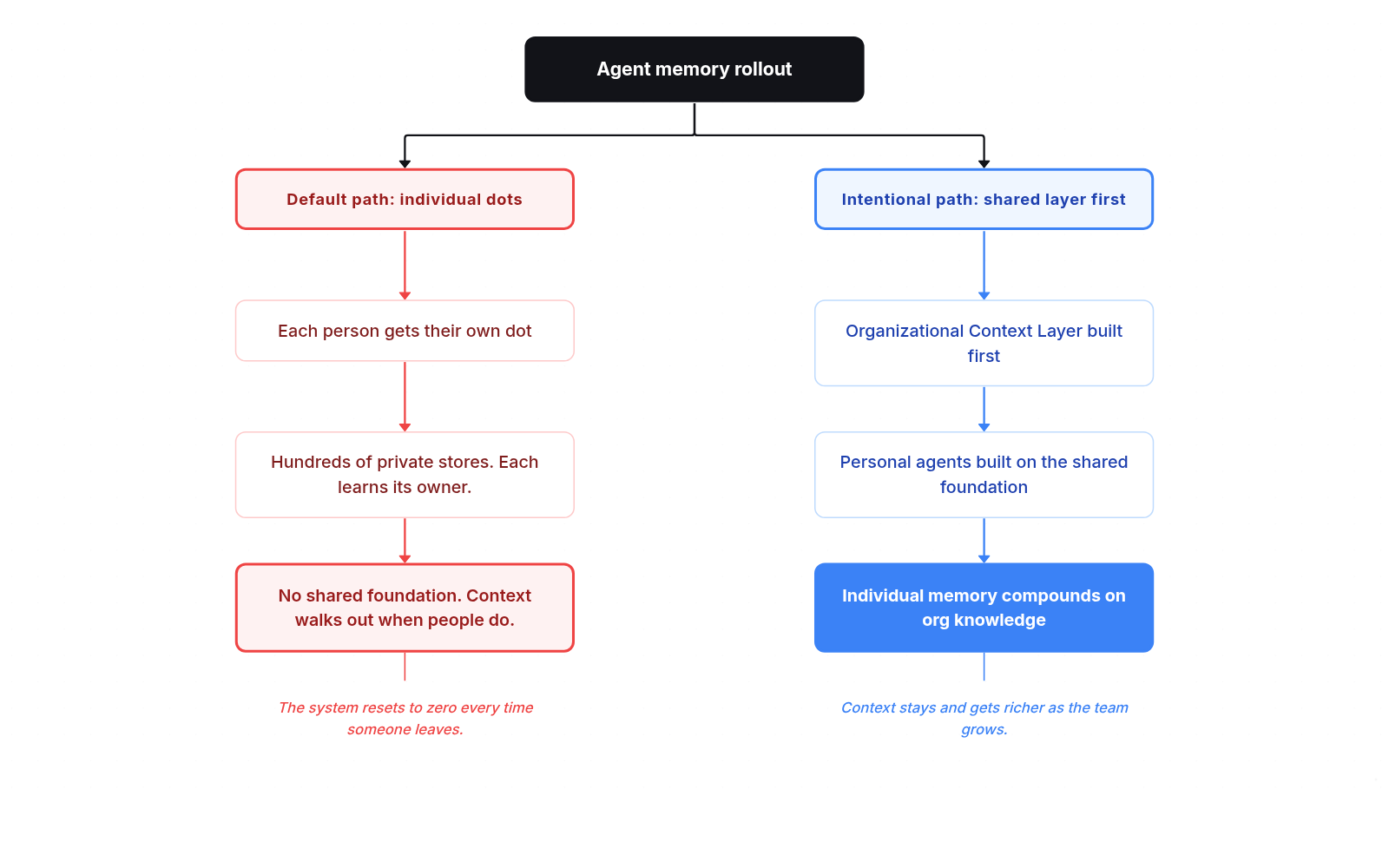
This is the default path. You get there by doing nothing, and it feels like progress for most of the journey because individual productivity genuinely improves. The failure mode is invisible until someone tries to hand something off, or until the third team tries to use an AI output and finds it inconsistent with everything the other two teams produced, or until the organizational knowledge that used to live in a person's head leaves with the person.
In the other scenario, the rollout starts with a different decision, and that decision has to happen before the dots arrive, not after.
Before anyone gets a dot, someone surfaces what the dot needs to know about the organization: what your vocabulary is, what good looks like, what your strategic priorities are this half, what decisions have been made and do not need to be relitigated. Personal agents then build on top of that shared foundation. Individual learning compounds on top of organizational knowledge rather than instead of it.
The difference between the two scenarios is not the platform. Both use the same tools. The difference is whether the shared context layer exists before rollout or never exists at all.
3. The Organizational Context Layer is infrastructure you build from your work, not a document you author from scratch
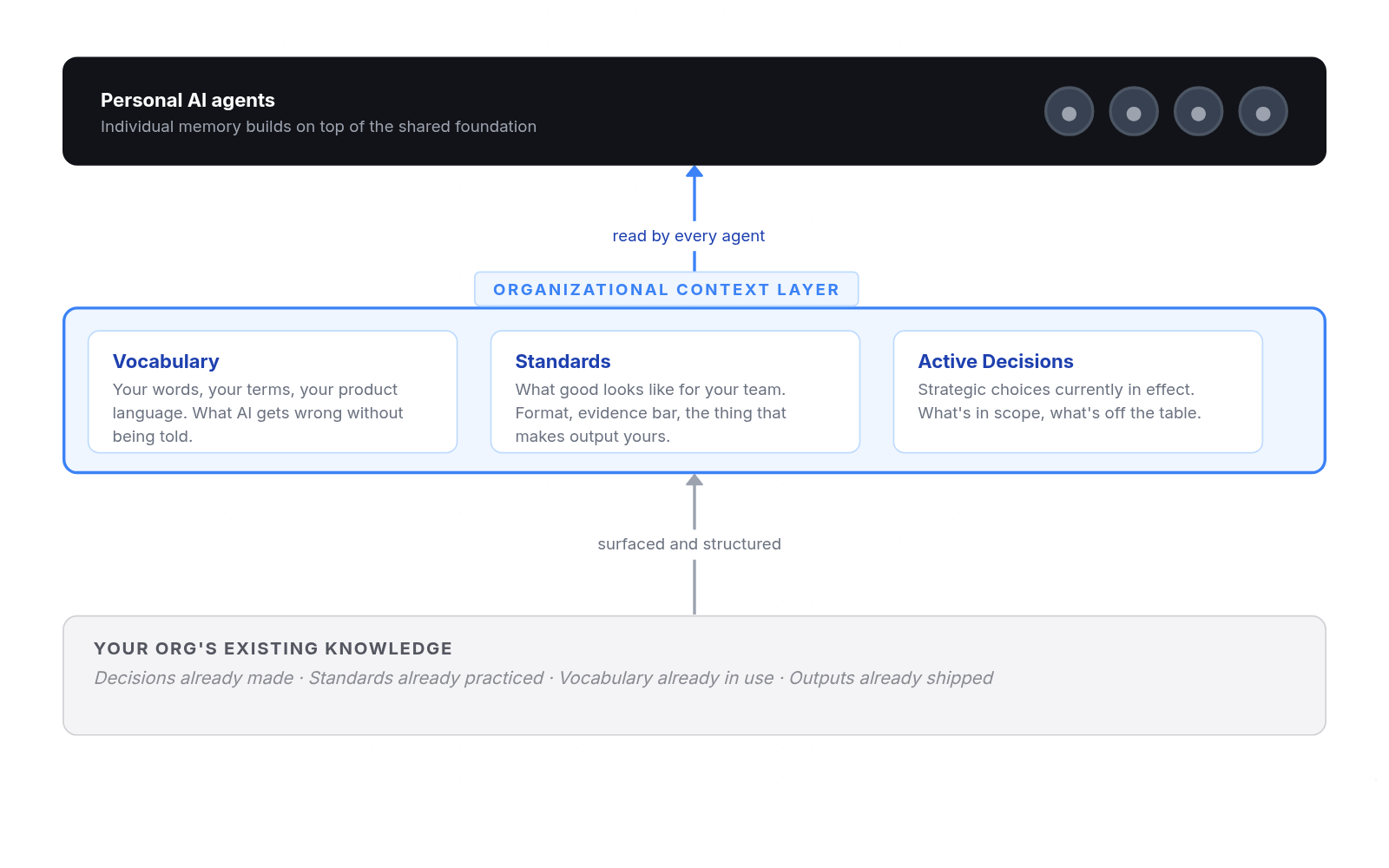
The artifact is called an Organizational Context Layer: the structured record of how your team works, what your AI needs to know before it can be trusted on your organization's work specifically, and what accumulates as the team ships.
The framing I want to be precise about: you do not sit down and write this from your head. That is not how it works, and "write a document" is the wrong mental model for what this takes. You build it, the way you build any infrastructure. You surface what already exists: the decisions already made, the standards already practiced, the vocabulary already in use. You structure that material so the AI can use it. You maintain it as the org evolves. Some of it gets extracted automatically from your best outputs. Some of it gets captured in the moment when someone makes a call that should not be made again by every future AI session. The work is curation, extraction, and maintenance, not authorship from scratch.
The design systems analogy holds here too. A design system does not emerge from a designer sitting down to invent a button. It emerges from looking at every button that already exists, deciding which one is canonical, and making that decision durable. An Organizational Context Layer works the same way. You are not inventing your org's knowledge. You are capturing what is already there, and making it accessible to the AI.
What the layer holds, in order of importance:
Vocabulary. The words your organization uses and what they mean. Your product terminology. The names you use for internal processes. The distinctions that matter to your work and that an AI trained on general text will get wrong until you tell it otherwise. Vocabulary is where most AI outputs first reveal that the model does not know your org.
Standards. What good looks like for the work your team produces. The format of a strong recommendation. The structure of a project brief. The level of evidence required before a claim ships in a client deliverable. Standards are what makes AI output useful rather than generic. They are also the hardest to capture, because they usually live in the head of whoever is most senior.
Active decisions. The strategic choices currently in effect that should shape every output: your positioning, your pricing philosophy, the customer segments you are and are not going after, the tools you have decided to use or not use. The decisions that keep getting relitigated in prompts and outputs need to be in the layer.
What the layer is not. Personal preference. The Organizational Context Layer is not about how any individual likes to work. It is about how the organization works. Personal context belongs in personal dots, built on top of the shared layer.
The layer is not a wiki. It is not a policy document. It is living infrastructure, read by AI, maintained like a codebase, and governed by someone with the authority to make it canonical.
Five questions to start surfacing yours:
What words do you use internally that an outsider would misread? List the ten that matter most.
What does a strong output from your team look like? Describe the format, the evidence standard, and the one thing that makes it obviously yours versus a competitor's.
What strategic decisions are currently in effect that should shape every recommendation your team makes?
What is out of scope right now? What topics, audiences, or approaches are off the table for this period?
Who has the authority to say "that is canonical" for your org? That person governs the layer. The answers exist in your org already. The work is finding them, not inventing them.
What I would tell a leader deploying agent memory right now
Do not wait for the platform to solve this for you. The container is excellent infrastructure. It will not self-populate with your organization's knowledge. That is a context problem, not a technology problem.
Build the shared layer before individual rollout, not after. Once a hundred people have their own dots, each tuned to their preferences, establishing shared canonical context becomes a coordination problem instead of a curation problem. The sequence matters.
Treat it like a codebase, not a filing cabinet. It needs an owner, a review process, and a cadence for updates. The design system analogy holds: the value is in the maintenance, not the initial capture.
Personal context and organizational context are different products. Your employees' dots should learn their preferences. That is the feature working as designed. What dots should not be doing is substituting for the shared layer that nobody built.
The organizations that get this right in the next six months will have a compounding advantage. The context layer gets richer every time someone ships. The organizations that start now will have infrastructure that is genuinely hard to replicate by the time the rest of the market catches up.
The container race has a clear winner emerging on the vendor side. The race for what goes inside is happening inside your organization, right now, and only one team can win it for you.
Start with the five questions. The answers are already in your org. Your job is to surface them before the dots arrive and everyone starts filling containers with something other than the truth.
Reading this on the web? Each issue goes out by email first. Put your address in and the next one lands in your inbox.