Elizabeth Warren Channels Teddy Kennedy, But Only At the End
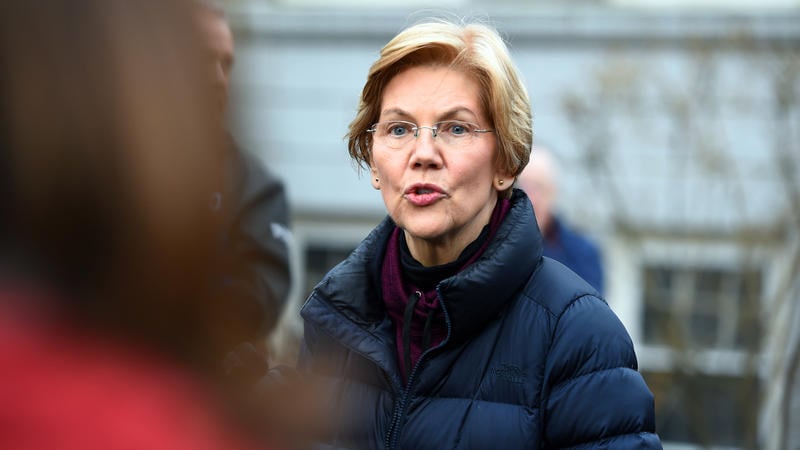
Elizabeth Warren didn't connect her candidacy to the past very often, unless I missed it.
But when she dropped out yesterday, she directly referenced Ted Kennedy's famous speech at the 1980 Democratic convention in New York.
At the end of her remarks to staff, Warren said, "Our work continues, the fight goes on, and big dreams never die."
It's a clear echo of Teddy's closing line in his speech at the Garden: "The work goes on, the cause endures, the hope still lives, and the dream shall never die."
That line hits Democrats of a certain age at a deeply emotional level. Here's a page from my book "Camelot's End" about that moment:
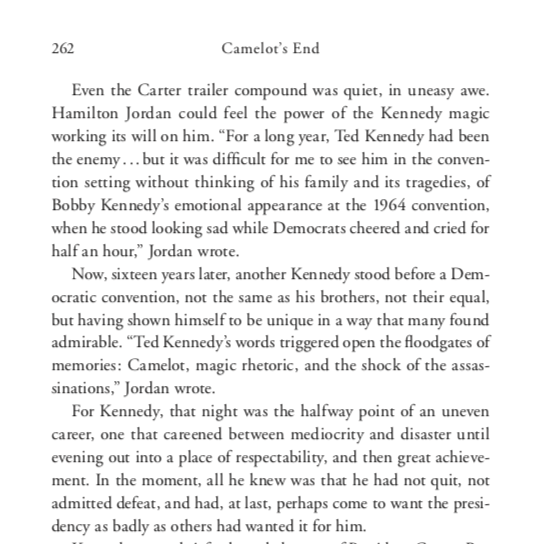
Warren's evoking of that powerful moment left me with a simple question: why don't modern politicians do this more often? Why don't they draw on the legacy of the past, on a shared political heritage? Is there some kind of fear looking to the past for wisdom or inspiration, out of concern that one will look retrograde?
Biden is doing it right now, with his talk of Obama/Biden Democrats. But Bernie never talks about history. He never mentions FDR, even though his campaign is in some ways clearly connected to that older style of liberalism.
Trump never talks about Reagan, like Republicans before him did. But we know why that is: he doesn't read history. He doesn't read at all.
What about Bernie? What's his excuse? And why didn't Warren make this kind of connection to her political heritage in Massachusetts, and to the Democratic party's past, more a part of her message?
Thoughts? Email me at @[email protected]
Michael Gerson, former White House speechwriter for President George W. Bush, wrote a column about the theme that I focused on in my lead piece from yesterday's newsletter: the Democrats' ability to consolidate around a consensus candidate in a way Republicans were unable to in 2016.
Gerson captured something that's come to my mind several times the last few days:
The Democratic Party still exists as an institution. Prominent Democratic politicians still think that conspicuous loyalty to their party will bring respect and future preferment.
The Democratic party still exists as an institution. To put a slightly finer point on it, the Democratic party still exists as a healthy and functioning institution, in the sense that as a party it still has coherence and agency.
Gerson also traces the different ways in which African-American voters, who are deeply religious and largely evangelical, have shaped the Democratic party's trajectory with a pragmatic hand, and compares that to the way that white conservative evangelicals have shaped the GOP under Trump.
Maybe the Democrats would be better off with Bernie against Trump?
Maybe. But he just hasn't demonstrated the ability to activate the historic levels of young voters and other elements of a new coalition of voters that he says would be added to the traditional Democratic voters.
And without an influx of new voters, the Democrats who do vote are siding overwhelmingly with Biden.
Andrew Romano & I wrote about this Tuesday night.
To play you out, here's "Any Major Dude Will Tell You" -- a Steely Dan tune -- covered by Wilco