
Wrong isn’t the same as bad
This is the second half of what I’d planned for this edition of the newsletter. It was done first, and ran long, and the first half isn’t done yet, so how about I send what I have out into the world now. (I should these out more often anyway.)
Impromptus that aren’t so prompt
Fresh off his win at the 2025 Chopin Competition (which results were a bit controversial), Eric Lu is now getting some critical heat for his new album of Schubert impromptus, out last month from Warner Classics. Norman Lebrecht doesn’t hold back: “I practically threw up at the opening note of the opus 90 impromptus, and again in the third piece in the set. The prefatory note is extended so long that its decay grows enough mould to fill a penicillin lab. This is wilful, ostentatious, ear-catching playing that is aimed chiefly at making an impression.” And here’s Frances Wilson: “Ponderous tempos, lingering rubato and over-emphasised agogic accents, all presumably intended to suggest ‘emotional depth’ abound, particularly in the D898/1, D935/1 and D935/2. Here, I feel Lu mistakes slowness for profound emotion.”
De gustibus and all that—but yeah, Eric Lu’s impromptus are slow. There’s no faulting his technique, though, and to be honest they’re not that much slower than some other performers’ versions (there are 619 different recordings of Schubert’s opus 90 impromptus on Apple Classical). I compared them with seven other recordings I could think of (including the three that Wilson preferred). At 73 minutes, Lu’s take is eight minutes longer than the average: 12 minutes slower than Alfred Brendel (who to be fair drops the repeats on one impromptu) but only three minutes slower than Maria Joāo Pires. Those minutes do add up, and at times you feel them. In the opus 90, no. 1 impromptu in C minor Lu holds the opening chord an awfully … long … time (I mean, Lebrecht isn’t wrong); the remaining opus 90 impromptus are essayed at a respectable pace, but not at a virtuostic speed-run. Lu clearly doesn’t see the need to turn them into Chopin études: he already has Chopin études for that.
Then there’s his performance of the opus 142, no. 2 impromptu in A-flat major—the easiest of the eight to play, and the one I know best (I have, to varying degrees, noodled with all of them). I’ve done my homework on this one: I’ve memorized it, performed it in public and studied many, many recordings. There are two ways to play this piece, which is marked allegretto: light and sprightly like a minuet, or slowed down to make it an atmospheric funeral piece. The difference in time amounts to half a minute at most, but the difference in character is profound. Lu is very much on the slower side, slower even than Daniel Barenboim (who actually played this piece at Jacques Chirac’s funeral).
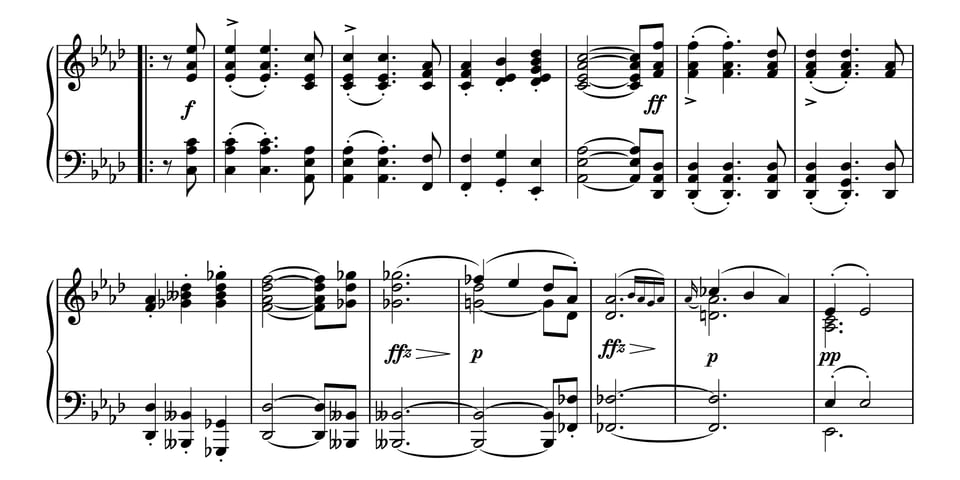
Often as not the problems I have with Lu’s 142/2 are infelicities other performers have also been guilty of. Schubert punctuates his scores with staccatos and rests that performers invariably pedal their way through, and Lu is not the only one to lay on the rubato on the staccato quarter notes in the above passage and play them ploddingly and unevenly. I have opinions on how to play this passage, and Schubert in general: even ffz notes require some degree of lightness and delicacy.
Which is to say that Lu is making choices here—choices that seem to be rubbing these reviewers the wrong way. I’m not sure I agree with those choices either. But then Glenn Gould played Beethoven’s Appassionata sonata way too slow, and Fazıl Say played the Tempest sonata just a bit too fast, and my disagreeing with their takes doesn’t mean they weren’t thinking about what they were doing. Wrong isn’t the same as bad.
Show and tell
So what do a John Wayne western and the Star Wars special editions have in common?
Got a chance to watch Rio Bravo (1959) while it was running on the Criterion Channel (they had a Howard Hawks thing going on). It’s supposedly a classic, but it turns out that I do not like it very much. It turned out to be the archetype of every western/cowboy movie cliché out there: if ever there has been a riff on a western meme, said meme exists in its pure form here. (Sheriff jails powerful rancher’s son for murder, rancher chooses violence—don’t tell me that doesn’t sound awfully familiar.)
Rio Bravo is also apparently a response to High Noon (1952), which apparently made Hawks and Wayne angry with its “un-American” portrayal of its marshal and townspeople. Rio Bravo takes the High Noon premise and does it their way. Unfortunately it doesn’t make for compelling viewing, because for all its didactic, masculine fury about what a strong sheriff should do, the movie’s pretty damn limp. The pace is slow and uneven, the stakes are surprisingly low, the resolution is unsatisfactory, and above everything else there’s so … much … talking. (It does not remotely surprise me that this film is one of Tarantino’s favourites.) It’s not just that Walter Brennan’s character goes on and on for whole paragraphs when a line or two would do (Brennan is fun, but in small doses; Rio Bravo hits the LD50 line really early). It’s that every … single … thing the characters do, they announce: like saying “I’m going to go over by that window” before going over to the window.
It suddenly occurred to me that this was being done as a feature, not a bug—that is, if you’re making a movie with a lot of kids in the audience. Kids aren’t always able to follow the plot closely or have the best attention spans: there’s often more going on than they can process. (Case in point: when I saw The Return of the King in the theatre, at one point I heard a small voice call out: “What happened to his finger, mama?”)
Which brings me to the Star Wars special editions. A while back Marcelo Zuniga put up some videos on YouTube comparing each change made to Star Wars, The Empire Strikes Back and Return of the Jedi in the 1997 special editions and subsequent versions with the original releases (he’s since had his account suspended, but other people have re-uploaded his videos). Watching them, one of the things I noticed, apart from the CGI and Han no longer shooting first, were some ostensibly needless, dubbed-over, dialogue changes.
In Empire, C-3P0 adds “there’s nowhere to go” during the asteroid field scene, and Vader’s terse “bring my shuttle” gets replaced with “inform my star destroyer to prepare for my arrival.” In Jedi, Han originally tells Lando, “it’s all right, trust me”; it becomes “it’s all right, I can see a lot better.” Each change makes the line weaker. The characters are talking more, explaining more. They’re breaking character to make their meaning more clear. It’s as though George Lucas held a test screening with some little kids, and every time they stopped to ask what was going on, he made a note.
Rio Bravo fails as a response to High Noon because it’s aiming at a different audience. Inasmuch as the problem was High Noon’s moral turpitude, its main concern seems to have been that kids went to see it thinking it’d be just another western, which it wasn’t, and came away with the Wrong Message. At least for 1950s America.
Miscellany
I am utterly weepy to learn that Marc Bloch (1886-1944), a notable French medieval historian, resistance fighter murdered by the Gestapo, and personal hero of mine, is being interred in the Panthéon on June 23. (For non-francophiles, this is the French equivalent of Westminster Abbey: it’s a mausoleum of national heroes. Voltaire, Hugo, Braille, Zola, the Curies.) The Bloch family is requesting that the extreme right be excluded from the ceremony.
The Dutch everyday sandwich is boring and iconic. “Boterham demands no love or effort, and keeps the day going. I feel there is absolute trust in a boterham, not necessarily because it is excellent, but because it is simple and unpretentious.”
American kids used to eat everything, but over the course of the 20th century, for a variety of reasons, they became picky eaters: that’s the thesis of Helen Zoe Veit’s Picky, out next week from Macmillan.


