
Delete your accounts
A short while ago I got a notification email saying that someone had friended me on Snapchat. A short while after that I got a notice from Disqus, the blog comment service, that ads would be coming to my comments section shortly. The twist is that I haven’t used either service in about a decade—I stopped using Disqus in 2016, when I moved the personal site to WordPress, and I deleted Snapchat from my phone ages ago on account of never actually using it. It’s just that I missed getting around to deleting the accounts that went with those services.
Deleting an account after ignoring it for so long isn’t always straightforward. Not only did I have to reinstall Snapchat on my phone in order to delete my Snapchat account, but I had to dig out my Snapchat password from where I used to keep such things before Apple’s Passwords app. I also had to remember where I used to keep such things before Apple’s Passwords app. (Answer: Yojimbo, an app launched 20 years ago that still runs on my M4 Mac mini.) And logging into a long-inactive account just so you can delete it? Oh, Snapchat wants a 72-hour cooling off period before doing that—which actually makes sense, if it’s because they think you might have been hacked and they’re giving you time to do something about it.
When you’ve been online for more than 30 years you accumulate a lot of accounts. Want to buy something online? Want to comment on a website? Sign up for a new account, unless you sign in or check out as a guest, and they usually don’t want you to do that. There’s something to be said for signing in with your Apple or Google account, or shopping at online behemoths like Amazon or eBay, despite how much power that gives them, because every additional account is one more damn thing to keep track of, one more vector to guard against attacks. And do I really need to have an account with every manufacturer and publisher of the things I buy?
I mean, I have an account with Miele because I bought a vacuum cleaner from them directly. Miele has a reputation for durability. How long will it be before I need to log in and buy another one from them? Long enough that there’s an even chance they’ll have changed systems and won’t recognize my old account. These are the sort of accounts you only remember when you get a notification that their systems have been hacked and that no personal information was stolen, but you should probably change your password all the same.
If every one of our user accounts was represented by a card in our wallets, we’d each have between one and two hundred cards, and we’d all agree that this was a crazy way to do things. Instead: out of sight, out of mind. It crept up on us, one account at a time, and after two or three decades this is now too much for anyone to manage.
This is sort of what Terry Godier talks about in “The Last Quiet Thing,” a must-read essay about the technical debt that has accumulated in our lives as more and more of our accounts and devices require ongoing attention to keep working.
Nothing you own is finished. Everything exists in a state of permanent incompletion, permanently needing. Your phone needs updates, needs charging, needs storage cleared, needs passwords rotated. Your apps need permissions reviewed, terms accepted, preferences re-configured after every update. Your subscriptions need evaluating, need renewing, need canceling, need justifying to yourself every month when the charge appears. The purchase isn’t the end of anything. It’s the first day of a relationship you didn't agree to, with no clean way out.
Learn it once and forget about it—the example he gives is a Casio digital watch, the design and interface of which has not changed in decades—is not remotely on offer any more. It says something that I have been watching every Apple product announcement and keynote for the past 25 years, and I have trouble keeping up with the constant interface changes on my Apple devices. I find myself remembering how it used to work rather than how it works now (if, in fact, that function has not been removed). I’m trying to keep on top of things and it’s still not working. And these are not the only things I have to keep on top of.
That which is not constantly updated will simply cease to function. I know this not only because I own one of the Kindles that has just been end-of-lifed, but also because our home is full of smart devices. The thing about smart home devices is that they last long by tech standards, but not by home standards. A decade seems like a long time until you reach the end of it, and then you have to buy everything all over again.
Our Belkin smart switches have already stopped working (they were in any event unreliable, and replaced long before their end date), and IKEA has switched to a new Matter-based platform and is no longer selling light bulbs compatible with its old system. So I can’t simply replace the $10 smart bulb that just failed; I have to buy a different bulb that works with their new system, which requires a new $80 hub, and then hope that the new hub will talk to the new lights and switches along with the old lights and switches—which it should, but IKEA’s new system has been having growing pains so who knows. The Hue app has been threatening to require me to create a user account to use our downstairs lights for years, so I’ve been avoiding opening the app (relying instead on the remote and Apple’s Home app). And I’m feeling increasingly vindicated in not replacing the thermostats with smart thermostats: there’s only one company doing smart thermostats for electric baseboard heaters, and we’d need nine of them at $129 a pop, and this is not a thing you want to stop working if and when the company goes out of business.
So I’m starting to think about how to make our home stupid again. Time for an audit of every smart device. Do I still need this device to be smart—i.e., connected to the network, automated, controllable by phone or watch or computer—or can I replace it with something cheaper? The motion sensor in the hallway was mainly set up so that the lights could be dimmed after bedtime: I can try lower-output bulbs and just use the switches. The smart temperature/humidity sensor in the living room was set up to turn off the snakes’ heating pads if the room got too warm, but we don’t keep snakes there any more; now I just need to see if the air is getting too dry for the piano, which I can figure out with a cheap hygrometer, even a digital one, because I wouldn’t need to pull out my phone or ask Siri and then wait for the data to update via Bluetooth. I just need to check, not download sensor logs—and it’s not like I have a smart humidifier waiting for a signal, just a small evaporator that comes out for a few months in winter.
This will probably be a slow process, implemented when the smart tech fails and needs to be replaced, because why spend money before we have to?
Reviews and sundry
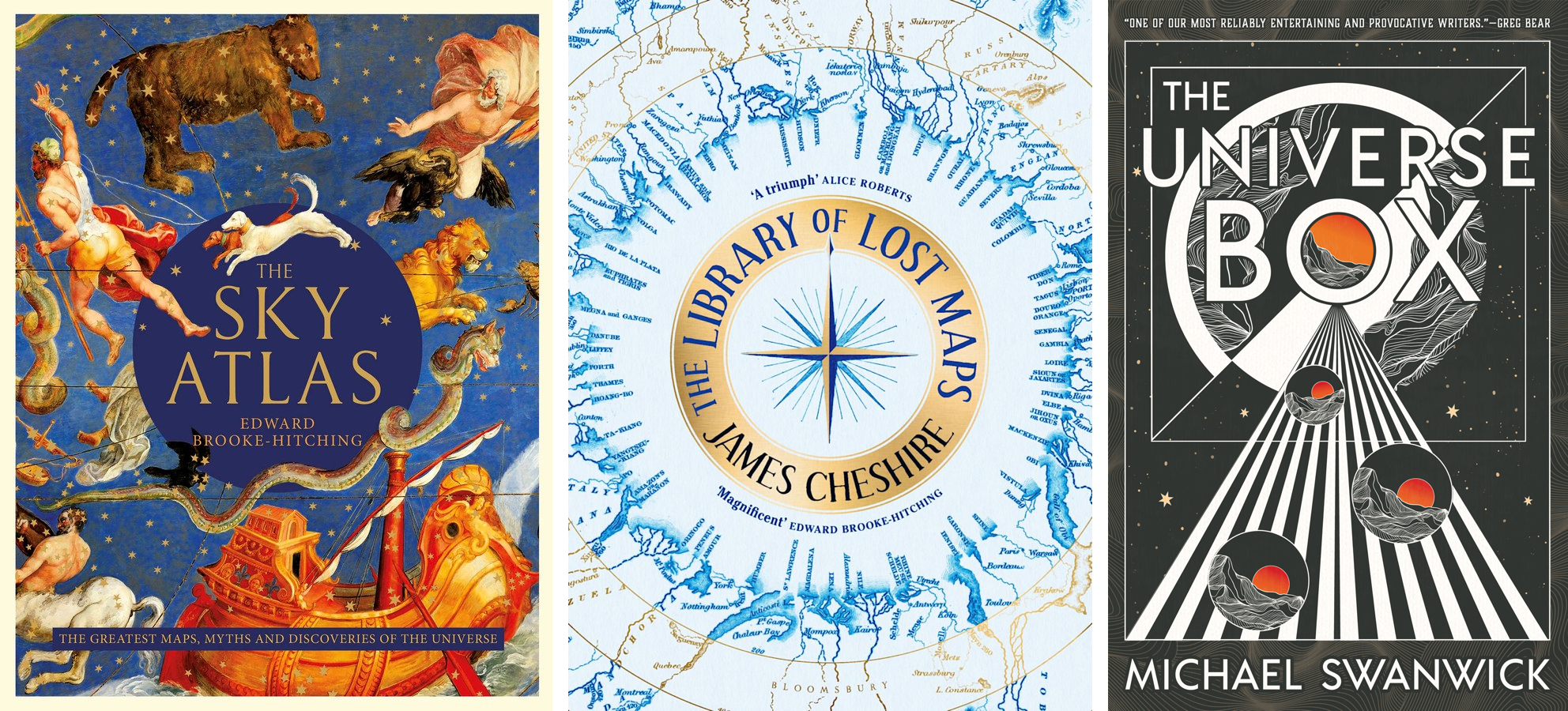
I just posted my review of The Universe Box, the latest short-story collection from Michael Swanwick, to my personal site. I seem to be channeling A. J. Budrys in this review, in that I’m using the review as a launching-off point to say something about Swanwick’s work in general (see also what I did with a Peter Watts collection in 2015). It’s my first review of a sf work in nearly four years, and it was just as difficult to write, and took just as long to write, as the last one. Which doesn’t bode well for my continuing to write sf reviews. They’re just too cognitively expensive relative to the end product.
Fortunately, my ability to review books about maps seems to be unaffected. Two recent reviews posted to The Map Room:
The Library of Lost Maps, James Cheshire’s love letter to the map library at University College London.
The Sky Atlas, a book by Edward Brooke-Hitching that doesn’t quite do what it says on the tin.
And finally, some of you will remember that I gave a talk on fantasy maps at the 2019 Scintillation sf convention in Montréal. (At least four of you subscribed to this newsletter were actually there.) I’ve posted the slides and text of that talk to my Patreon, available to paid members (which at least one of you is) as a thank-you for supporting The Map Room.
Look, a murderbird
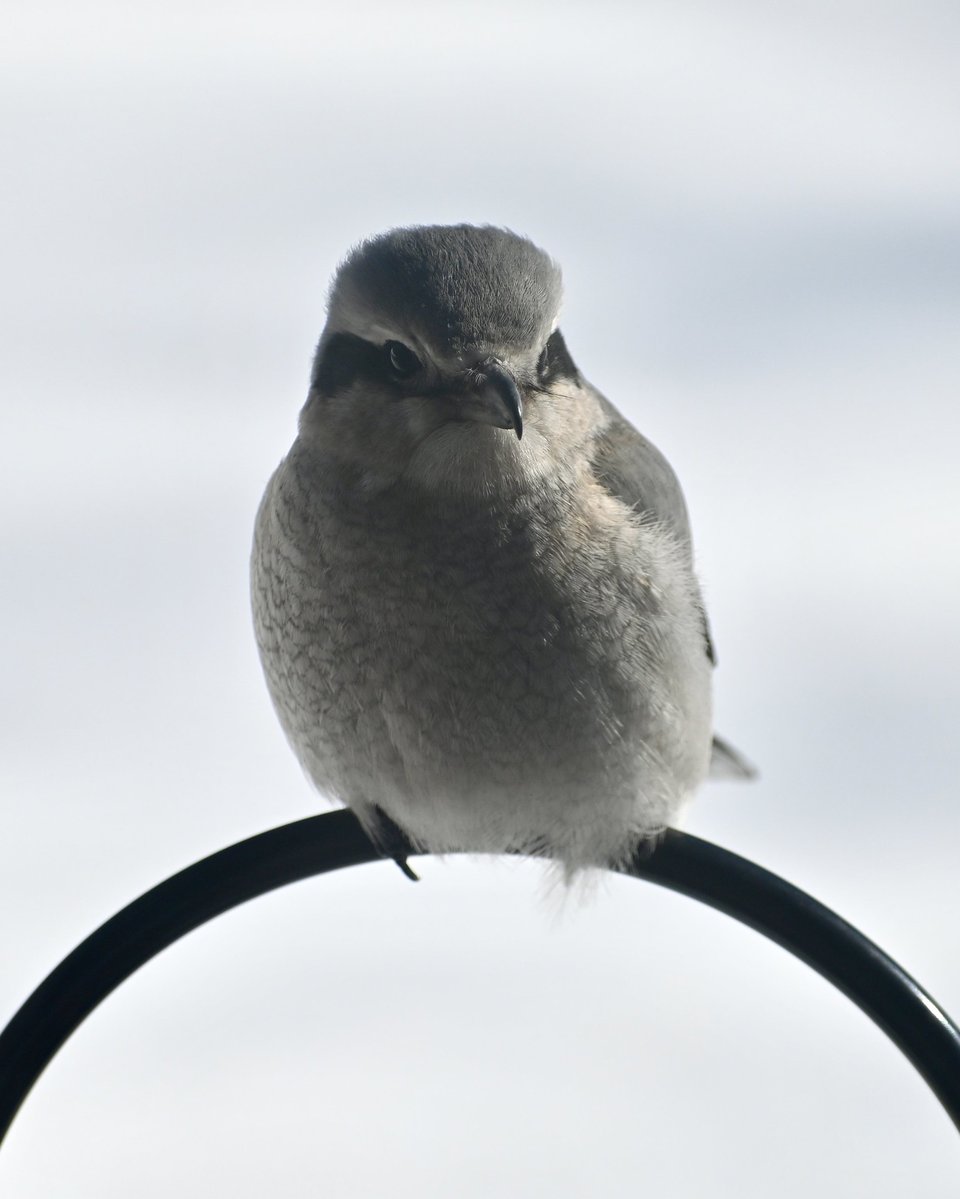
So far we’ve spotted 43 species of bird on our property. The latest to make the list turned up in early March: a northern shrike (Lanius borealis) that hung around one of our feeders. And by hung around I mean hunted: on day one it caught and eviscerated a meadow vole, spiking the disemboweled corpse on the cedar outside our bedroom window to freeze, and it would have done the same with the goldfinches and juncos that usually hang around the feeders (but were strangely absent when the shrike was about). Because that’s what shrikes do.
That was March. Between then and now the bird situation got a complete makeover. The goldfinches, juncos, chipping sparrows, woodpeckers (hairy and downy) and nuthatches are still around, but they’ve been joined and/or overwhelmed by the starlings. Robins appeared one day out of nowhere, as did the wood ducks, and the pileated woodpeckers are back to destroy dead trees. This morning a northern flicker was hunting ants on our front lawn, because the ants are back too. The wood frogs and spring peepers have been calling too. I guess that means spring is here.
Miscellany
Duane Jensen passed on 25 Jan 2026 at the age of 64. The owner of Phoenix Typewriter, he posted hundreds of how-to typewriter repair videos to YouTube, a resource that practically every hobbyist has made use of repeatedly. According to this interview last year, Duane was suffering from COPD on account of all the solvent fumes (the man did like his lacquer thinner).
More than 40 percent of musicians suffer from tinnitus—three times the rate of the general population. “Surprisingly, the research debunked the myth that rock musicians are at higher risk than classical ones; the auditory danger is consistent across all genres, suggesting that instrument type, seating position, and long-term exposure are the true drivers of damage.”
Liz Bourke: “‘Aragorn’s tax policy’ is, to some extent, an articulation of something that has haunted the discussion of ‘realistic’ fantasy ever since. But on the face of it, it’s a facile question to ask, because medieval kings are structurally constrained: they can’t have a ‘tax policy’ in a modern sense.”
“Since then, the trend in the second-hand market has been an ever-greater emphasis on the profit angle. It’s understandable. A savvy browser can hit the jackpot.” An excerpt from Steve Burgess’s Cheap Skate in Lotusland looks at how thrifting has shifted from saving money to finding something you can flip for a huge profit.
Wikipedia has decided to blacklist archive.today (aka archive.is, archive.ph, archive.fo, archive.li, archive.md, and archive.vn), affecting more than 600,000 pages. The controversial archiving/scraping website—a lot of us have been using it to get around news paywalls—was engaging in a scorched-earth campaign against a blog critic that included rewriting web page snapshots (undermining the whole point of the service) and using CAPTCHAs to power a DDoS attack against the offending blog. (I used one of their links in the last newsletter; I’ve deleted it in the web archive version.)
“Our programs are fun to use.” Marcin Wicary looks back at the quirky software company Beagle Bros, who made the funnest Apple II utilities in the 1980s. A staple of my childhood.
Octavo is a Mac app for turning PDFs into booklets, zines and other documents that require complex printing. $25/C$35.
Apocalypse no: how almost everything we thought we knew about the Maya is wrong.
A short history of the indispensable lab culture medium agar, which sources are more precarious than you might think (for example, Japan was a major supplier—and then World War II came along).
“Brand age watches look strange because they have no practical function. Their function is to express brand, and while that is certainly a constraint, it's not the clean kind of constraint that generates good things.” Paul Graham looks back at how the Swiss watch industry, faced with quartz watches that cost less and told better time, pivoted from engineering to branding.
Why Japan has such good railways. “The Japanese love cars, but they take trains because they have the best railway system in the world. And their system excels because of good public policy: business structure, land use rules, driving rules, superior models for privatization, and sound regulation have given Japan its outstanding railways.”
Updates
Pretzel may have been back on her feed as of issue #14, but she’s gone off again, and fuzzies aren’t convincing her this time. Again, she’s pushing 30, which is nearly twice what I’d expect from a corn snake.
Since issue #16 dropped, BBC Music magazine has weighed in on the Eric Lu album of Schubert impromptus. Their reviewer gives it five stars (Apple News+ link), pitching Lu’s tempi this way: “Where Alfred Brendel and Radu Lupu, for example, find urgency and impulse in the darker-hued passages of the F minor and C minor Impromptus, Lu is more measured, bringing textural clarity and focus to the music, often during its most harmonically remote episodes.”


