
A firehose of assumptions
Pretzel, our oldest snake (and last remaining corn snake), is somehow still with us. This past summer she started refusing meals, which when a snake is at least 28 years old (my best guess: I got her in May 1999, and she wasn’t a baby then) you make certain assumptions as to what happens next. We’ve been losing two to three snakes per year to old age for a while now. Most of them were as much as a decade younger than Pretz (and still old enough for them to have had a good long run), and the pattern is always the same: first they stop eating.
Then we palpated her and felt lumps, which likely meant either ovarian cysts or ovulation. If the former, well, she’s ancient: here it comes. If the latter, well, come on, snake, it’s been 20 years since your last successful clutch, what are you even doing. But laying herself hollow, even in the absence of a boy, was Regular Pretzel Bullshit once upon a time, so we set her up with a humidity/nesting box and waited to see which way things would go.
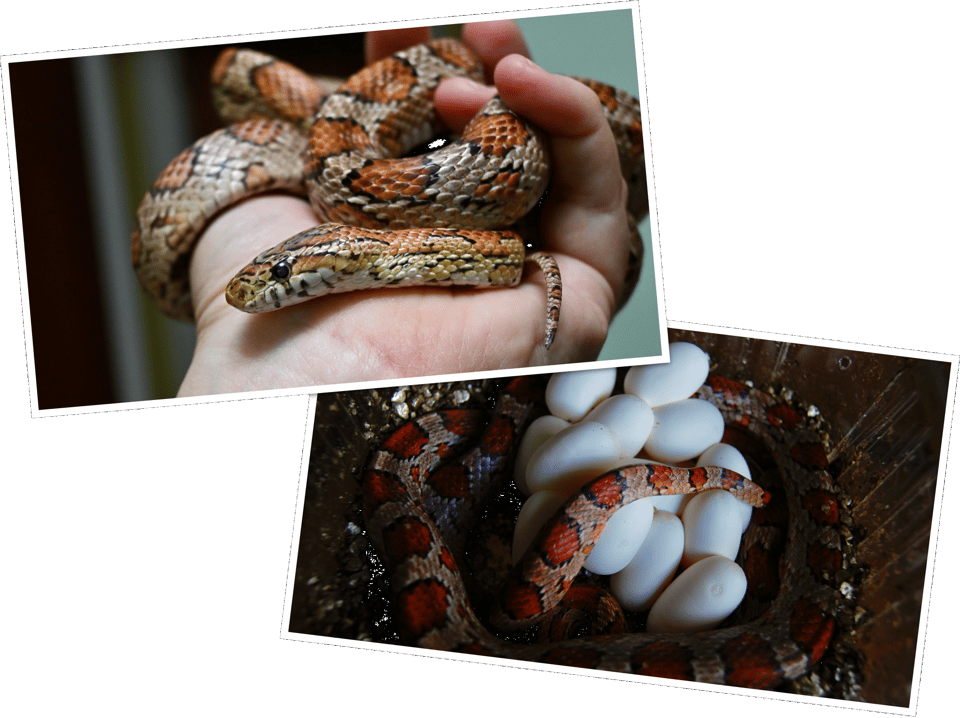
After a lot of nothing happening came the forehead-slapping moment: Jen remembered that when Pretz had gone off her food previously, a decade or more before, her appetite could be restarted by offering her a smaller size of mouse. She generally prefers eating smaller mice, usually hoppers, so we offered her the next size down: a fuzzy. And she took it. She’s since taken two of her normal hoppers, so we seem to be back to normal, at least for the moment (she is, after all, still ancient, and the lumps haven’t got an outcome yet). We’ve also gone back to feeding her in a separate holding container—our practice when feeding snakes who share a cage who might otherwise fight over the same food item—on the suspicion that that’s what she’s used to (she’s spent most of her life living with another corn snake, but is by herself now, having outlived them all) and is set in her ways. Again: ancient. And also orange. But eating again.
You could say that I’ve forgotten more about snakes and snake keeping than most people will ever know—I started this nonsense when I was eight years old, after all. The corollary is that I’ve been messing around with snakes for so long that yes, there’s quite a lot for me to forget about snakes and snake keeping, and here’s a case in point.
(It’s also true that I’ve been at this long enough that my writing about snakes over the years—articles, blog posts, book reviews, Quora answers—now comes to something like 60,000 words. A few pieces are on the website, but most are offline now. There’s enough for a book, and I sometimes think about self-publishing a collection of these pieces—I actually have a couple of partially finished versions set up in Scrivener and Vellum—but to be honest I can’t imagine there being much interest in such a project.)
#
As you’ve probably figured out from the fountain pens and the typewriters, I spend time thinking about how I can reduce my digital footprint and make my life less online and more analog.
One thing that came to mind this month was the wristwatch. I’ve been using an Apple Watch for nearly a decade: my second one, a Series 8, is now three years old and should have at least two or three more years of life left to it. Maybe I should replace it with a mechanical watch when the time comes. I knew that there was a thriving watch community, so it wasn’t long before I found a firehose of information and advice online. (It is a paradox of retro tech that its subcultures tend to be extremely online.)
But while I was getting a firehose of information about mechanical watches, I also got a firehose of assumptions about mechanical watch ownership—namely, that you would not be able to stop at just one watch, and would inevitably spend too much money building a collection of favourite watches. And I thought to myself: oh no, not again.
Because I’ve seen this movie many times before—hell, I’ve acted in it over and over. It’s practically a commonplace of virtually every hobby I’ve dipped my toes in, especially the ones that focus on buying stuff, that you can’t stop at one. I’ve seen it in snake keeping, in fountain pens, even in typewriters: the language of overconsumption. That a single pet snake, a single fountain pen, a single typewriter, or maybe at most a pair, should be enough for most people is a truism that falls apart when you’re really into something. (ASK ME HOW I KNOW, he said ruefully.) And while most hobbyists will be perfectly happy to recommend something “if you can have only one,” they themselves were lost a long time ago.
Part of that is because, in order to build the expertise required to be able to offer that kind of advice, you have to be exposed to and try out a lot of different things. What’s often missing is the sense that acquiring this expertise is not typical for the average user or owner. It’s another enthusiast blind spot. What’s typical for an enthusiast is presented as good advice for a more general audience. It’s not so much buying advice as community outreach, a recruitment drive: here’s how to be one of us.
I thought back to books like Robert Applegate’s General Care and Maintenance of Milk Snakes (1992), which does a bit more than what it says on the tin, in that the author talks a lot about, and shares photos of, his own procedures for caging, hatching and raising very large numbers of snakes (we’re talking hundreds here). This is not something someone who’s brought a Mexican milk snake home from a pet store needs to think about doing! Not every pet owner needs to be a breeder! All Bob did was tell us about how he managed his little operation, but books like his end up normalizing the idea that having Way Too Many pet snakes is not only desirable, but possible—and that can get a lot of people into trouble. I’m kind of amazed we didn’t.
I’m kind of annoyed with myself for not seeing it sooner, before I’d gotten quite as carried away with snake keeping, or ended up with more fountain pens than I actually use on a regular basis (quite a few are sitting unused and un-inked in a box right now), but I suppose I needed to cycle through a few different hobby spaces for the pattern to become visible, and that’s not something most people get to do.
You know what it was, though, that made me see it? Listening to watch enthusiasts talking about a hobby that is basically about shopping as a “journey”—because fountain pen enthusiasts use that word too. That was the tell.
#
Miscellany
We’ve been using Zoom rather than FaceTime for our video chats because a lot of our friends are on Android and/or Windows. But I’d forgotten that Android/Windows users can join FaceTime chats via a web browser if we send them a link. We might try that instead next time, to get around Zoom’s limitations on group chats.
Strange but Turing-complete esoteric programming languages include Airline Food, “whose programs are supposed to look like Jerry Seinfeld's stand-up,” and Tabloid, whose commands are based on clickbait headlines.
Ever wondered why Ukraine doesn’t re-gauge its railways so that they’re compatible with central and western European rail networks (1435 mm) rather than Russia’s (1520 mm)? Jon Worth argues that there are few circumstances where re-gauging railways make sense.
When people encounter a red-bellied snake (the North American version, I mean), they often think they’ve found a baby snake. No, that’s an adult. (This one we found in 2009, for example, was a pregnant female.) Now, this is a baby red-bellied snake (SBC Nature Photography).
In The Atlantic, Tyler Austin Harper writes about his love affair with carbon steel knives—they’re high-maintenance and rust easily, but they’re “sharp as hell.”
The New Yorker has Simon Akam’s piece on the attempt to standardize Romansch, Switzerland’s fourth language, which exists as five semi-mutually-intelligible dialects, and the backlash that followed.
Essayist is the Mac app of the year on Apple’s App Store. It’s a word processor focusing on academic writing, with supports for citation styles, references and formatting. I’m long past needing it now, and besides it’s $80/year, but even my grad student self might have been of two minds about this: back then messing with formatting and citations was a kind of self-soothing activity, a recovery stroke between intense bursts of research and writing. Automating such things away is not necessarily helpful.
There is one make of manual typewriter still being made today. But you really shouldn’t buy it. Manufactured in Shanghai and sold under a variety of names (Maplefield, Royal Epoch, We R Memory Keepers), it’s quite possibly the worst typewriter ever built. Typewriter Revolution author Richard Polt bought one to see just how bad they are: “these China-made designs are not intrinsically terrible […] But as it is, the slipshod assembly is a downright insult to the consumer, and everything is made of low-grade material.”


