Going Out, April 2026
It was while writing up last month’s outing that I checked Songkick again and saw that the performer who had produced perhaps my favorite album of 2025 would be in Chicago in April. I bought a ticket immediately, and for the next four weeks every time I thought about that upcoming show I got a little flutter of excitement in a way I had honestly considered myself too old to ever experience again.
Last Thursday, I got off work, grabbed some food, and walked up to the Chicago Theatre, where the marquee, visible from blocks away, read:
CAZZU
LATINAJE EN VIVO
TONIGHT SOLD OUT
It was seventy-five minutes before showtime, and a crowd was already forming outside the doors. The crowd was primarily composed of Latina women dressed almost exclusively in gothic black, ranging in age from late teens to geriatric but all vibrating with nervous energy, politely-contained excitement, or giddy talkativeness. Vendors roamed the block selling knockoff t-shirts and plastic headgear, with a choice between devil horns or a spiky golden corona that recalled both saints’ halos and the crown on the Statue of Liberty. Construction of the new L station meant that traffic on State Street would be at a permanent crawl until well into the night; it was a pedestrian’s world.
Once inside the building, I started to head down to where I remembered the men’s room was before being politely informed by Chicago Theatre staff that all the downstairs facilities had been reassigned to women due to the demographics of the night’s show; I would have to go up two flights of stairs to find an eerily empty men’s room, after which I found myself buying a beer, more because I’d accidentally made eye contact with the concessions worker than because I was thirsty, but I did get to hear from her that there would be no intermission. No opener? Fantastic, it wouldn’t be too late of a night.
Showtime was listed as 8 P.M., and I was in my seat by 7:15 (my usual habit, as I rarely have other obligations). But I was not surprised when 8 came and went without anything happening but more and more audience members filing into their seats: I’ve partied with Latin Americans before. When the lights came down at 8:30, the ambient chatter in the grand theater space spiralled upwards into a sustained scream that would only intermittently let up throughout the night, and a broad grin spread across my face in the darkness. “Ca-zzu, Ca-zzu, Ca-zzu, Ca-zzu” the crowd started chanting in unison as though pre-planned, while dry ice billowed over an Expressionist brick wall. We all leaned forward in our seats, craning to see shadows moving in the lights illuminating the window and door in the wall.
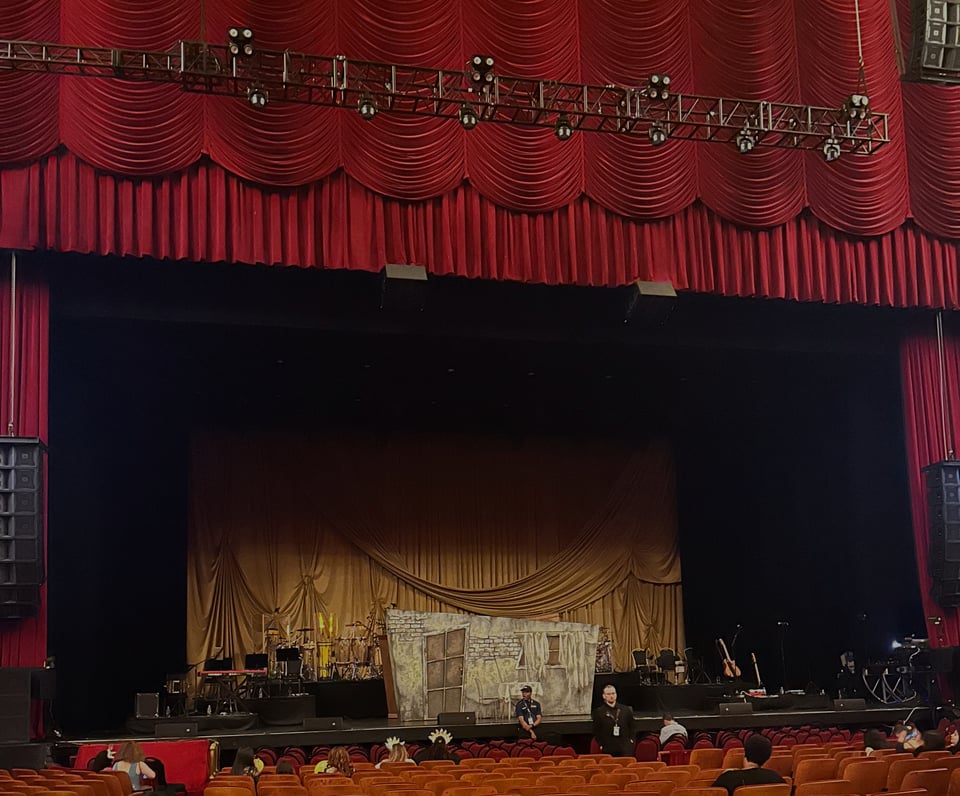
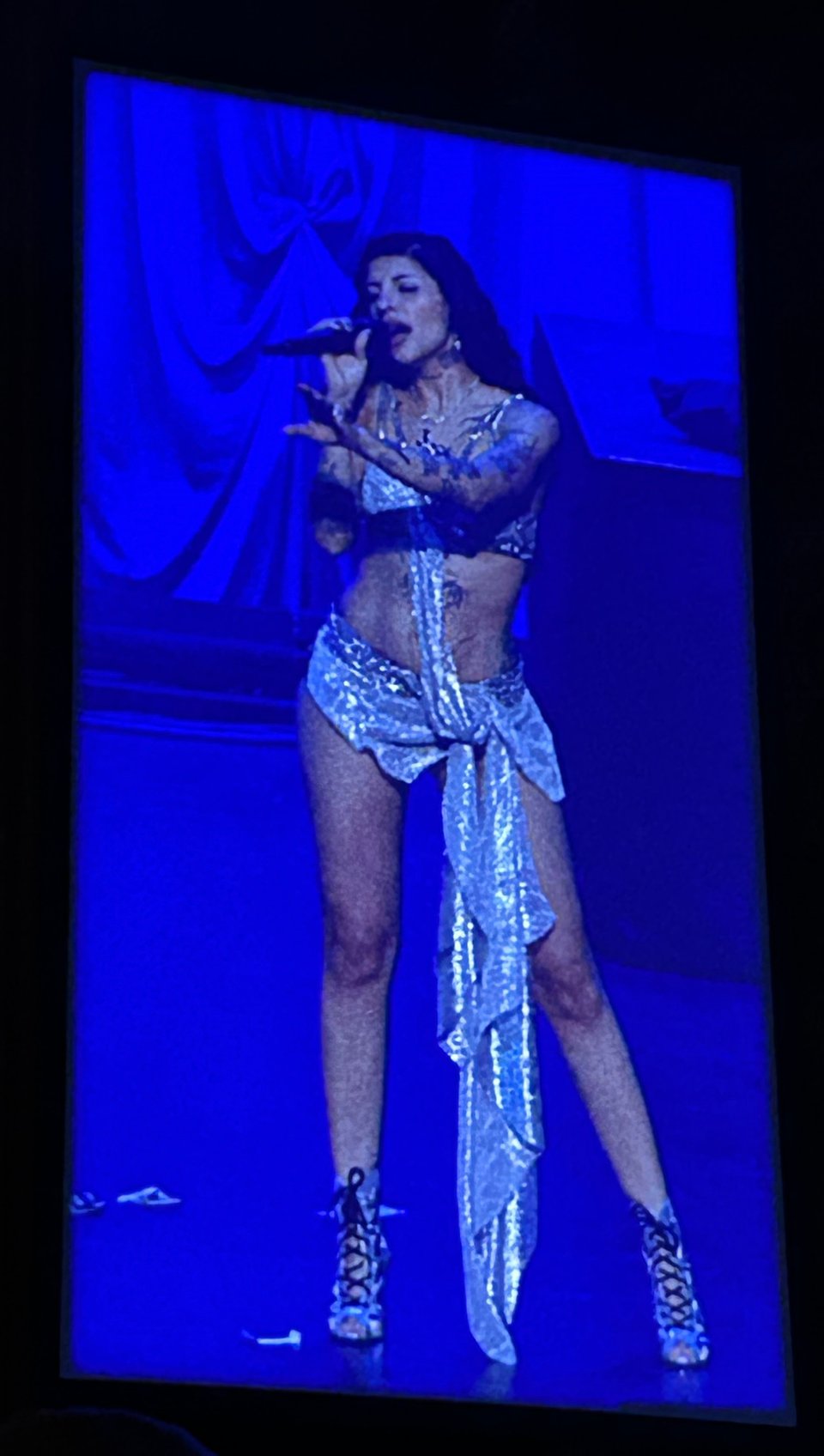
When the lady of the evening stepped out of the door, one long leg first, the building erupted. She was dressed in a traditional tango gown: black, flowy, hitched at one hip in order to show off superb legs. Her band began playing a slow, dramatic tango, the bandeonista squeezing out flourishes while she took a seat and stared melancholically into the middle distance, all as screams, shouts of devotion in English and Spanish, and hysterical laughter rang in the theater; and when she brought the microphone to her lips everyone suddenly hushed; then a moment later, as she began to sing the opening lines of “Ódiame” [hate me], she was instantly joined by an untrained but passionate chorus from the balcony, from the mezzanine, from the main floor, singing along with every word.
Julieta Emilia Cazzuchelli is thirty-two years old, and has been a major figure in the Buenos Aires urbano scene since 2017. (Urbano, just in case an explanatory parenthesis is necessary, is a catch-all term for “Latin urban,” Spanish-language music derived from hip-hop and dancehall, including reggaeton, Latin trap, and associated genres.) I’d been vaguely aware of her since 2018, thanks to some Twitter mutuals who were more plugged into the Argentine pop scene than I was, but I didn’t really fall in love with any of her songs until 2021’s “Castigo” [punishment], the video for which positions her as a force of queer-coded anarchy against repressive patriarchal authority. Even after that, my attention drifted away, caught by explicitly Afro-Latin performers; Cazzu, as her name very obviously indicates, and like many artistic Argentineans, is of Italian descent.
And as I watched her dance, sing, and mime through complex narrative staging over the course of two packed hours, I kept thinking about her in a lineage of Italian-American (in a continental rather than a national sense) performers. Like Madonna Ciccone or Stefani Germanotta, she puts on a hell of a show, she has smart, creative things to say about gender, sexuality, and stardom, and she’s supremely confident in her voice, her image, and the scale of her ambition —— but unlike them, she hasn’t yet reached the crest of her career.
The first hour-plus of the show was more or less a fully-produced jukebox musical; neither Cazzu nor her team of four male dancers acknowledged the audience, moving through an intricately-choreographed thematic narrative with multiple sets. It opened with a forlorn tango section, with Cazzu as a solitary woman being lusted after by various men, then moved into a raucous Latin pop section, with Cazzu seducing and discarding man after man — the delirious early high point of the show came here, with a fairly faithful reenactment of the video for ranchera breakup anthem “Dolce” [the Italian brand name] minus the makeup and prosthetics, as virtually the entire theatre bayed ravenously for masculine comeuppance. (I couldn’t help wondering how the assorted boyfriends and male chaperones in the crowd felt at this point, if they had been infected by manosphere propaganda to the point where they found it frightening instead of exultant.)
This was followed by a rhapsodic trap section, Cazzu as a crime boss giving orders to her male underlings. For a change, instead of chanting “Ca-zzu Ca-zzu Ca-zzu” in the moments between songs, the crowd switched to “Je-fa Je-fa Je-fa” and went wild when she performed “Jefa” [female boss], scattering prop money and roses as far into the front rows as she could throw. And she tore off her gown for the steamy final section of the jukebox musical, in which booty-forward songs like “Bounce”, “Chapiadora” [gold digger] and her first big multi-artist hits accompanied some respectable twerking and acrobatics, as her dancers lifted her into the air before taking her offstage at the end of “Que Disparen” [let them shoot]. The screens in the Chicago Theatre gave each dancer’s credit before fading to black with the word “Fin” (end), but the band kept playing.
Cazzu reemerged for the second half of the show in a spangly vedette outfit for a more traditional concert, finally taking a moment to speak to the audience, express gratitude and bask in their full-throated adoration. She apologized for missing some cues (I never noticed), and sang more personal songs (I will always get choked up at “Inti”, about her daughter), covered art-tango legend Astor Piazzolla, and segued into the final section of the evening, a grooving cumbia party. (“Es prohibido parar?” [is it against the rules to stand?] she asked, getting even us oldsters on our feet.) She sang tejano queen Selena, she sang her song with Mexican cumbia institution Los Ángeles Azules, and finally, after making us wait all evening, sang her enormous hit “Con Otra” [with another woman] (#9 on my favorite songs of 2025), the only one I was able to sing along with comfortably. After which she invited select fans up on the stage for the high-energy merengue “Menú de Desgustación” [tasting menu], a tribute to Dominican party rocking, and that was it. A flood of beaming humanity back out to State Street, where the party continued; as I made my way to the subway entrance, dozens of young women were rapt in a dancing circle, singing “Con Otra” a cappella together underneath the marquee.
It was a wonderful evening. I am not someone who gets out of my head very often, but getting swept up in the surge of emotions swimming around the theater felt not just exciting but necessary. When she could get words out in between audience screams, Cazzu briefly referenced the ongoing oppression of American Latines under the current regime (not to mention her own country’s rightward lurch), and there was something thrilling and empowering to be in a massive crowd of Spanish-speaking Americans who waved many different national flags, kept their phones up to document the evening, sang along with every word, and danced in the aisles despite the efforts of theater staff to keep fire exits clear.
I also very much enjoyed the fact that she was accompanied throughout by a live band, including a keyboardist, a bandeonista, violinists, trumpeters, a flautist, guitarists, a bassist, and two drummers (watching one of them intensely working the hi-hat during the trap songs was a little surreal). The higher-energy songs sometimes drifted into jazz-funk (and even sex funk, pace Bluesky) when the flautist got going, but the capaciousness of her musical identity, which embraces traditions from across the American continents without making distinctions between art tango, boot-scooting cumbia, funky candomble, block-rocking reggaeton, heartbreak ballads, or booty bass, is so exactly why I fell in love with her Latinaje album last year that I was just as thrilled by her excesses as by her concision.
I started this series by reporting on a visit to the same venue last June, where I was conflicted about the show and especially the audience. If anything, the audience for Cazzu was even more disruptive and attention-seeking than the audience for Dropout, but that’s part of the territory that comes with being a pop star, and the enormous grin on Cazzu’s face throughout the concert portion made clear that she was reveling in it. (Even if she did have to tell one of the fans permitted on stage that the middle of the final song wasn’t the best time for a selfie with her.) And it is a deeply-rooted part of my personality that I will never be as sniffily judgmental about what excited young Latina women do as I am about what enthusiastic white adult nerds do. (It takes one to despise one.) Checking setlist.fm, Cazzu performed 29 songs in two hours, and kept me on the edge of my seat the entire time; to a certain extent, screaming one’s fool head off is the only appropriate reaction.
I have my May ticket already — it’s for this Saturday, so expect to read about this time next week — and if I don’t quite have the same flutter of excitement when thinking about it I’m looking forward to it a lot. I’ll tell you all about it (and perhaps my other plans for the day) next time.