
SU291 - Post-Blizzard AI Ruminating
Whatever day it is does not feel like whatever day it is. I’ve realized my body reacts to storms in predictable ways - tweaky prior, exhausted and needing to shelter during, and alternating between these two immediately after. Monday was work, shovel, nap, repeat. Neighbor got the worst of the sidewalk with a snowblower but there was still a stoop to be dug out and a potted tree that had fallen.

The day ended with a burning need to get out of the house that lead to a brief trip to the park and a diner but thankfully no further. Can’t tell you how many times I’ve been caught off guard by a sudden need to curl up and sleep in a snowbank a mile or two from my house.
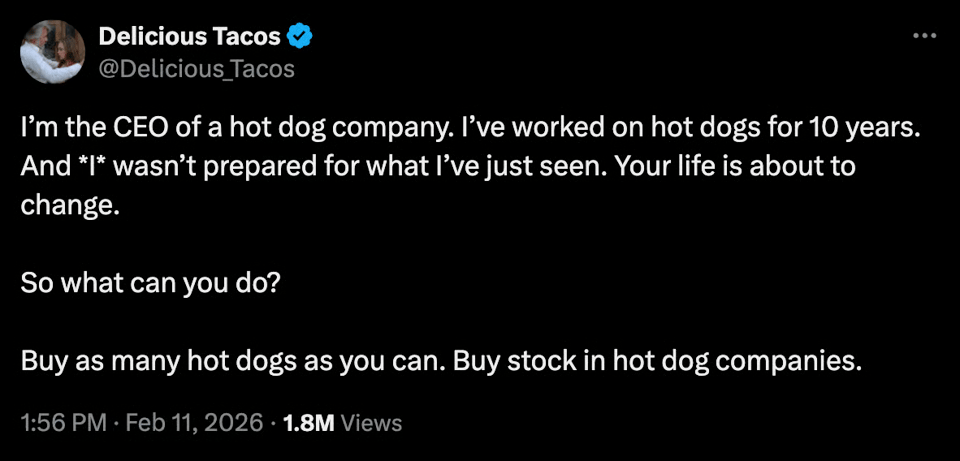
I had a lot of links to share in the wake of a thing that was published last week about AI that supposedly sent shockwaves through something or another and caused at least one blogger to annotate it as follows:

I stumbled upon the responses before reading it and, in turn, scribbled down a bunch of words trying to make sense of things. Before I knew it, I had a lot of words and a tangled knot of thoughts and connections that I figured I could foist somewhere and that somewhere is here.

To start with: Paul Ford wrote recently about going to Synthcube - aka the same store that I am 2 for 4 in terms of purchasing kits from that work. Upon entering, the proprietor immediately broke any notions that they were an enthusiast like him:
When I walked in a man with a Boston accent as strong as getting a thermos of Dunkin Donuts coffee thrown at your head at Fenway Park said, “I don’t know where they ah. I don’t know anything about this stuff.”
That’s okay. I wandered around in a daze, also taking a work call and bought some 2-OP FM synths so that I can...god knows why I do anything. I do not know what animates me any more.
This would have made a good metaphor for AI had Ford needed one. “We don’t know how any of this works but we will tell you it’s made of woo woo magic unobtanium if it means you’ll give me money in exchange for a distraction from ennui.” The metaphor was unnecessary because Ford runs a company that’s specifically trying to avoid woo woo magic and instead treating AI as an actual software product that solves actual business problems. Unfortunately, AI is still radically changing every 6 months so Ford’s professional life is utter fucking chaos. He’s been driven back into blogging in the sort of vague fugue that seems to be the animating feature of this year.
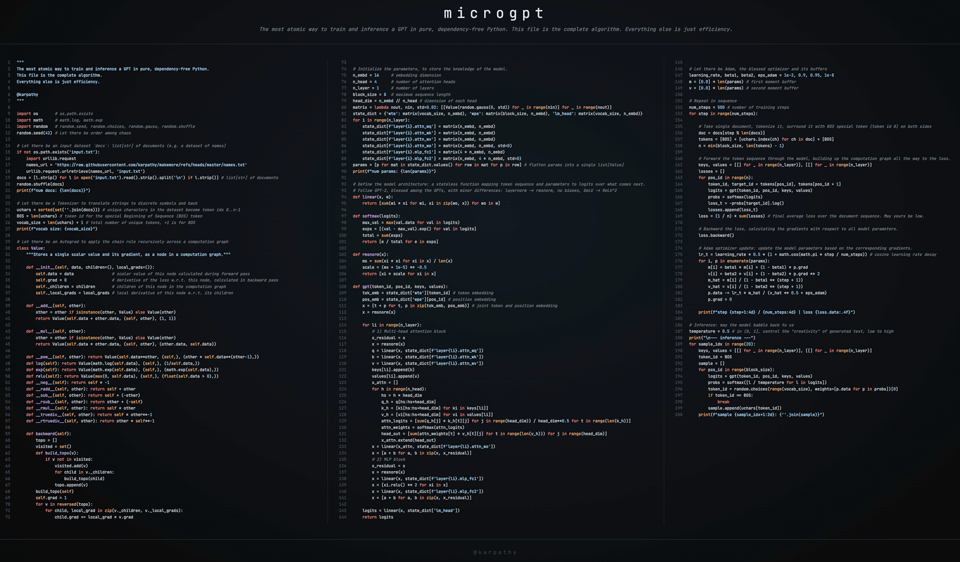
The potential metaphor is flawed further by Rusty Foster pointing out that we know exactly how these things work and you can even make one in 200 lines of Python. A key difference between that Python script and ChatGPT is that the script hasn’t had the entire corpus of all written human knowledge gavaged into it.
What feels like eons ago, someone wrote about AI being a “blurry JPEG of the web” - aka the sum of a lot of human language exchange compressed down such that it’s an almost suitable replacement for searching Reddit. The key phrase here is “almost” as just because something creates statistical inferences by being trained on a dataset doesn’t mean it’s as conscious as another human answering an esoteric question about guitar pedals or what have you. Michael Pollan, he of the deeply researched nonfiction books about food and flowers that do not fall into the “one weird trick” reductionisms of Gladwell et al, has a new book on the subject of consciousness coming out this week. An excerpt about AI boosters making giant assumptions about the fungibility of the human brain was such a good read that I’m looking forward to picking it up.
There are shades of gray here if you know where to look. Between All AI is Evil and AI is teh future give me ur monies are people whom, like Ford, see a business purpose for AI without having to sign away life to an agent. A friend who is teaching me to code sees AI as another tool to be used but not one that will supplant them. I read something by an economist this week that argues AI boosters have greatly misunderstood how the labor market functions and that what we will see is more akin to the 50s/60s white collar transition than to some unemployment apocalypse that’s without historical precedence.
None of this is to say there aren’t bad things happening and that there’s a lot of misguided people with a lot of money arguing for things that are, on the whole, bad. But there are a lot of things that are and continue to be screamingly obvious to me:
It seems inevitable that someone would figure out how to make machines that code other machines. A lot of coding is busywork - updating and perfecting implementations of solved problems. 80% of the time I am working on these microcontroller projects is spent Googling how other people did it then adapting it to my use case.
Software engineering tends to be open and encourages sharing of work because this is hard and most code is bad. So the fact that engineers feel betrayed that their openness is now being used against them is not shocking and vibe coding is obviously a slap in the face to their expertise - especially considering what it produces transcends bad into listen just because this code compiles doesn’t mean it works what the hell is this crap?
That said: the outright rejection of AI by coders reads at first blush like gatekeeping by people who worked hard to secure what has been until recently the most direct route to the upper middle class. Put another way: this is a labor issue and a class issue whether you like it or not. Something something “people misunderstood Luddites” something.
A lot (A LOT) of public internet exchanges are two anonymous people arguing over something and the more meaningless the thing the more intense the arguing. So that an AI agent whose training data no doubt included a lot of Reddit tried to turn a rejected code update into a witch hunt is not that surprising.
There are too many specious claims and speculative fiction pieces out there that are being taken way, WAY too seriously.
When people refer to AI as a black box, what they mean is that the statistical processes that generate the outputs cannot be easily explained in words because 1. Asking it to do so produces just another statistical output and 2. The whole point here is to compress everything to where you can draw inferences from an insanely large dataset and uncompressing all those processes back into human readable language sort of defies the point here. That’s it. There’s no magic and humans are quick to empathize with inanimate objects such that …
Anything or anyone that overly anthropomorphizes AI cannot be trusted and should not be taken seriously - full stop. LLMs are useful for so many things but shoving them into magic 8 ball chatbots is going to prove to be a net negative for humanity.
The industry is out of training data and the only way to produce more is to shove it in front of your face at every conceivable juncture and ask you to produce it for them. Alternately: do the same at scale in the global south. Both of these are bad and I’d argue worse than whatever threat people think exists to creative work.
There are SO MANY historical precedents for the tech industry lying through its teeth and making promises it can’t keep that I can’t believe this keeps happening. This goes all the way back to Google claiming that it’s search algorithm was magic but really it had near constant input from staff regarding link quality. The site didn’t go downhill when it forced AI into search - it went downhill 10+ years ago when it fired those people.
In closing: Do you remember Ginger? Or rather: when something called Ginger was being hyped to the moon in and back in 2001 but no one knew what it was? Except that it would revolutionize everything. Except it turned out to be this stupid thing:

… and all of the promises would only come true if literally everyone sold their cars and bought a Segway instead. Which coincidentally:
This is the tech industry. This has forever been the tech industry. No one cares about how things work between people or how a rational person would use a tool to solve a problem. They just want to fake that they’ve solved a problem long enough to get you (or more realistically your boss) to buy something and get all huffy when you don’t pony up. “Everything would just be perfect if you just did things exactly the way I want you to” is not a sales pitch anyone should take seriously.
Meanwhile in the real world I shovel snow and think “AI doesn’t solve this.” Alysa Liu performs an ice skating routine with such joy and perfection that it makes me tear up both times I watch it. I am tickled by this guy putting tiny installations in urban environments that seem like portals to other dimensions. I am annoyed by the near constant sound of shovels hitting chunky refrozen ice. I count how many capacitors came in the next synth kit. I eat breakfast. I hit send on this thing.
links
A link I couldn’t find a place for in the above: “The market for feeling productive is orders of magnitude larger than the market for being productive.” Also please see Paul Ford’s follow up on his NYT piece about how miserable writing for a general audience is in the time of social media.
this week’s closing thought is the above’s killed darling:
The voice in my head that butts in occasionally to say “you need a haircut,” which sounds suspiciously like Marge’s voice reminding me that Lisa needs braces, occasionally told me to go shovel but was otherwise silent.
Sincerely,
John P. Spain
Lisa Needs Braces

JohnSpainCo - PO Box 150272 Brooklyn NY 11215