From Art to Infrastructure: Building the Dark Forest Speakeasy OS
In my last post, I wrote about hosting the Create-a-thon, a 48-hour DIY creative challenge. But while I was hosting the event, I was also simultaneously a participant.
Going into the weekend, my plan was straightforward: I was going to make an audio-visual performance using TouchDesigner and Ableton. I had everything ready and a schedule mapped out: Friday night I would make music, Saturday morning I would go out and collect 3D scans and video footage for the visuals, Saturday night I would link the audio and visuals, and Sunday would be spent tweaking, editing and practicing.
But by Saturday night, I had scrapped all of it. Instead of making the art I had envisioned, I spent my 48 hours building infrastructure. I built a working prototype for a web application called the Dark Forest Speakeasy Operating System (DFS_OS).
Here is why I pivoted, and how I vibe coded a prototype app from scratch in a day.
The Origin: Floating in the Dark Forest
The seed for this project was planted on the Friday morning before the Create-a-thon even began. I was attending a workshop hosted by Future Makers, where I worked alongside a mix of creative industry professionals to brainstorm the future of Toronto’s creative landscape in the year 2050.
I had recently been binging the New Creative Era podcast with Yancey Strickler and Josh Citarella, who discuss "Dark Forests" as online spaces that provide privacy away from public platforms.
The concept, originating from Liu Cixin’s The Three-Body Problem, suggests that in a hostile environment (like the algorithmic web), silence and stealth are survival strategies. When the Create-a-thon prompt was revealed to be "Floating in Space," everything clicked.
I wanted to take this highly digital concept of the "Dark Forest" (hidden, private spaces) and bring it IRL (like a speakeasy). While Strickler and Citarella are currently developing a digital OS for these online spaces, I saw an opportunity to build a speculative extension of their work for the physical world. I imagined a tool that felt like "early Facebook events meets Temporary Autonomous Zones". A way to gather offline with trusted confidants, to communally create and to share art and ideas in private.
The Pivot: Following the Thread
Despite this exciting idea, I spent Saturday fighting myself. I tried to stick to my original plan of making music, but it felt uninspired, things just weren't clicking.
Two things helped me let go. First, I was working an afternoon jazz show that was also a celebration of life for a regular on the local jazz scene: a woman who lived fully and followed her passions purely. It was a stark reminder to follow the creative thread calling to be pulled, rather than the one I felt I should be pulling.
Second, I remembered that app building is a creative act. Every granular design decision is a socio-political choice. I realized my project wasn't the event itself, but the system that enables the event. I was interested in "meta-creativity": creating the conditions for ourselves and others to create.
The Build: "Vibe Coding" with AI
I am not a full-stack engineer. To build a functioning app in 48 hours, I leaned heavily on AI tools: a process people are calling "vibe coding."
My workflow was a mix of architect and bricklayer.
Ideation: I started Friday night working with Google Gemini, iterating on the philosophy and the "manifesto" of the Dark Forest Speakeasy concept. We moved from designing a physical brick-and-mortar space to a lightweight pop-up framework.
Execution: Once the concept was solidified, on Sunday morning I moved over to VS Code and Gemini Code Assist to begin building. I fed it the conceptual prompt, and we worked to iterate on the code bit by bit. I could also ask it clarifying questions about what it had done, and manually edit code myself when necessary.
Crucially, I’m not just copy-pasting code; I’m learning from it. Watching the AI generate solutions and explaining its logic has actually sharpened my own coding literacy.
We settled on a "Vanilla" Tech Stack. No React, no complex frameworks. Just HTML5, CSS3, and raw JavaScript. This kept the project lightweight and understandable: an app that feels like a tool, not a product.
The Prototype: How DFS_OS Works
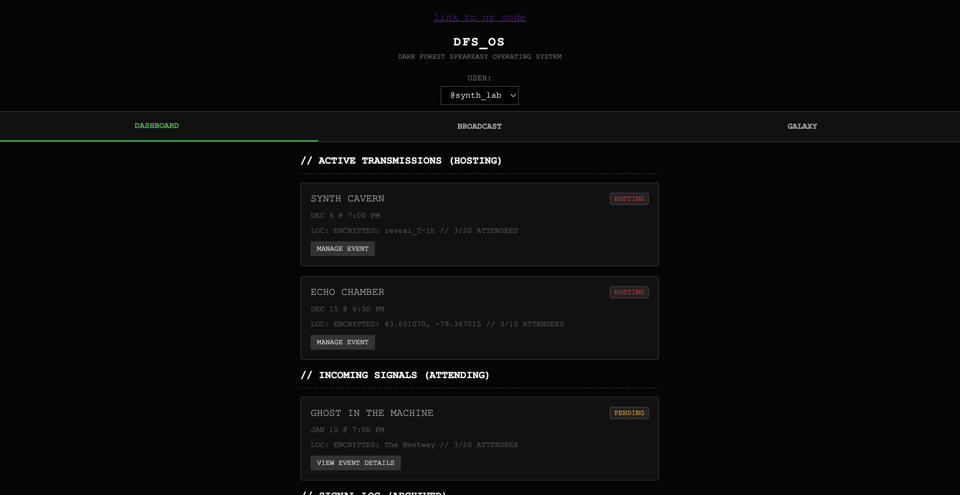
The result is a high-fidelity Single-Page Application (SPA) that runs entirely in the browser using localStorage to simulate a backend.
Aesthetically, I stuck with the "Terminal Green", function-over-form aesthetic that code assist produced in our initial code block. I didn't want to get bogged down in CSS tweaking when the functionality was what mattered, those changes can and probably should come later, something I learned while overhauling my personal website in the last couple weeks.
The DFS_OS features three core concepts designed to protect the "vibe" of a gathering:
1. The "Friend-of-a-Friend" Invite Tree The most critical feature is the invite logic. The host (Level 0) invites primary guests (Level 1). If enabled, those guests can invite their friends (Level 2), but the chain stops there. It enforces a "two degrees of separation" rule, ensuring the room remains intimate and safe.
2. Contextual Anonymity The app uses "simulated authentication." It knows who you are and hides information accordingly. For example, location details are stored as ENCRYPTED strings in the data until you are a confirmed guest. It treats event details like a secret key.
3. The Galaxy (The Archive) In the spirit of the Dark Forest, documentation is handled carefully. The app includes a "Galaxy" view: a public archive of past events. The goal is to eventually have the app compile photos and texts into "zine-like" micro-webpages that don't feature clear faces or identifying details, preserving the privacy of the moment while sharing the output.
Conclusion
By Sunday night, I hadn't made a song or a video. But I had built a working operating system for a new kind of social gathering.
This weekend taught me that software is just another medium. We can build our own tools. We can craft our own Dark Forest Operating Systems that reflect our values: privacy, intimacy, and connection, rather than accepting the pre-formulated platforms where we are dropped into as invasive species.
The DFS_OS is currently just a prototype living on my laptop and website, but the idea is now out in the wild. And sometimes, that’s the most important thing you can create.