Designing with Living Organisms? But please, follow the path of care.
Hi, how are you doing? Thanks again for subscribing to the Porous Letters. This is my first letter to you, talking about my advocate for care in designing with living organisms. I hope you enjoy!
In recent years, biodesign, the creative practice of working with living organisms, have gained significant attention across the Global North. Countries like the UK, the US, Australia, China, Japan, and much of Europe have seen a surge in biodesign initiatives, from international competitions like the Biodesign Challenge and the Dutch BAD Award to dedicated Master’s programs at renowned design schools.

While it is fascinating to see the new kinds of “products” people can create with living organisms, several questions remain insufficiently addressed amongst academics and practitioners.
First, how can designers move beyond human-centered sustainability to imagine systems where humans and other living beings form mutually sustaining relationships?
Second, how can designers acknowledge the rights, labor, and agencies of these living organisms throughout the design process and outcomes?
And third, how can biodesign be a pathway towards mutually sustianing relationships, without reinforcing extractive logics disguided by ecological claims?
As a design scholar who has more than five years of experience diving into biodesign and how care is emboded in biodesign, in this article, I explore a proposition that urges us to rethink our assumptions. Drawing from relational and feminist ethics, I propose that: “If beings do not pre-exist relatings, then designing does not pre-exist caring.”
This shift asks us to reimagine biodesign not as a creative act that precedes care, but one that grounds upon it. It suggests that sustainable and ethical biodesign must begin with the deliberate cultivation of relationships: a web of care that allows both humans and nonhumans to live as well as possible, together.
Biodesign as a Context of Inherent More-than-human Power Dynamics
By integrating organisms such as bacteria, fungi, and algae into everyday artefacts, the biodesign paradigm challenges conventional industrial production while envisioning more sustainable and regenerative futures. Yet it may still be too early to determine whether these goals are being meaningfully realized. The socio-ecological implications of biodesign have been critically examined by artist Dr. Daisy Ginsberg and designer Natsai Audrey Chieza. In their 2018 editorial Other Biological Futures (Journal of Design and Science), they caution that biodesign risks becoming merely a drop-in replacement within an otherwise unsustainable economic system — serving primarily human well-being and privileging a few carefully selected monospecies.
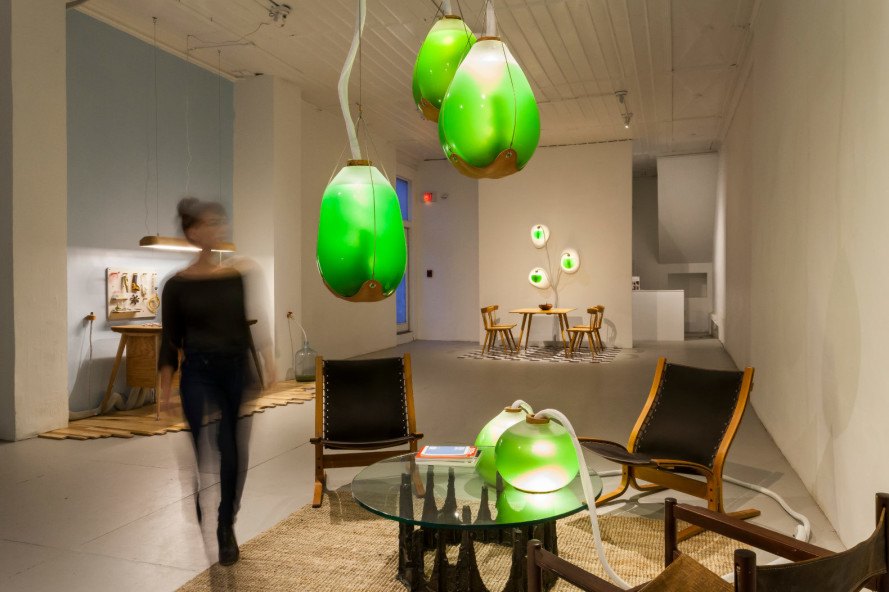
On one hand, biodesign explores new possibilities for co-existence within novel ecologies. For instance, Living Things, a project incorporating microalgae cultivation into domestic furniture, demonstrates the potential for cohabitation between humans and algae in shared living spaces. These artefacts may open up new forms of symbiosis and cohabitation, while “raising critical questions about care, responsibility, and adaptation in everyday contexts.” Whether situated in domestic interiors, public spaces, or even within the human body, such living artefacts extend our proximity to nonhuman life in material and affective ways. However, rather than supporting the flourishing of diverse lifeforms in their naturally evolved habitats, biodesign often involves the deliberate appropriation of specific organisms into what is framed as the “human environment.” — which is essentially a form of extraction and exploitation that is not straighforwarded justified.
On the other hand, things are improving. As biodesign matures, design scholars are increasingly foregrounding its ecological and ethical dimensions. For example, design scholar Fiona Bell and colleagues explored how multispecies-driven degradation processes reshape 3D-printed biomaterials, while Groutars and colleagues advocate for ecologically situated design practices that embed living artefacts within intricate webs of life. The notion of regenerative ecologies further frames biodesign as a catalyst for cohabitation and coevolution between humans and other-than-human species.
But are these approaches enough? In my view, they still fall short of fundamentally challenging some anthropocentric foundations of biodesign. A more radical agential approach can be seen in the work of Yuning Chen and colleagues, who propose the concept of microbial revolt to foreground microbial agency within design processes. Similarly, Jiho Kim and collaborators explore methods of becoming microbes — designing to cultivate empathy, attentiveness, and expanded sensibilities toward microbial life itself.
Care in Biodesign
As ambivalent as care itself, designing with living organisms inevitably involves power asymmetries. The human designer or cohabitant often holds authority over the conditions that determine an organism’s survival. These living beings are frequently sustained within tightly controlled environments — designed to keep them alive primarily so they can “function” in ways beneficial to humans.

In this context, I draw on María Puig de la Bellacasa’s conception of care as a disruptive force — one that unsettles dominant, utilitarian frameworks. I propose that care must be understood as an essential and inseparable dimension of biodesign — not as a moral afterthought or an act of routine maintenance, but as a relational commitment that begins before design and continues throughout.

Too often, care is invoked superficially: as a label, a slogan, or a gesture of goodwill once the object is “finished.” But living organisms mobilized to human-dominant environments require delicate care from humans from the outset — not only translated as “keeping alive” in scientific labs and design studios, but also “socially-attuned” through the manifest of materiality itself. This care is not optional; it is the very condition of the organism’s ability to live and, by extension, of the design’s ongoing viability. What I am advocating here, is a shift in the thinking of care from separate consideration to integral element through every pore of the design.
Puig de la Bellacasa describes care as a multi-layered, non-innocent, and mundane doing — a form of engagement that is both ethically charged and materially grounded. Her framing invites us to imagine more generative, co-constitutive relationships between humans and other-than-human life, relationships that resist purely instrumental or functional logics. I find this framing deeply resonant within the context of biodesign.
Yet the current recognition of care in biodesign remains either too instrumental or idealized.
Critiques of Claims on Care in Biodesign
Over the past decade, early biodesign practitioners began incorporating the notion of care by acknowledging that human actions are essential to keeping the living organisms in their designs alive. For instance, Dutch designer Teresa van Dongen’s Spark of Life (2014) — a lamp powered by electrogenic bacteria — requires users to periodically feed the bacteria nutrients to keep it “functioning.” Van Dongen envisioned this act of feeding as a way to cultivate a closer relationship between people and their objects. Similarly, in Ambio (2014), a lamp containing bioluminescent bacteria, the user must tilt the lamp periodically to provide oxygen — essential for both the light effect and the well-being of the bacteria.
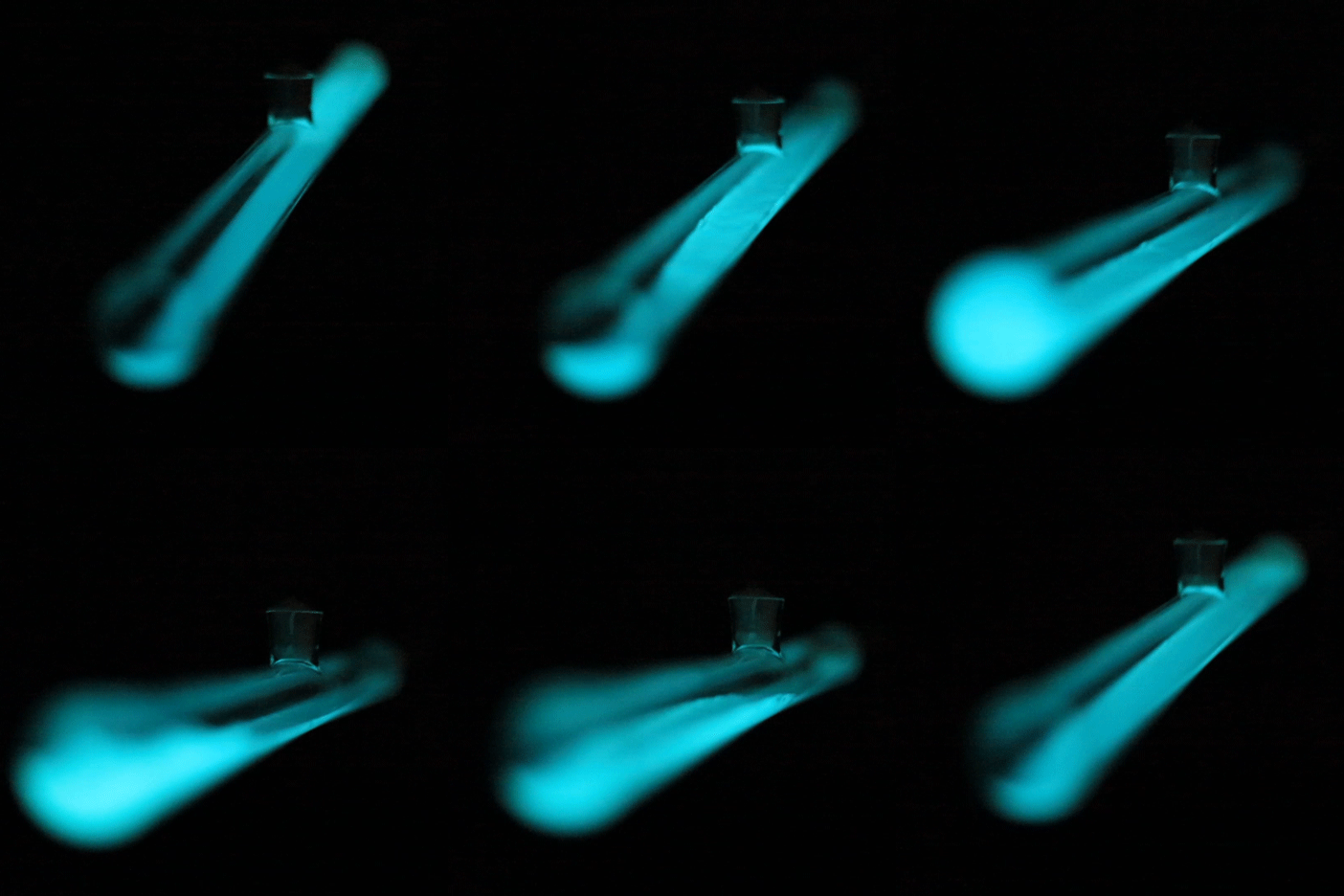
These works inspired scholars such as Elvin Karana, Bahareh Barati, and Elisa Giaccardi to propose the concept of mutualistic care in biodesign. They describe it as a reciprocal, evolving relationship between organisms and humans, where care is exchanged for functional or aesthetic benefits. While conceptually appealing, this framing risks presenting care and mutualism as immediate, smooth, and ideal outcomes — as if the mere inclusion of care language ensures ethical design. This is problematic. It overlooks the ambivalence, friction, and uncertainty that characterize real-world relationships with more-than-human beings. It also departs from Puig de la Bellacasa’s framing of care as a thick, messy, and disruptive practice — one embedded in the complications of everyday life, not polished ideals.
To me, such conceptual neatness lacks the ethical imperative that should drive biodesign today: the spirit of inquiry, of asking why, and of attending to the specific rather than retreating into generic ideals.
In contrast, scholar Rachel Armstrong offers more grounded insights into what an ethic of care in biodesign might entail. First, she highlights the need to recognize microbes’ omnipresence, agency, and world-making capacities — their metabolic roles in transforming Earth into a habitable biosphere. Second, she advocates for decentering the human designer, envisioning design as a process that emerges from an “expanded community of multispecies participants.” And third, she introduces the idea of “mutual thriving” as a foundational principle — redefining biodesign as a collaborative, symbiotic, world-making practice.
While I find Armstrong’s ideas generative, some of them appears disconnected from practice. Moreover, such broad principles are open to interpretation and risk becoming rhetorical — inviting a kind of care-washing, where invoking care discourse substitutes for actual relational or material accountability.
Designing Does Not Pre-exist Caring: Grounding Care in Practice
Beyond the discussion of care during cohabitation, there is something deeper at stake. What I propose in this article is a more permeating understanding of care — one that does not begin or end at a specific moment in the design process, nor exist as something separate from the livingness it engages with.
This is a form of care that seeps through the entire relational field — not bound by phases, tasks, or outcomes, but entangled with the ongoing conditions of life itself. To better understand this expanded notion of care, let us turn to a few examples outside of biodesign that illuminate how care can be enacted — not as a design intervention, but as a way of being-with.
What can we Learn from indigenous knowledge and ecological care?
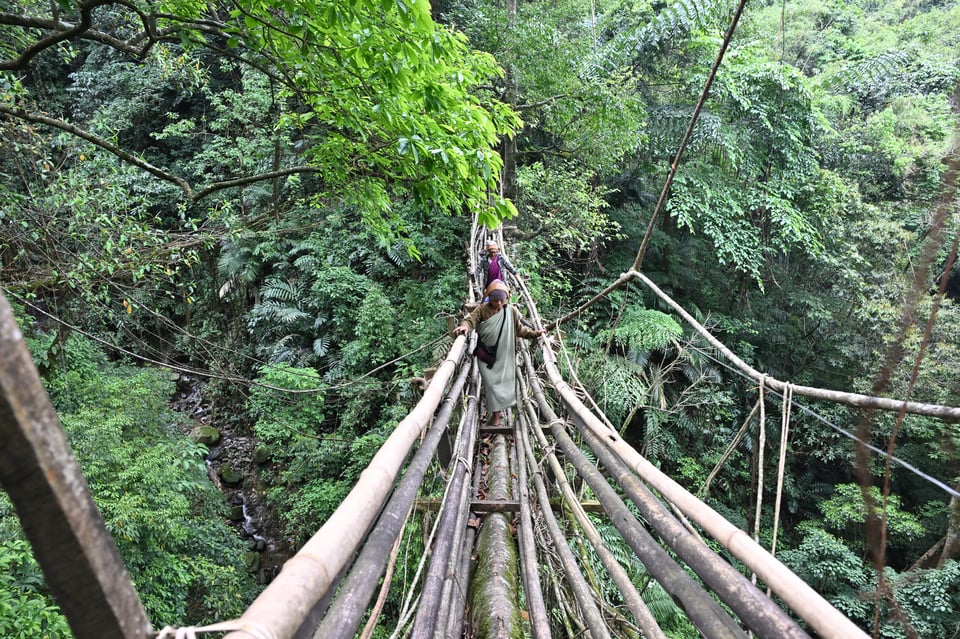
In indigenous tribe of Khasi in Meghalaya, north-eastern India, people have mastered the art of making bridges from ficus trees that help them travel through dense tropical forests. The Khasi villagers tie the aerial roots of the rubber tree (Ficus elastica) at both ends of the river to pieces of bamboo which help guide these roots towards each other and intertwine. In order to keep the trees healthy and their bridges long-lasting, Khasi people have adopted a sustainable lifestyle in deep connection and interdependancy with nature — areas within forests where extraction of natu- ral resources is prohibited to allow natural regeneration, or a ban on hunting wildlife. I find it a beautiful example of mutualistic relationships rooted in indigenous culture of human life; but also an example of care that weaves with everyday necessaity, restraint and boundaries. The Khasi people keep at a minimal level of intrusion to the living tree, whilst span the “design” of the bridge over years and years to respect the natrual growth and rhythm of the tree in its original environment.
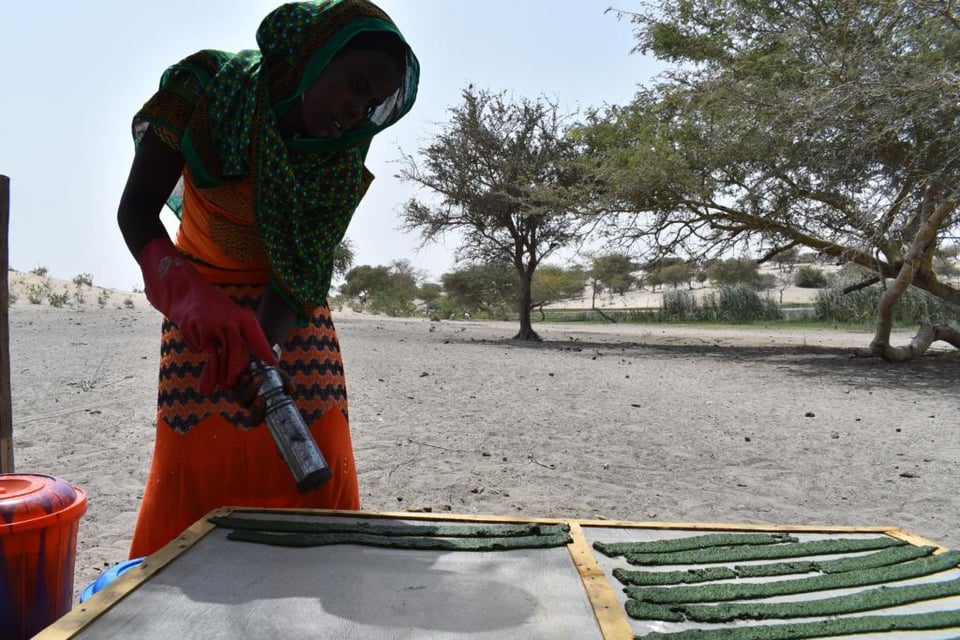
Another example of more-than-human interdependence is the relationship between African communities and Spirulina (cyanobacteria) around Lake Chad. Revered globally for its detoxifying and nutritive properties, Spirulina grows naturally in the oasis (wadi) waters surrounding the lake. In the village of Artomossi, located in the Iserom canton of Chad’s Kanem and Lake provinces, around 200 women traditionally harvest and process the algae. Each day, water from the ponds is collected, filtered and sun-dried into “spirulina cakes” and sold locally or exported to neighboring countries. This practice reflects how natural reserves can belaboratories of harmonious interaction between people and nature, sustaining both traditional knowledge and local livelihoods. However, despite a recent increase in Lake Chad’s surface area, its ecosystems remain fragile — having lost 90% of their area between 1960 and 1985. Deforestation, drought, and biodiversity loss are compounded by conflict-driven population displacement and economic precarity.
In response, UNESCO launched the BIOPALT project, which supports local communities in some of the world’s poorest regions. Applying the principles of the Man and the Biosphere (MAB) programme, the project fosters culturally appropriate, green-economy-based income-generating activities. These include an early warning system for floods and droughts, the restoration of fishing practices, and the cultivation of lucerne to feed the endemic Kouri cow — a species with deep ties to local ecological and social life.
How Can We Care When the Lab Is Involved? Suggesting Path of Care.
While the previous examples are inspiring, they differ significantly from practices of biodesign — where living organisms are not situated in their native habitats, but relocated to laboratories designed for their isolation, cultivation, and use. In the case of the Khasi root bridges, the organism remains alive and rooted in place, with human intervention facilitating its growth. In the Lake Chad example, Spirulina is partially harvested and consumed — an act that involves both interdependence and a form of killing.
These examples reveal how care and extraction often coexist. They remind us that interdependence doesn’t preclude harm — but rather, demands deeper attention to it. In biodesign, where habitat transition is often drastic and extraction more explicit, I find myself asking: How can we care when organisms are removed from their ecological contexts? And more importantly, how can we care better?
This is not to suggest that such practices are inherently unethical. I align with Donna Haraway’s view that some degree of appropriation is inevitable — part of the messy reality of living, researching, and designing as humans. But what I strongly critique is when such practices lack reflection — when they are carried out without acknowledging the extractive conditions they rest upon. As Haraway argues, the real problem is numbness: the absence of pain, responsibility, and response toward the nonhuman others we entangle with.
To counter this, I propose several ways in which biodesigners and researchers might practice more-than-human care. For clarity reason, I categorize these ways into pre-design, during-design and post-design groups from a biodesign project’s point of view. However, I fully recognize that these stages are usually entangled without clear boundaries.
This article is only a departure point and I know each of these points deserves an article to elaborate on. That’s why I will unpack these points further in my future articles. For now, food for thought.
Pre-design:
Acknowledge and visualize the full picture of care relationships we establish with living organisms inside and outside the lab — whether temporary, one-directional, or entangled.
Incorporate care into our positionality as researchers and designers — by reflecting on our own habits of consumption, extraction, and attention in everyday life.
Invite ecological assemblages as part of the design. Think of living materials as ecosystems rather than monocultures, “pure” organisms or selected few organisms.
During-design:
Treat the lab environment as a “meta-petri dish” — a space embedded in broader ecological and social systems, deserving the same care we give controlled cultures.
Minimize instrumentalization, intervention, and killing wherever possible — especially in decision-making processes where other outcomes are viable.
Fully consider the inherent tensions in self-care and care for other living beings during co-habitation and avoid naive techno-solutionist approaches. Care is ambivalenct and imperfect in everyday life.
Post-design:
Consider how the design can last as long as possible rather than only last for one life cycle, how biomass and waste can be collected and decayed.
Incorporate routes for disassembling, recycling and degrading into the design.
Open Questions and What Comes Next
That said, many important questions remain unanswered — questions that resist closure and require ongoing reflection and practice:
What tensions and struggles does care entail in real-life contexts?
How can care be meaningfully facilitated within the boundaries of design itself?
In what ways can care be designed to disrupt, rather than reinforce, human dominance?
What dilemmas, ambivalences, or contradictions might a biodesigner encounter when trying to care?
How might lab practices shift to better acknowledge the agencies and labor of living organisms?
What could biodesign become — beyond its prevailing forms in labs, studios, and sites of use?
And how can we cultivate design methodologies that invite living organisms into the decision-making process?
These are not questions with simple answers. But they matter. In future articles, I will continue to explore these entanglements — drawing from theory, practice, and lived experience.
If these questions resonate with you, I invite you to follow my updates and join me in staying with the trouble of more-than-human care.