Eat This Newsletter 316: Strategic
Hello
In today’s harvest, the knotty question of organic goodness, multiple celebrations of autumn’s apples, hunger — visible and hidden, global and local — and the latest on seed to sip spirits.
Organics Examined
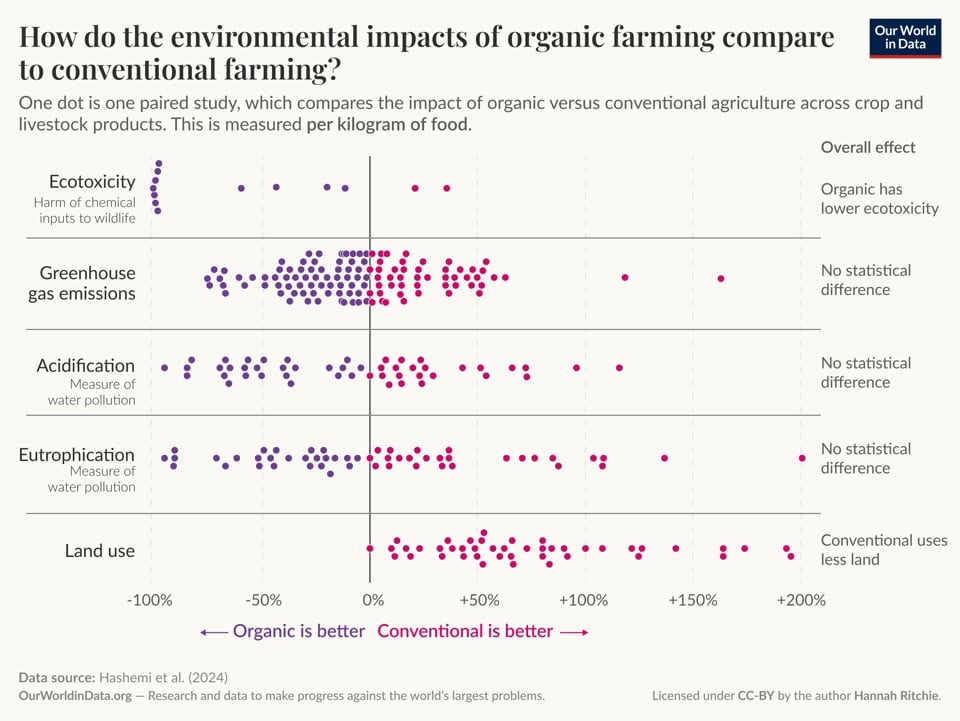
Our World in Data is a true marvel if you want to understand complicated things. A recent article there — Is organic farming better for the environment than conventional farming? — has been getting a lot of traction, and deservedly so.
There is no point in trying to summarise, given that the article is itself a very clear summary of mountains of research. Bottom line: It’s complicated.
Some conclusions I do find hard to believe. For example, while organic fields may harbour more biodiversity, the effect does not extend to an entire farm or the surrounding area. Is this comparing an organic field with an inorganic one on the same farm? If so, I would not expect the farm in transition to contain more biodiversity than a fully organic farm. But the surrounding area? That seems to suggest that the organic farm is one island in a sea of conventional farms. I have not gone back to the original sources, but I do wonder whether there might be entire catchment areas that are either organic or conventional and that could be compared.
The land use penalty, by contrast, is very real. Organic does deliver less food per unit area, so would require more land to deliver the same amount of food. It follows that for ecotoxicity and greenhouse gas emissions, organic is better than conventional per unit area, but worse per unit food. For other environmental impacts, there is no difference.
I do wonder, though, whether the threat of more land having to be converted to agriculture for an entirely organic sector might be more than offset if all the land that currently grows food that passes through animals before it passes into people were to be used to feed people directly.
Overall, what you eat is more important than how or where it is grown. Conventional Canadian lentils transported to New Zealand are going to be better than an organic lamb chop any way you slice it. Maybe they would be even better grown regeneratively, if only we could agree what that means.
Ripeness to the Core
No apologies. It’s apple time again (in the northern hemisphere).
- The Botanists in the Kitchen have, of course, chosen “apples, those iconic harbingers of autumn,” to end their investigation of the Rose family. Almost everything you could possibly want to know about apples is there, including one for the pedants — the core is the fruit. One thing I had never thought about. Crab apples are in no way special: they “are just Malus taxa with fruit less than 5 cm in diameter”. And one thing the BiK maybe don’t know: an Egremont Russet with crunchy peanut butter is ambrosia.
- Scientific American offers a good old detective story that used DNA and known historic varieties and texts to identify the long-lost ancestor of almost all the apples in the USA. Turns out to be a French variety that dates to at least 1628. And the apple enthusiasts have now found not one but two individuals. A great and satisfying read.
- Savouring Old Apple Varieties brings it all together, with news that a living genebank of cider apple trees outside Hereford in England has been granted the status of a National Plant Collection. The same DNA sleuths are at it with this collection too, genotyping each apple and discovering hidden gems. One puzzle: the Apples & People website has announced that it is to close at the end of 2026. There’s no mention of an archive. How can you care about preserving old apples without also conserving what you’ve learned about them?
- And if you’re going to be around Williamsburg MA on 6 November, you might want to visit the 7th Pomological Exhibition put on by Gnarly Pippins. Even if you’re not, read the post for Matt Kaminsky’s thoughts on the difference between mast and crop, and how being a crop gives us the vocabulary to describe it. Or vice versa!
Grand Global Hunger Plan Revealed
The leadership of the Food Security Leadership Council has offered the world, and more specifically the United States, its counsel. Avoiding the Next Famine in Foreign Affairs magazine explains why and how “a U.S.-led effort to address hunger would … rebuild global confidence in its leadership and demonstrate the value of international cooperation.”
The paper offers some big suggestions that would indeed do a lot of good, and not just for global hunger. It also lists some of the factors, natural and geopolitical, that threaten hunger, which in turn threatens peace and stability. And it concludes with a resounding blast.
Rarely do Washington’s strategic imperatives and humanitarian principles align so neatly. It is rarer still for a U.S. foreign policy agenda to clearly reflect what the American people want their country to be: not just strong, but moral. Food security, in other words, is a unique opportunity for the United States. The country cannot afford to waste it.
I guess we’ll see.
Local Hidden Hunger Exposed
A new paper in Nature Food details how “loss of salt iodization harmed child survival and academic achievement in Ethiopia," an early and successful adopter of iodine fortification. (It’s behind a paywall, but here’s the preprint.
Ethiopia’s iodine-rich salt came from a processing facility on the coast in Eritrea. In May 1998, the border closed, cutting off supplies. The country lifted its previous ban on non-iodised salt, and by 2005 severe deficiency was widespread, along with visible goitre in schoolchildren and women of reproductive age. By 2015, non-iodised salt had once again been banned.
The border closure thus offered Robel Alemu at Tufts University and his colleagues a natural experiment. The analysis of the experiment is complex, but in essence the researchers compared groups born at different times relative to the border closure, so their exposure to iodine differed, and they also took soil iodine levels into account. They found that, especially for those in rural areas who are more reliant on local food, children born when they and their mothers could not get iodised salt had higher mortality and did worse in secondary school and in university entrance exams, and the effect was worse in areas with lower soil iodine.
Iodine fortification is clearly a good thing, but it needs to be maintained. The researchers conclude: “As many countries continue to struggle with achieving and sustaining adequate iodine coverage, our findings highlight the importance of resilient fortification systems and demonstrate the long-term educational returns to micronutrient policy at scale.”
Iodine-fortified salt is undoubtedly one of the great public health success stories of the 20th century, but as that paper shows, the benefits can easily be lost. An article in Food & Wine raises an interesting question. Are the people who have switched to pink Himalayan salt or one of the other gourmet, artisanal salts aware that they may be at risk of iodine deficiency? The article points to an increase in “mild to moderate deficiency” in the US.
Distillers Choice
A little more than a decade ago I made two episodes about independent distilleries; Small-scale spirits and Whiskynomics. Ten years after, some of them are still going strong. Offrange magazine reports on estate distillers, centred on Whiskey Acres, a farm and distillery that was a prominent part of one episode.
Seems they and others have gone from strength to strength. In particular, the idea of cereal varieties influencing the final whiskey, whisky, and bourbon has been validated several times over. After discovering that the F1 hybrid maize varieties they were growing did affect the taste of the distillate, Whiskey Acres went back to open-pollinated varieties, which would allow them to save their own seed. They tried a few heirlooms, with some success, and then took the ultimate plunge, creating their own variety “from an heirloom Minnesota yellow dent corn and a red flint variety from Italy used in polenta”. Ironically, given that it was the inability to save their own seed that put them on the path to heirlooms and their own variety, they are now looking to protect their variety “so it won’t be available to competitors”.
Cheers!
Take care


Add a comment: