Eat This Newsletter 314: Renewal
Hello
As the summer continues to break records in the north, it feels good to have news of at least one company taking that seriously, even though others seem to be just whining.
The Supermarket of the Future Has Landed
An absolutely fascinating and long interview on The Common Table with Klaus Wiens, head of construction and store development for Rewe in Germany. Timber construction, roof-top farms supplying fresh fish and salads, it’s all very inspired, and inspiring.
The whole idea of reimagining the source of so much urban food is amazingly complex, and the interview is very thorough. There are great nuggets too. Like, the original pilot supermarket in Wiesbaden grows 800,000 “units” (pots, I expect) of basil a year on its roof, supplying 450 stores in the middle of Germany, and according to Wiens uses no chemicals. So, is the rooftop farm organic? Yes, but no.
“German certification cannot certify basil that isn’t grown in soil.”
It’s all a bit gushing, but for all that I’d quite like a Rewe as my local supermarket.
Food Waste Recycling’s Big Flaw
A group of researchers at the University of Vermont did a giant modelling study asking what would happen if all food waste in the United States were turned into either compost or biogas. The good part is that it would reduce the climate impact of food waste almost completely, by 89–99%. It would also reduce pollution of waterways and groundwater by 49–54% for nitrogen and 78–98% for phosphorus. But there’s also bad news.
A minor point, but spreading all the compost on the land would save less than 2% of the nitrogen and phosphorus applied to the soil each year. A far bigger problem is that it would spread around 20,000 tons of plastic into the soil.
There are lots of reasons. People are not that great about removing plastic packaging from food they are about to dump. And the machines that sort through food waste at the dump are not perfect either, so quite a bit ends up in the biodigesters and compost piles, waiting to be spread around.
One option is biodegradable packaging, which could itself be made from avocado peels and stale bread. Widespread adoption would eliminate the plastic problem almost entirely. Or we could, you know, start “reducing how much single-use packaging we use, and questioning how much of it we need in the first place”.
Food waste recycling in the USA can reduce climate and nutrient pollution impacts yet risks plastic accumulation in soils is behind a paywall, but there’s a good write-up in Anthropocene magazine.
Pricier Parmigiano-Reggiano
Reuters last month reported on climate change and cheese, a story that gained traction in the past week. In essence, the heat is affecting the bottom line at Credito Emiliano’s Magazzini Generali delle Tagliate. That’s the vault where they store hundreds of thousands of Parmigiano-Reggiano wheels as collateral for the low-cost loans that they advance to dairy farmers and cheese makers. This summer’s heat (not over yet) has increased the amount of electricity they’ve needed to keep the vault cool by almost a third. As a result, they say, the collateral is costing them more to store than it is worth in the event of a borrower defaulting.
I’m not sure I fully buy that, but in any case, there’s a countervailing tendency. The heat is also making the cows much less productive. They spend more time lying down, eat less, and produce less milk. Energy costs in the dairy barns have gone up too, with misters and fans to keep the cows cool. And the winter will be hard, because the heat and drought have stopped the grass growing, and the rules that protect the good name of Parmigiano-Reggiano forbid feed from outside the area.
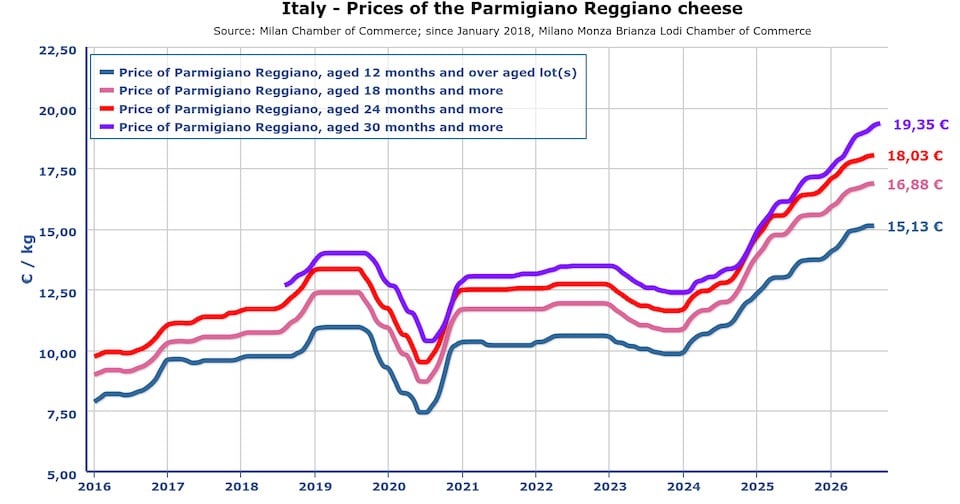
But if there’s a shortage of cheese, doesn’t that just make it more expensive? And if it is more expensive, doesn’t that make it more valuable as collateral, justifying the extra cost of keeping it cool? The graphs here show prices rising long before this summer, but the different scales make it hard to say anything sensible beyond that. I do note that the March peak this year (which may reflect September 2024 milk production, it isn’t clear) is the highest since 2016. Overall, it is absolutely clear that climate change is affecting production and prices, and not just of parmesan. Beyond that, who knows?
Exotic Foods News
Not exotic if you’re from Nigeria or Bastar in India, but exotic for me, and so I was happy to learn about Swallow in Nigeria and Chapda Chutney in India. Maybe some day I’ll get to try them.
Cyclospora News Too
Guess what? Customers in the United States have gone off fresh produce. A survey by the International Fresh Produce Association revealed that sales are down 6.5% by volume and 7.4% by value. Furthermore, “88 percent of consumers say that their confidence has been shaken in the safety of fresh produce, at least somewhat,” while “44 percent of those surveyed are waiting for an announcement that the outbreak is over and 63 percent want more reassurance directly from the government.”
Nothing too surprising there. But if you’re not used to the way big food operates, the article sheds a little light on how IFPA does its thing.
This is the end of my summer treadmill. Next week will see a new episode of Eat This Podcast and the newsletter will go back to alternate weeks. I’m looking forward to the change.
Take care

p.s. Now might be a good time to forward this email to a friend and suggest that they might like to sign up too.


Add a comment: