Eat This Newsletter 304: Small
Hello
A slight whiff of nostalgia seeps out of this week’s selections.
No-frills Tractor Gets Traction
It seems notable that demand is booming for a new, no tech, repairable tractor. Perhaps you heard Jennifer Clapp explain the stranglehold that the giant agricultural machinery companies have on farmers, and especially John Deere’s notorious disregard for farmers who want to repair the machinery they bought and own. And of course people have told farmers (and everyone else faced with similar problems) to vote with their wallets. The problem is that there have been few alternatives worth opening your wallet for.
Recently, however, a company in Alberta, Canada, started making a tractor that you can “turn on at the start of the day, … use it, and shut it off at the end of the day”. Plenty of farmers want just that. So far, fewer than 100 have managed to get their hands on one, but the company is planning to triple its production. I suspect John Deere isn’t the least bit worried, but I bet other manufacturers are eying the potential market.
Small Can Be Competitive
Contrast even a tiny no-frills tractor with the wheel hoe Gunnar Rundgren made from a repurposed bicycle. “Still my favourite tool,” he wrote, in an article doubting that technology could ever make small farms more competitive than large farms. That was at the end of April, and at the end of the article Rundgren asked readers for “examples of technologies that make small farms competitive in commodity markets”.
At first sight, there’s a trap in the request: “commodity markets”. If you’re producing something that gets sold wholesale, you are a price-taker and there is no way you can compete with a larger operation, even in a niche like “organic”. But that isn’t the only trap. “Competitive” is also a trap.
The pertinent question is not how or if small farms can compete, but why they should compete in the first place.
That’s from the follow-up article, which I found in Resilience magazine.
People will say that the kind of small farm Rundgren envisages — and operates — is some kind of anachronism today. They’re right, if all you consider is the cash price of commodity ingredients. Is that all there is?
Big Beer Comes for Small Grain
Fonio is the tiny grain of a very hardy cereal that grows across the Sahel in Africa. It has been a standby for rural people for thousands of years, important for nutrition and as part of diverse cultures. Recently, urban dwellers have begun to be exposed to fonio too, mostly in West Africa but also in Brooklyn and other hipster enclaves, for fonio is the new darling grain of craft brewers.
“[T]asting notes expand to include lychee, white grape, mango, and sauvignon blanc — appealing flavors that can fit with modern hops. Fans describe it as a miniscule (sic) grain with enormous possibilities.”
And that’s with only about 15% fonio in the grist. Take it to 100%, which a couple of brewers have, and they talk about “a fruity dryness that evokes sparkling white wine more than anything else”.
There’s more — a lot more — in the article, but little on the potential impact of a Western fonio boom on the farmers who grow and depend on it. Brooklyn Brewery, where fonio beer got its modern start, is the biggest importer in the US at 10 tonnes, small beer compared to the global harvest of around 700,000 tonnes. I’m probably worrying for nothing.
The Vegetable Lamb of Tartary
A lovely essay in the Public Domain Review charts the history of the boramets, borametz, or barometz, better known, perhaps, as the vegetable lamb of Scythia or Tartary, at the time “a vague region lying somewhere between the Volga and Ural rivers and near the Caspian Sea”.
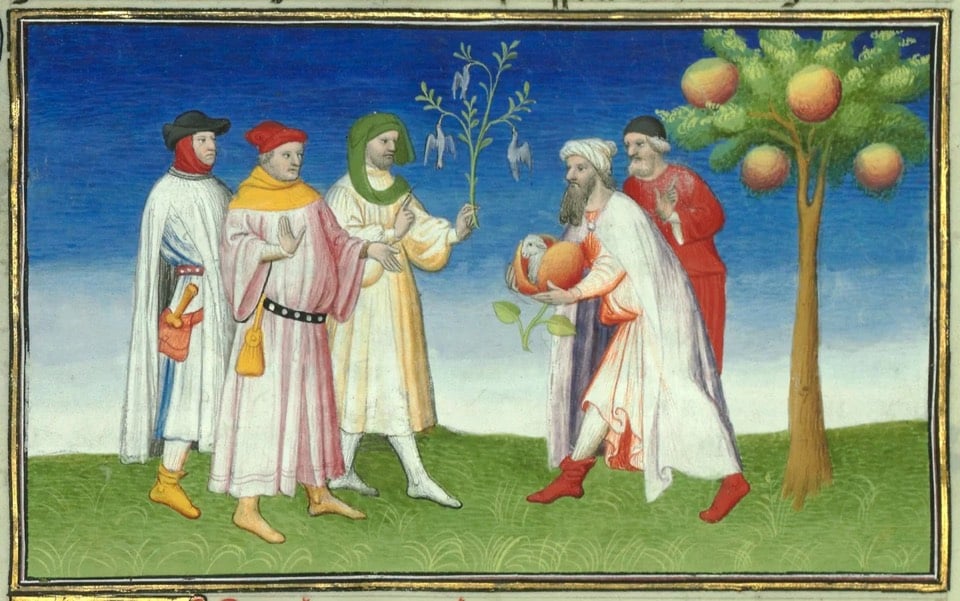
A 15th century exchange of three barnacle geese for one vegetable lamb
If you’ve never heard of the barometz, it came in two forms. In one, a tree or bush held flowers or fruits that within them contained something very like a lamb. In the other, a larger beast, more a sheep than a lamb, was supported by a sturdy trunk roughly where its navel might be. Thus tethered, it ate the herbage it could reach and when that ran out, died.
Thom Sliwowski does a great job of unpacking the stories of the vegetable lamb and offers the main ideas to account for this strange creature, part plant and part animal, that (like the barnacle goose, also seen in the picture) made complete sense before the 16th century. I won’t spoil the fun.
“In Tears Amid the Alien Corn”
The Criminalization of Gleaning by Peter Linebaugh formed a final chapter in a special issue of the journal History & Anthropology. A lot of it is not strictly relevant to food. Equally, a lot of it is, and for my money there could have been even more had food waste more widely been considered. A really interesting read.
Take care


Add a comment: