Eat This Newsletter 303: Rationality Rampant
Hello
We’ve had our first burst of real summer weather here and it makes a fantastic difference. Now, of course, I find myself dreading the too-hot-to-think ahead, but perhaps I can make a difference long-term and short by adopting a new approach to pasta.
Pasta Heresy and (what ought to be) the New Orthodoxy
Someone I follow for unrelated reasons just opined on how to cook pasta; don’t salt the water, cook for way less time than recommended, serve pasta and sauce separately, “to keep the tastes and textures distinguishable, merging only as you chew”. That’s the way his “mother (who grew up in Rome)” did it.
My first instinct was, of course, to disagree, but I abandoned that idea when I saw that the one comment he had received (so far) echoed more or less exactly what I would have said. The commenter made this key point: “I wholeheartedly disagree that the taste of the pasta and the sauce should be distinguishable.” Me too.
I’m no expert, nor did my mother grow up in Rome, but my experience has taught me that the whole idea of treating pasta and sauce as separate things is misguided. I’m not talking about the “rules” that each sauce has one and only one pasta shape it should be made with. Rather, the belief that adding sauce to pasta is all that is needed to finish the dish. Over the years I have learned to save some pasta water so that I can adjust the consistency if I need to. You may not need to, but if you forget to save some water, you’re lost. And the very act of mixing the pasta with the sauce changes both to create the final dish.
And yet, some heresies ought to become orthodoxy. Back in 2009 the sainted Harold McGee asked a fundamental question: How Much Water Does Pasta Really Need?. Much less than you might think, with benefits to the final dish too. The method is not quite the pasta as risotto approach, which starts with dry pasta and vegetables and adds liquid bit by bit. But using a quarter the water saves a lot of time and energy. There are other tricks too that you can easily search out, like starting in cold water, or pre-soaking the pasta, and if you’re looking to understand what’s going on, you could do worse than read one professor’s search for the most frugal way to cook pasta.
Incarcerated Cooking
You may recall two recent episodes on cooking in prison. I’m grateful to Ed Hasbrouck, protagonist of one, for sending a link to a piece by Ron Guier, who has been in prison for the past seven years. Guier explains that “the meals we prepare in prison bring our ragtag little community together to acknowledge our shared humanity. They remind us that even though we are separated from our families and friends, we are still part of something bigger than ourselves and that we are stronger together.”
There’s a lot to like in Ron’s story, from learning to cook as a survival skill and being played by his older brother, to the satisfaction he gained from cooking for his “mean and unkind” stepfather and, later, the ingenuity that seems to characterise all prison cooking. Clearly, Ron Guier can cook; equally, he can write.
Grapes as growth promoters
Antibiotics used routinely in conventional agriculture are dual purpose. Yes, they stop animals that are crowded together from getting sick, but they also improve productivity by enabling animals to grow more rapidly, especially welcome for broiler chickens. While some countries have banned antibiotics in feed completely, the United States is still worrying about it, unwilling to give up the productivity benefits despite the cost in antibiotic resistance. A possible solution may emerge from an unlikely quarter: grape processing.
Crushing grapes for juice and wine leaves behind millions of tonnes of pulp, skins, seeds and stems collectively known as grape pomace, which is high in polyphenols. Those polyphenols are anti-inflammatories, and antibiotics promote growth by reducing inflammation in the gut. A team of researchers at Cornell University compared the effects of grape pomace and a standard feed antibiotic on broiler chickens fed a deliberately inflammatory diet. The results are very encouraging. Just half a percent of grape pomace in the diet is almost as good as the antibiotic in “improving weight gain, feed efficiency and gut health”.
Could grape pomace replace antibiotics in chicken feed? That would be good news for grape processors, chicken farmers, and public health.
“What needs to happen next is demonstrating that it works in real-world conditions with a much bigger number of birds,” [the lead researcher] said. “Our partners now are mostly on the wine and pomace-producer side. We communicate but don’t yet collaborate with the poultry industry.”
Rational? Maybe. Practical?
Michael Ruhlman’s book Ratio popularised the idea that once you know the proportions that make a food (or, more recently, a cocktail), you instantly have access to thousands of variations on a dish. Cookie dough, the example often given, is 1 part sugar to 2 parts fat to 3 parts flour. Scale that up and down for the amount you need, add any fixings you want and, with a few modifications, a thousand cookies are at your fingertips.
I find that kind of cookery by calculation easy, because that’s how I am. What if you don’t? Well, I can confidently assure you that You Need A Kitchen Slide Rule will be no help at all. I mean, it’s a lovely thought that the magic of mathematics makes a slide rule perfect for adjusting amounts in the proportions you need. But honestly, if you can’t do the sums directly (and no shame for using the calculator on your phone), are you likely to have a slide rule hanging about?
That said, I appreciated the comment about how sensible bakers’ maths is and, even more so, the notion of polling a wide variety of recipes to establish which proportions are more important than others. I tried a version of this once for buckwheat galettes, but might need to try again more systematically as they are never quite right.
Processing: The News
For all the hoo-hah about defining ultra-processed foods (“too complicated”) in the US, it seems that Healthy Eating Research has managed to do so. I am grateful to Marion Nestle for summarising, which I summarise further:
A food product is ultra-processed if it contains at least one cosmetic additive or at least one non-culinary ingredient, not counting vitamins, minerals etc. In addition, any food that meets the FDA’s definition for “healthy” claims is not ultra-processed.
Processing: The Story
My friend the internationally renowned nutrition scientist Jessica Fanzo recently returned to Italy to live, a move she thinks “will finally stick”. And after being back here four months, prompted by two trips back to the US, she explains Why Ultra-Processed Foods Are the Real Driver of the US-Italy Obesity Divide.
It’s a really thorough account, isolating seven factors that, give or take, differ most between the US and Italy and are probably associated with obesity. In the end, she concludes that “the U.S. obesity epidemic is more about a food environment saturated with hyperpalatable, nutritionally void products that systematically override satiety signals—a metabolic hurdle that Italian food culture largely avoids by prioritizing whole ingredients”.
Seems fair to me.
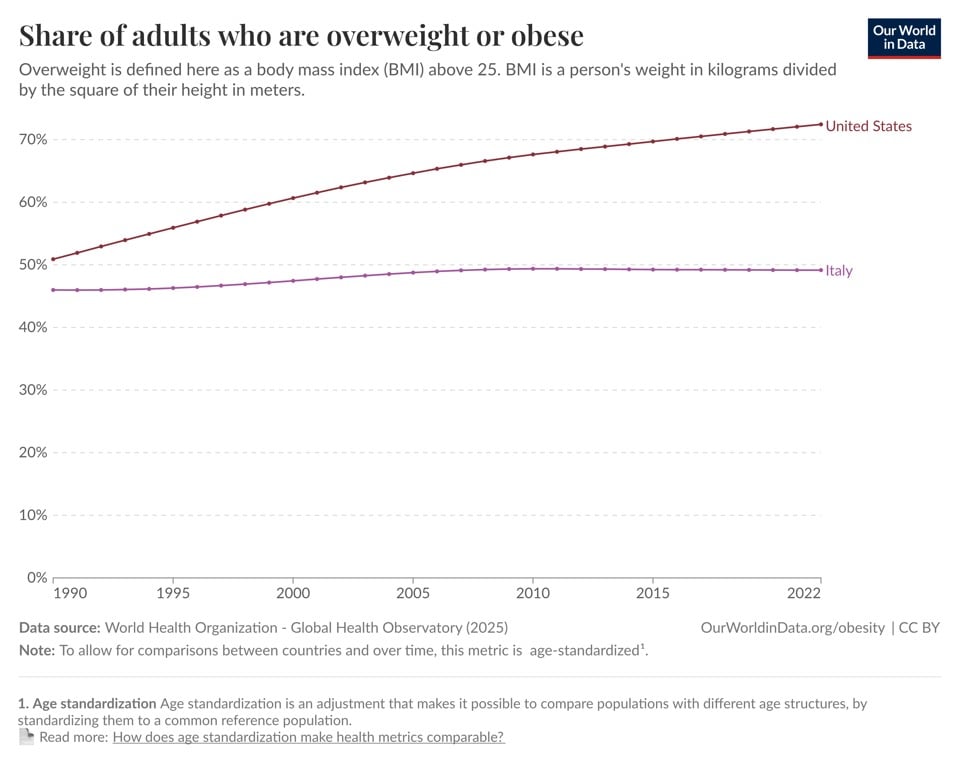
I just want to add one extra observation, gathered while checking up on some intuitions. The trend in obesity and overweight in Italy is essentially flat (46% in 1990, 49% in 2022) while in the USA it has increased from 51% in 1990 to 72% in 2022.
Support a Farmer, Eat at Home
One more picture.
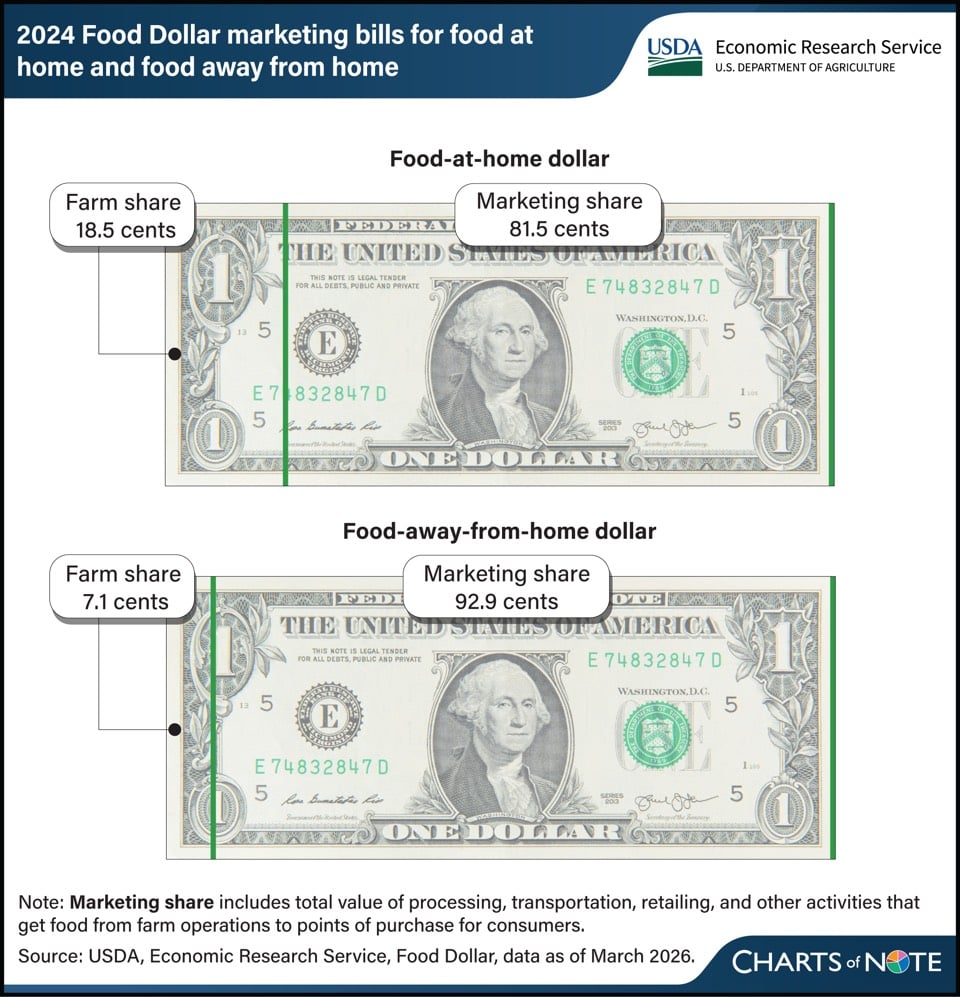
At least if you live in the United States, eating at home gives a farmer more than 2½ times more of the money you spend on food than eating out, because it avoids the cost of someone else preparing and serving the meal. I have questions, of course. Does the same difference apply to reheating prepared food that you bought at the supermarket?
Take care

-
On processed food, hyper palatable, and overly easy access to junk foods, Washington Post writer Tamar Haspel zeroed in on those characteristics years ago. Have you ever interviewed her? Might make a good podcast. Thanks Jeremy


Add a comment: