Eat This Newsletter 295: Revisited
Hello
New light on old topics today; infant formula, farm subsidies, and a little bit of Black history.
Formulaic Failures
I simply cannot imagine how an ordinary mother, especially in the United States, copes with the uncertain safety of infant formula. Sure, breastfeeding is a very good thing, but a safe source of formula if only as a backup is surely essential. And yet, the scandals continue. I can do no better than refer, as ever, to Marion Nestle, who does a good job of keeping up to speed in her recent post The infant formula scandals: will they ever stop?.
Nestle offers plenty of links to others keeping an even closer eye on the scandals around ByHeart in the US and Nestlé around the world. She also offers a recipe for home-made infant formula, while noting the many dangers that attend home-made. Bottom line:
“If you are worried about contamination of powdered formula, a better option is to use pre-prepared pasteurized formula. It will cost more, but will be safer.”
Won’t Someone Think of the Farmers
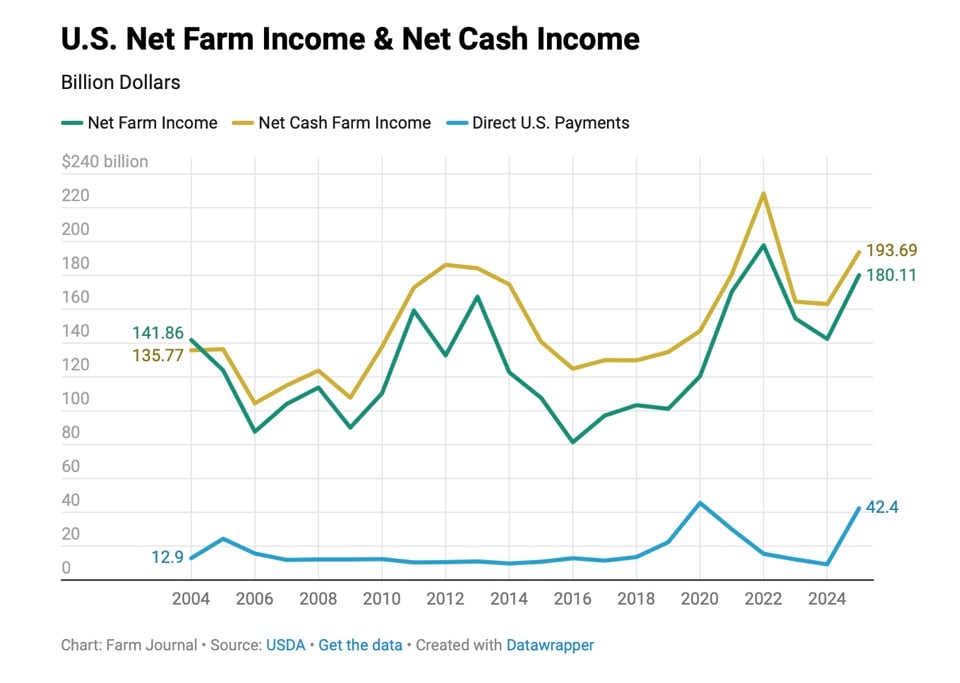
I am indebted to Sarah Taber, an astute commentator on agricultural policy and practice in the United States, for her succinct explanation of this graph.
“The green line is how much $ farmers make from selling crops & livestock. Goes up in D administrations, down in R ones.
The blue line is free money farmers get from the gov’t. Goes down in D administrations, up in R ones.
It ain’t rocket science.
The graph is based on data from the USDA’s Agricultural Research Service, and is part of an article explaining the huge rise in farm incomes in 2025. Net farm incomes have swollen, despite a decline in overall revenues. And that is because government handouts to farmers have increased from $9.3 billion in 2024 to $42.4 billion in 2025, a 345% increase.
Perhaps that explains why, despite everything, they vote the way they do. Or, as Sarah Taber also says, “The US farmer’s favourite livestock is US taxpayers”.
Reclaiming Pecan History
An extract from a book usually needs a bit of context if it is to make much sense. Alas, How an Enslaved Gardener Transformed the Pecan Into a Cash Crop lacks a bit of context. It explains how “Antoine’s successful inosculation … ultimately supported the production of up to ten million pounds of pecans annually by the early 1920s, resulting in a multimillion dollar pecan industry,” and that’s good. But the extract alone tells us nothing about the enslaved man Antoine or his enslaver Roman. Still, it isn’t hard to find out more without having to read Beronda L. Montgomery’s book in its entirety, if you wish.
This also gives me an opportunity to remind you about an episode from way back in the mists of time: Pecans and history, in which I spoke to Professor James McWilliams about his book The Pecan: A History of America’s Native Nut. Chapter four is all about Antoine’s graft, though I failed to ask about that.
Take care


Add a comment: