
Primetime - Jender Theory
I don’t have any memory of learning about To Catch a Predator until I was a teenager, long after the show had been taken off the air. I think the first time I ever watched any of the show was via a YouTuber’s reaction videos. I’ve never sat with a proper episode of the show. But as a man I’ve met a lot of people like Creed Bratton’s character in the film, a random man that Chris Hansen meets on a flight early on in Primetime. This guy Jim, I’ve met many people like him across the spectrum of their adulthood. Men who live vicariously through violence being done to others and fantasize about carrying out a justifiable act of brutality. Jim asks Hansen, “Don’t you ever just wanna bleed ‘em?” Hunger rumbles from his stomach and up and out of his mouth. Hansen replies, “Maybe what I do is a little worse.”
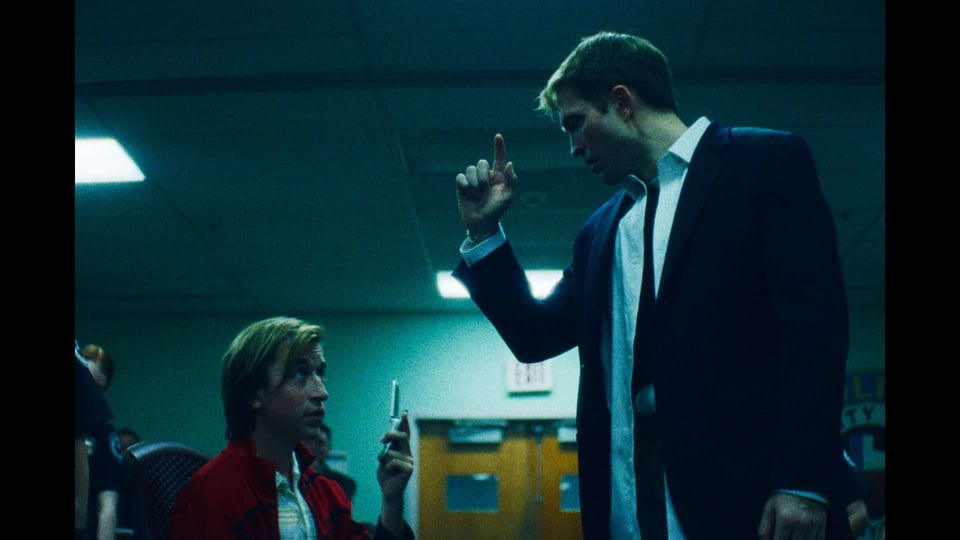
Pattinson’s turn as Chris Hansen comes amidst an admirable string of roles, his many eccentricities warped in oversaturation and digital fuzz. Hansen is a larger-than-life presence and Primetime matches that energy by submerging its world into Hansen’s delusions of grandeur. We see into his world through multi-camera displays and impressionistic surreal collage, but what surprised me most about Primetime was the focus on Skyler Gisondo’s “Decoy Dan,” an upstart actor that’s recruited into Predator’s espionage. Gisondo’s contrast with Hansen is the first indication that the man is both more and less than he seems. Hansen’s fantastical view of the world and of himself lets Primetime play with sharp emotional contrast, creating a parabolic pacing not unlike the feeling of binging a show - Hansen goes from top of the world to rock bottom and back again rapidly, Pattinson effortlessly imbuing Hansen with showmanship, charisma, and conflicted shames and desires.
As Dan is groomed by Hansen into a career that goes against his dreams as an actor, Hansen entraps himself with an unstable love affair that threatens his public image. His grandeur suggests that the work of To Catch a Predator is to combat an ancient evil, he carries a memento of a past good deed done greedily. Hansen is an Ahab searching for a whale, no longer seeing the predators he targets as fully human, picturing the whale as a Possibly in Michigan-esque uncanny other. In the film’s most direct challenge to Hansen’s virtue, a rabbi caught by Hansen’s crew asks him “Who gave you the right?” For the first time, Hansen has no answer for his show.
Primetime’s interrogation of the American thirst for justice in the 2000s is quite thoughtful. The suggested conflict betwixt Hansen and fellow reporter Stone Phillips, the militaristic might and jingoistic swagger of Bokeem Woodbine’s sheriff, and Hansen’s insistence of the valor in his quest portray permutations of the same egotistic desire for it that came with the 9/11 attacks. Primetime offers a look at a veil between true justice and self-effacing grandstanding, where Hansen attempts to weigh his sins against his good deeds, but never stops to question if sin could be found in the deeds themselves.
When thinking about what has always repelled me from ever watching To Catch a Predator I’ve always thought about what the morality play of it suggests, and what media has come to replicate that morality play. It’s impossible not to see Hansen’s creation as a test run for a moral surveillance state that’s now led to the entire viral dashcam and police footage ecosystem. There is a hunger to see people we don’t like being hurt in a way that they deserve, a primal sadism that mass media didn’t invent but knows how to indulge. The vicarious pleasure of seeing a good guy catch a bad guy, no matter how violently or cruelly it’s done. Whenever I see videos like this out in the wild I can’t help but think about how the camera reduces us to what it captures us doing. No amount of contextual thinking sits in the brain quite like the authentic capturing of time and space. The camera traps us within a moment, making that moment eternal.
Primetime preys on the fear of entrapment from the first scene to the last, enclosure is constantly emphasized in narrow frames, multi-view panoptical displays, hypnotic computer screen glows and recurring images of still figures shrouded in darkness, applied to Hansen, his whale, and the specter he pictures in India. Primetime poses To Catch a Predator as a prototype panopticon operated by Hansen - everyone caught in his camera will deserve what happens to them while under his watch. In Hansen’s world, the camera is judge, jury, and executioner. For Primetime, the camera is the ultimate weapon. No gun can replicate the fear, pain, and suffering that comes from being captured. It’s this approach that allows Primetime to posit a scathing critique of Hansen’s work, that he preyed on an unhealthy craving for punishment that ultimately swallowed him in its endless maw.
