August 2026 - Notes on Opal, Nukes, Obsessions
light and dark ahead
another spin around the moon
witness what we can
—JD, notes haiku #6
Opal Turns One
This month Opal turns one year old! She grew so fast.
We are slowly transitioning her to adult dog food. No easy task as she is a picky eater. No doubt we have helped her learn to be picky. sigh

These days most of our training involves games which teach Opal about making choices. Currently, the game I’m teaching her is called “Vito’s Game,” as shared by Canadian dog trainer Susan Garrett. The game involves two bowls, treats, and some obstacles.
What’s fun about this game is that there are no body or talking signals permitted by Opal’s human. It’s taken consistent practice, but Opal has finally figured out what the game is about. I’m slowly introducing her to more obstacles in the game to help her think even more. The video below shows you the game.
It’s so cool to watch Opal make a decision between taking the shorter path or walking around the obstacles to get to the bowls. Sometimes she pauses very briefly, looking at the easy way (between the obstacles and me) and then deciding to go around the obstacles. In the beginning she tried the shorter way several times. Sounds simple, doesn’t it? This is what Garrett’s games are about—helping your dog make choices.
We’re not training Opal for agility trials. We’re giving her mental exercise which is just as important as physical exercise.
Opal might be graduating to adult food, but she’s still a puppy.

Nuclear New Mexico
As a proponent of nuclear disarmament since my teenage years, for me August represents the 81st anniversary of the bombing of Hiroshima and Nagasaki. Last month on July 16th, however, marked 81 years since the Trinity Test occurred.
Once (sometimes twice) a year, the White Sands Missile Range holds an open house for the Trinity Test Site, where the very first nuclear bomb was exploded as a test to make sure the Manhattan Project’s new plutonium implosion device worked. The Gadget was the prototype for the “Fat Man” bomb that would kill thousands in Nagasaki on August 9, 1945.
In October 2019, when my beloved and I approached the entrance gate at the Missile Range, we were surprised not to see protestors, but a kind of vigil held about the lingering effects of the Gadget.
The vigilers were not the usual anti-nuke protestors. They wanted to educate about the plight—their plight—of the people who lived near the Trinity Test site. They were the Trinity Downwinders and their allies.
The Trinity Downwinders were the first casualties of nuclear weapons. There was no effort by the military or the Manhattan Project to warn thousands of New Mexicans, people mostly Indigenous and Hispanic, that a plutonium bomb was going to be exploded near their homes. Homes as close as 35 miles to ground zero. The fallout landed in at least four counties: Lincoln, Otero, Sierra, and Socorro. The land, water, and animals were all contaminated by the nuclear fallout. Over time, cancers developed, across generations of people, including farmers and ranchers.
Over fifty years ago, I visited Hiroshima. That city was devastated by an uranium-based nuclear bomb, “Little Boy,” on August 6th, 1945. Given a special tour of the radiation hospital there, I learned that the cancers created by nuclear fallout lasted through generations of Japanese people. The half-life of highly enriched uranium is some 700 million years.
One young woman I met was a fourth generation cancer survivor. She held her toddler in her arms as she talked about her fears for her child’s health. Over the years, I believed I understood who had been affected by the bombs and the subsequent testing of more nuclear devices.
However, I was ashamed to discover Trinity Downwinders were unknown to me. New Mexico’s Downwinders were the first nuclear casualties. But because of above ground nuclear tests that ended in 1963, there are also Downwinders in Colorado, Nevada, Arizona, Utah, Oregon, Washington, and Guam. Uranium miners too, across several states including New Mexico, have developed cancers and other diseases.
Last year, Congress’s Radiation Exposure Compensation Act (RECA) finally included New Mexicans. RECA gives partial restitution to those affected by radiation and who lived here between 1945 and 1962. RECA also includes uranium miners who worked between 1962 and 1990. Congress still fails to include several other states where citizens have been affected by radiation and uranium mining.
Last year, just outside the missile range, New Mexico dedicated a roadside memorial to the Trinity Downwinders.
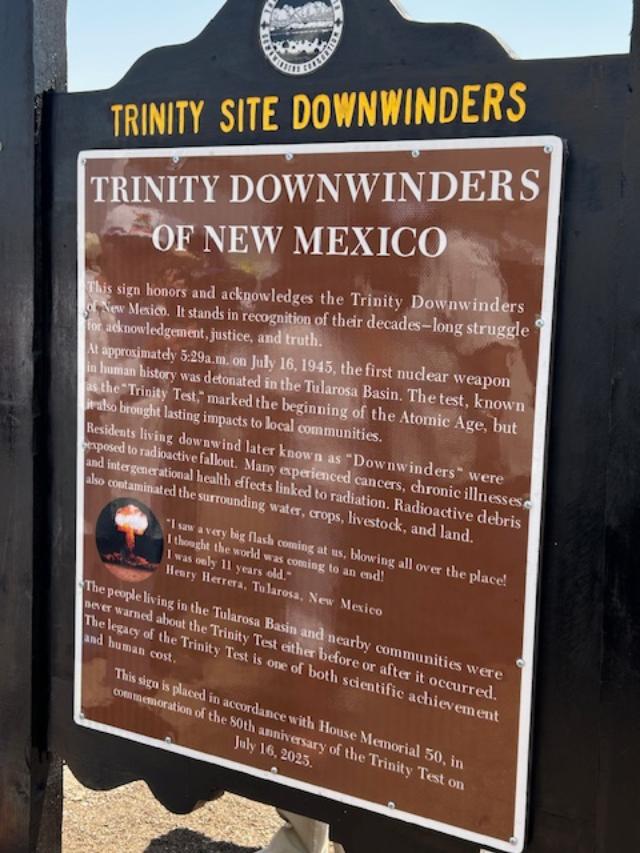
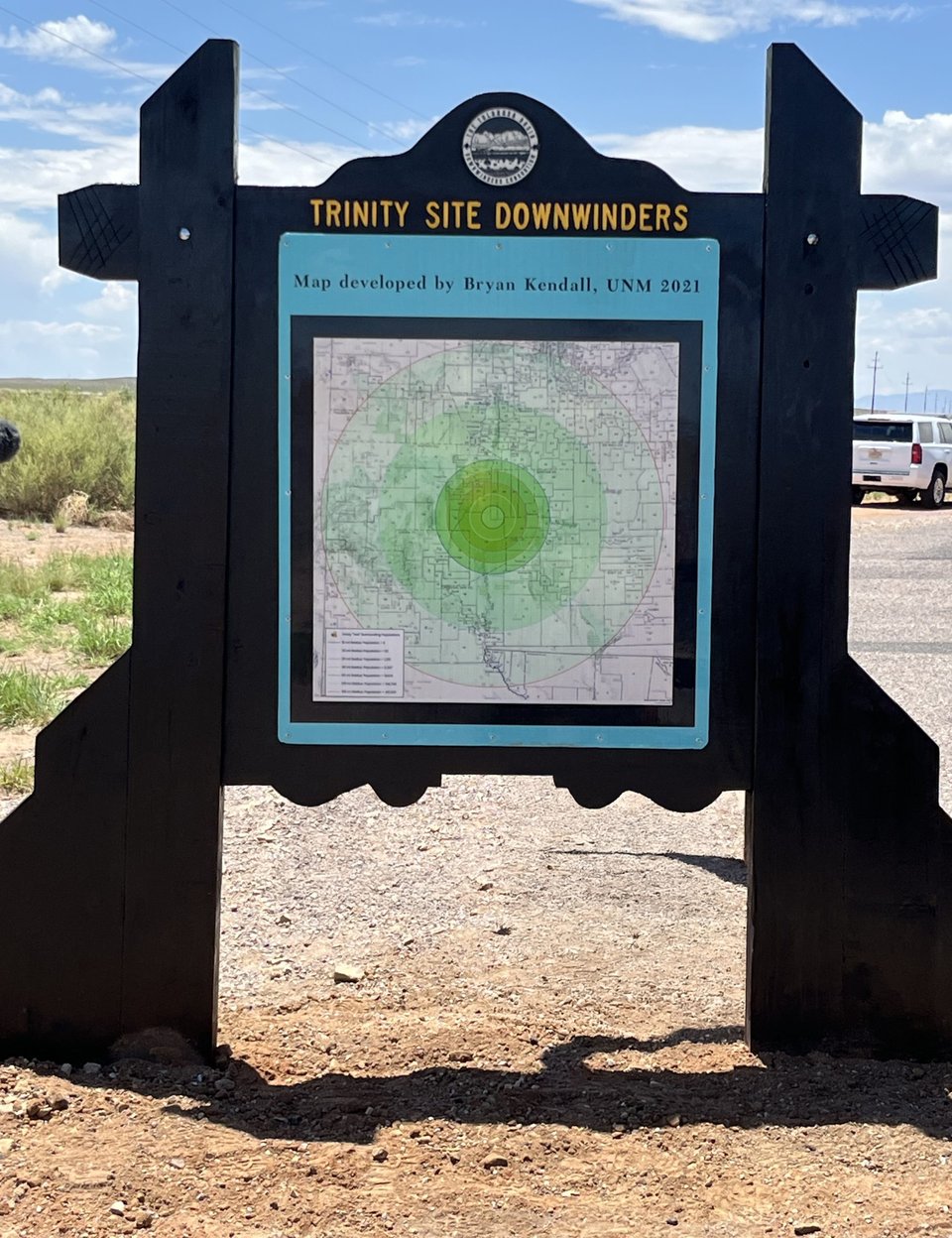
Plutonium-239 was used for the Gadget test and for the Nagasaki bombing. Like uranium, plutonium doesn’t fade away like a rainbow. It has a half-life of 24,110 years. Visitors to the Trinity Test site are advised to spend no more than an hour on the grounds.
Plutonium pits, the core of nuclear bombs, contains plutonium-239. The current U.S. administration has asked for 80 new plutonium pits to be produced annually until 2030. It’s estimated we already have 3-4,000 pits. While the nuclear bombs of 1945 killed thousands of people, nuclear bombs created since that time are estimated to be able to kill millions of us.
An obelisk made from local basaltic lava rock sits on top of ground zero of the testing site.
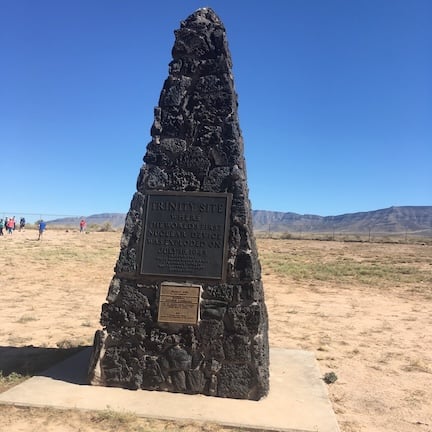
Erected in 1965, the plaque reads—
Trinity Site where the world's first nuclear device was exploded on July 16, 1945
There’s nothing pretty about this desolate place, except the mountains beyond it.
The McDonald Ranch House, where the Gadget was assembled, has been restored to what it looked like in July 1945. The McDonalds, the ranchers who gave over their land under protest, thought they would be moving back to the ranch after the war was over. That never happened. It never could.
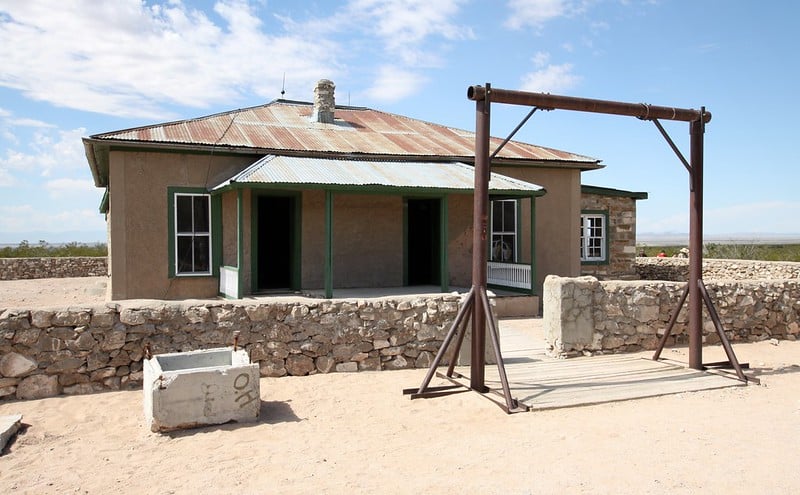
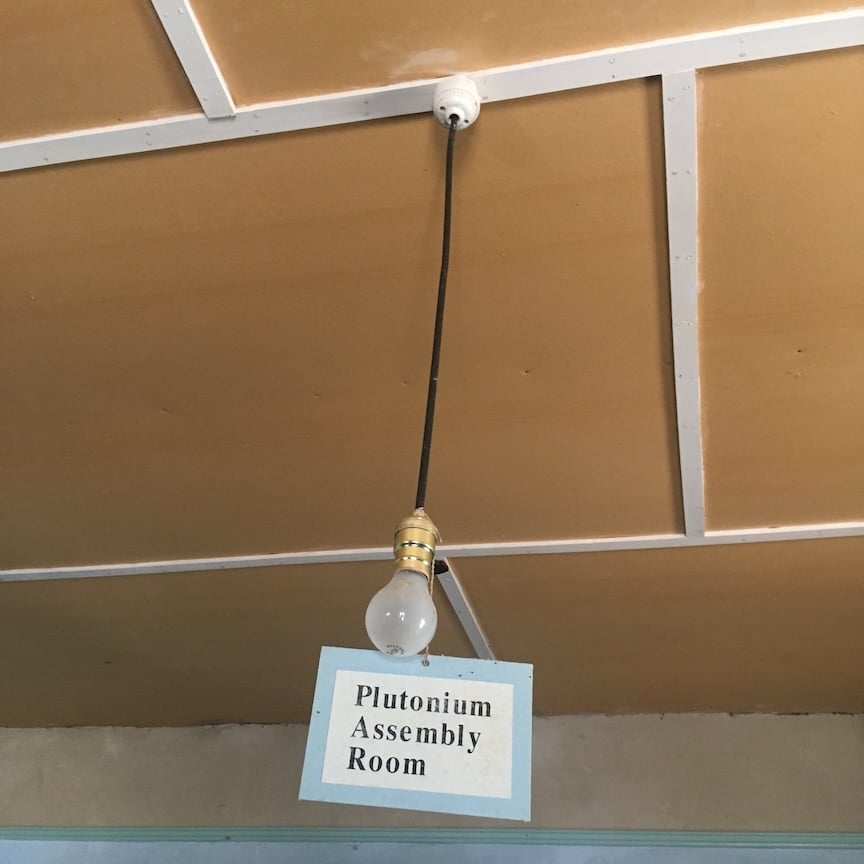
The ranch house and its rooms are small. The former master bedroom of the McDonalds represents what the assembly station looked like, without of course, the parts of the bomb. The assembly room is frightening in its dusty banality. A single bare bulb hangs from the ceiling, as one did in 1945. The light bulb holds a sign, “Plutonium Assembly Room.”
Deeper Reading
Nuclear Nuevo México: Colonialism and the Effects of the Nuclear Industrial Complex on Nuevomexicanos, Myrriah Gómez, University of Arizona Press, ISBN 9780816537105
First We Bombed New Mexico, a film by Lois Lipman
They Didn’t Want to See Us, Aviva Nathan, Searchlight New Mexico, July 15, 2025
Why Wasn’t Little Boy Tested? Alan Carr, July 6, 2020, National Security Research Center
Writing
The newsletter has no theme this month. I knew Trinity Downwinders would be the topic for the New Mexico section, but I was unsure what the other two items would be. Would you rather have had a sweet Opal photo—

or learned about how dogs have survived living in Chernobyl after the 1986 nuclear reactor explosion?
Things I’m obsessed about lately: plutonium pits, Los Alamos National Laboratory, legacy nuclear waste, the vanishing night sky, all the satellites Musk launches, the Rio Grande drying, the Rio Grande, how much water does New Mexico really have, acequias, underground water, water wars, drought, dog training, astronomy, geology, index cards, wildfires, losing weight safely, tendons, machine weights, why what’s on the plate is bigger than my palm, tendonitis, pizza, what is Opal thinking, and, more importantly, what is my spouse thinking about today?
Some of those obsessions are in my new novel.
Aren’t you glad to get a sample of what happens inside my writer’s brain? I promise you the new novel is a thriller, but it’s also funny. Off to write chapter ten!
Stay kind and curious, friends. See you anon.—JD
Currently drinking: Himalayan White Tea from Jun Chiyabari via The Steeping Room
Currently reading: At The Precipice, New Mexico’s Changing Climate, by Laura Paskus
Currently using: Platinum #3776 inked with Aurora Turquoise

