
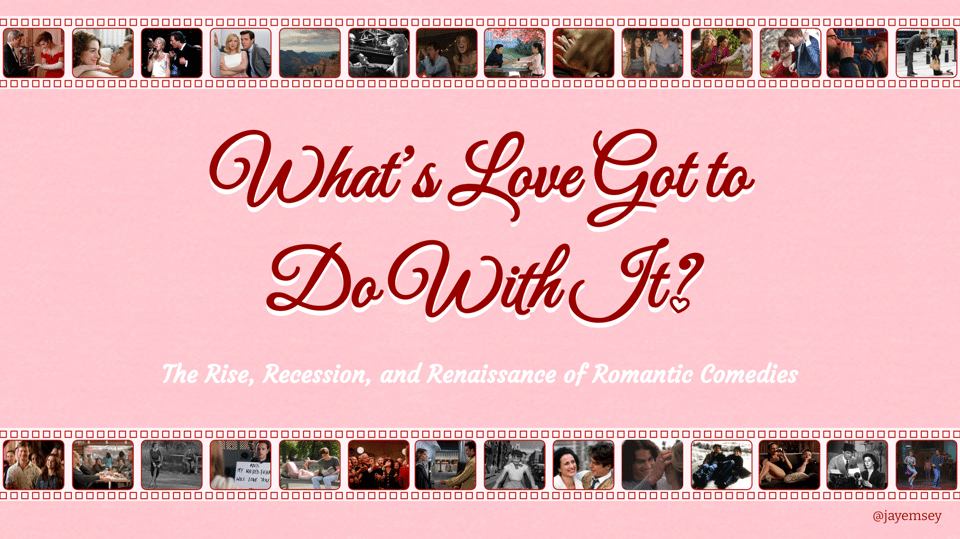
[FIRST LOOK] What’s Love Got to Do With It?: The Rise, Recession, and Renaissance of Romantic Comedies 💘
happy early valentine’s day!
I mentioned this project when I was on Mark Pollard’s Sweathead podcast back in October 2024, and I fully intended to publish it last Valentine’s Day, but at the last minute I decided to hold it to do some restructuring. Ultimately, I just didn’t like it as much as my other projects, which was disappointing because I’m normally very proud of them! And it wasn’t a project that was going to be outdated any time soon. But it did give me time to watch Bridget Jones: Mad About the Boy (2025), which was excellent.
So now, here it is, in all of its glory—What’s Love Got to Do With It?: The Rise, Recession, and Renaissance of Romantic Comedies. Honestly part of the reason it took so long was that, compared to the topics of some of my other projects—post-apocalypticism, bimboism, existentialism and moral philosophy—you’d think rom-coms would be a piece of cake, but as it turns out, there’s a reason no one has offered an easy answer to the question: “Why don’t they make rom-coms like they used to?” I went down an absurd number of rabbit holes to answer this question, and this is the first deck I’ve made that necessitated an entire separate overflow deck of scrapped slides I couldn’t bear to delete fully but didn’t actually have a place in the narrative (RIP 💀). It’s a complex question! But I tried my best to break it down in what I hope is an interesting way. The entire film industry has suffered under capitalism’s intense pressures (look no further than the deluge of reboots, spinoffs, sequels, etc.), but rom-coms have fallen victim to a unique vicious cycle of risk and reward. It’s a billion-dollar equation no one has successfully solved, which I think means a wealth of opportunity if studios are willing to take a chance.
I love a rom-com. I have to be in a particular mood to watch all other genres, but I will never say no to a rom-com. Rom-coms are inherently hopeful, a balm for the soul in unprecedented times (desperately needed at this moment for...reasons). But my personal preferences aside, I also think rom-coms are genuinely really interesting, because much like love, they are inexplicably charming (plenty of people love “bad” rom-coms), and much like horror movies, they’re statements about the cultural mood. Horror and disaster movies are manifestations of our fears, but rom-coms reflect our aspirations—not just ideal romantic relationships, but an ideal world.
In college, I took a class called “The Comic Turn of Mind,” in which we studied everything from Aristophanes to Larry David to Shakespeare to Freud (my final was titled “Real Men Wear Heels: The Deconstruction of the Gender Binary and Sexual Politics in Some Like It Hot,” and it remains one of my favorite essays I wrote in college), so I knew I was going to start with the foundations of comedy, but I underestimated just how many cultural forces have shaped the rom-com genre. I set out to answer a couple of key questions: Is the rom-com really dead? Is it ever coming back? Were rom-coms really better back then? And how do rom-coms reflect evolving standards for love and romance?
I was lucky enough to speak to Dr. Melissa M. Moore, a researcher who wrote her dissertation on a corpus of 188 rom-com scripts analyzed using a LLM (she has kindly given me permission to share all of her research on this topic, linked throughout the deck!), and Scott Meslow, the author of From Hollywood with Love: The Rise and Fall (and Rise Again) of the Romantic Comedy, which is cited in apparently every article ever written about romantic comedies. Their work was instrumental in developing a cultural perspective of this deck, because I’ve found articles bemoaning “the death of the rom-com” and heralding “the revival of the rom-com” equally annoying and also disingenuous in that they usually haven’t done more than five minutes of research before making that kind of declaration; they’re just personal grievances. It gives back in my day energy. And while I admit the rom-coms of the ‘90s had a particular je ne sais quoi when it comes to vibes, I think many of them are vastly overrated (I was actually furious after finishing Sleepless in Seattle because I couldn’t believe it was—and still is!—the gold standard for rom-coms; I thought it was awful) and practically a guidebook for how not to approach romantic relationships (the exception is When Harry Met Sally..., which remains perfect).
And before you ask, I don’t have a favorite rom-com—I’ve highlighted many of my favorites but it’s impossible to pick just one. And I assume that if you like rom-coms, you’ve already watched the classics, so instead I’ll recommend my favorite hidden gems, rom-coms I feel were not appreciated in their time and are still quite unknown to most people, even ardent fans of the genre:
Down with Love (2003) starring Renée Zellweger and Ewan McGregor: A stylistically gorgeous homage to the quippy, zany, and swingy battle-of-the-sexes comedies of the ‘60s—mistaken identities, space-age interior design, and plenty of innuendo (also, Ewan McGregor at peak hotness as a dreamy ladies’ man in a tuxedo and some of the most beautiful period costumes on film I’ve ever seen)
I Could Never Be Your Woman (2007) starring Michelle Pfeiffer and Paul Rudd: This one was direct-to-video so I don’t think it got a fair shot, but it’s a fun, poppy 2000s rom-com minus the toxicity, which is incredibly rare and very refreshing—delightfully smart writing courtesy of Amy Heckerling (writer/director of Clueless, but I actually like this one better!), a sweet mother-daughter dynamic with an adorable preteen Saoirse Ronan, and remarkably healthy communication and emotional maturity (there is one gimmick that deserves a big caveat, which is the very weird personification of Mother Nature that in my opinion was unnecessary and could have been rewritten as a best friend or something)
Long Shot (2019) starring Charlize Theron and Seth Rogen: A refreshing twist on the uptight woman/bumbling fool pairing—she’s running to be the first female president but doesn’t have to be convinced to have fun, and he’s a goofy-but-ultra-principled indie journalist that’s had a crush on her since childhood—it’s sweet and unexpectedly earnest; the only person who’s actually a jerk in this movie is a caricature of Rupert Murdoch (we love to see it!) who acts as the villain
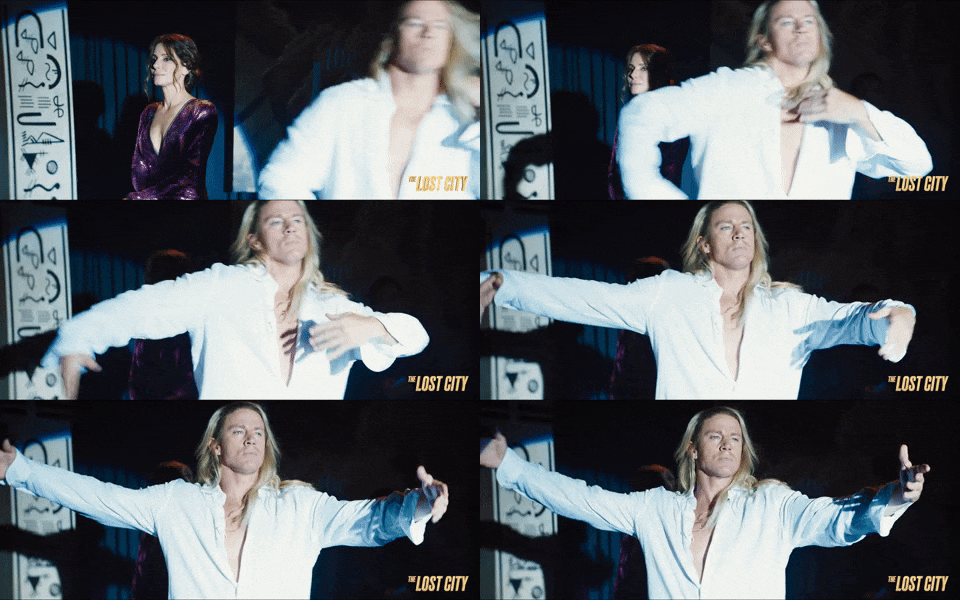
The Lost City (2022) starring Sandra Bullock and Channing Tatum: A star-studded rom-com mixed with adventure, with both crackling chemistry and a surprisingly tender meditation on grief and loss (featuring Channing Tatum as a Fabio-esque character, which makes this movie at minimum great—put Channing Tatum in more rom-coms! Fly Me to the Moon does not count, for reasons explained the deck)
Rye Lane (2023) starring David Jonsson and Vivian Oparah: A sweet British rom-com with fresh a fresh take on editing and character development, but with all of the hallmarks of classic rom-coms—no gimmicks, just a really well-told story and absolutely magnetic chemistry; it will have you giggling and kicking your feet
I have rewatched all five of these multiple times; they’re spectacularly cast, excellently written, and very funny (which a lot of rom-coms forget—they should be funny!).
The final version goes live on LinkedIn later today, so give it a like or comment a “💘” to let me know you’ve seen it. Enjoy!
💖 jenny
Thanks for reading Constellation Theory ✨! Subscribe to receive new posts and first access to projects.
This newsletter will always be free. But if you’d like to support the publishing fees or just show some love and appreciation, you can buy me a coffee (or boba) here! 🧋
