
ABC
Reading William Bronk alongside Robert Creeley over the last few weeks has reminded me of what I love and hate about both. Two poets who might be distinguished by their obsessive rumination on the Basic Existential Situation, with very little in the way of form or humour or history or of the world’s specificity. That’s most of what anyone remembers about them. That and the short line. Two poets with small vocabularies, one feels that probably as much as the gloom. Bronk is for example happy to speak of “purple flowers” (“Great drifts of purple flowers hold / the roadside; patrols of purple flowers roam / through fields and climb to overtop high banks. / Purple is what color there is in the world.“ —Bronk, Certain Beasts, like Cats) where another poet might develop a botanic or ecological vocabulary, or delight in the Latin names of things. What kind of flowers are they? He doesn’t care. And certainly there is no anthropomorphism, none of Lawrence’s pushy “incipient purpling towards summer in the world of the heart of man.” Instead he speaks of “some trivial trees,”
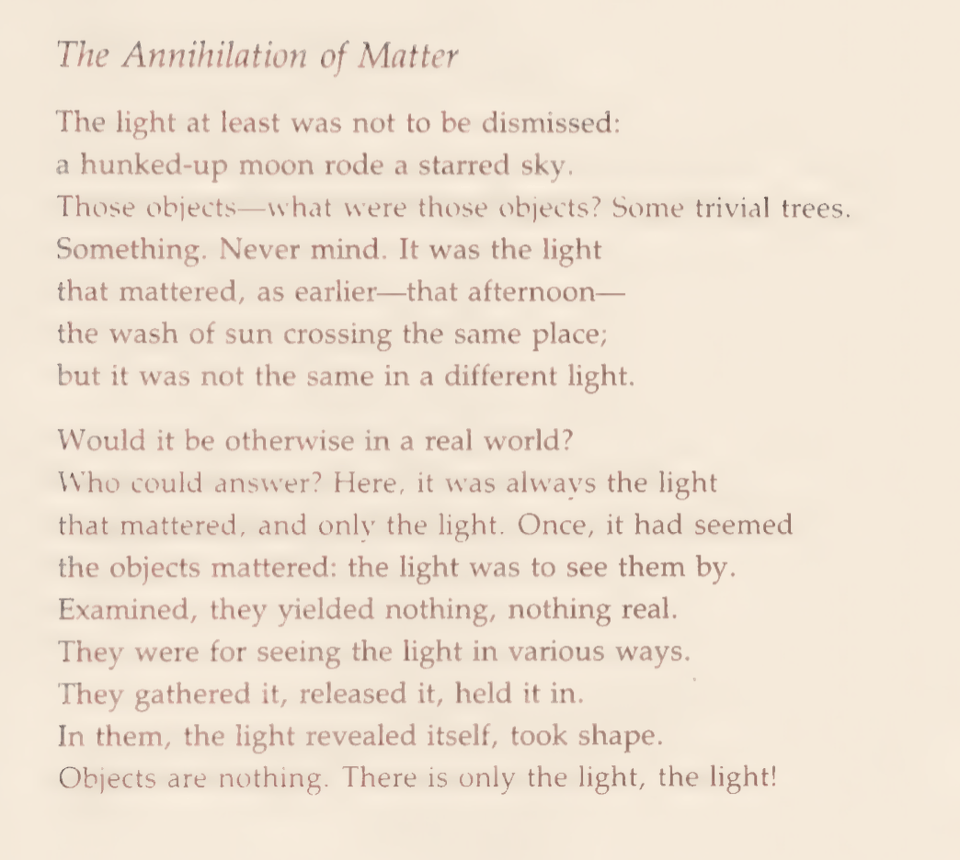
“These objects—what were these objects? Some trivial trees. / Something. Never mind. It was the light / that mattered…” —Bronk, The Annihilation of Matter
Did he possibly have Ashbery’s Some Trees in mind? A few years ago I asked a lot of people to read that poem out loud, just to hear how they might read the opening totally unearned wow—you’ve got to step into it, you hit the first note alone and it’s got to be in tune, and the closing couplet is just horrible, too cadential, too discursive, why would he ruin his own poem that way? How, as a reader, can you save it, bringing irony into the voice just enough and just in time.
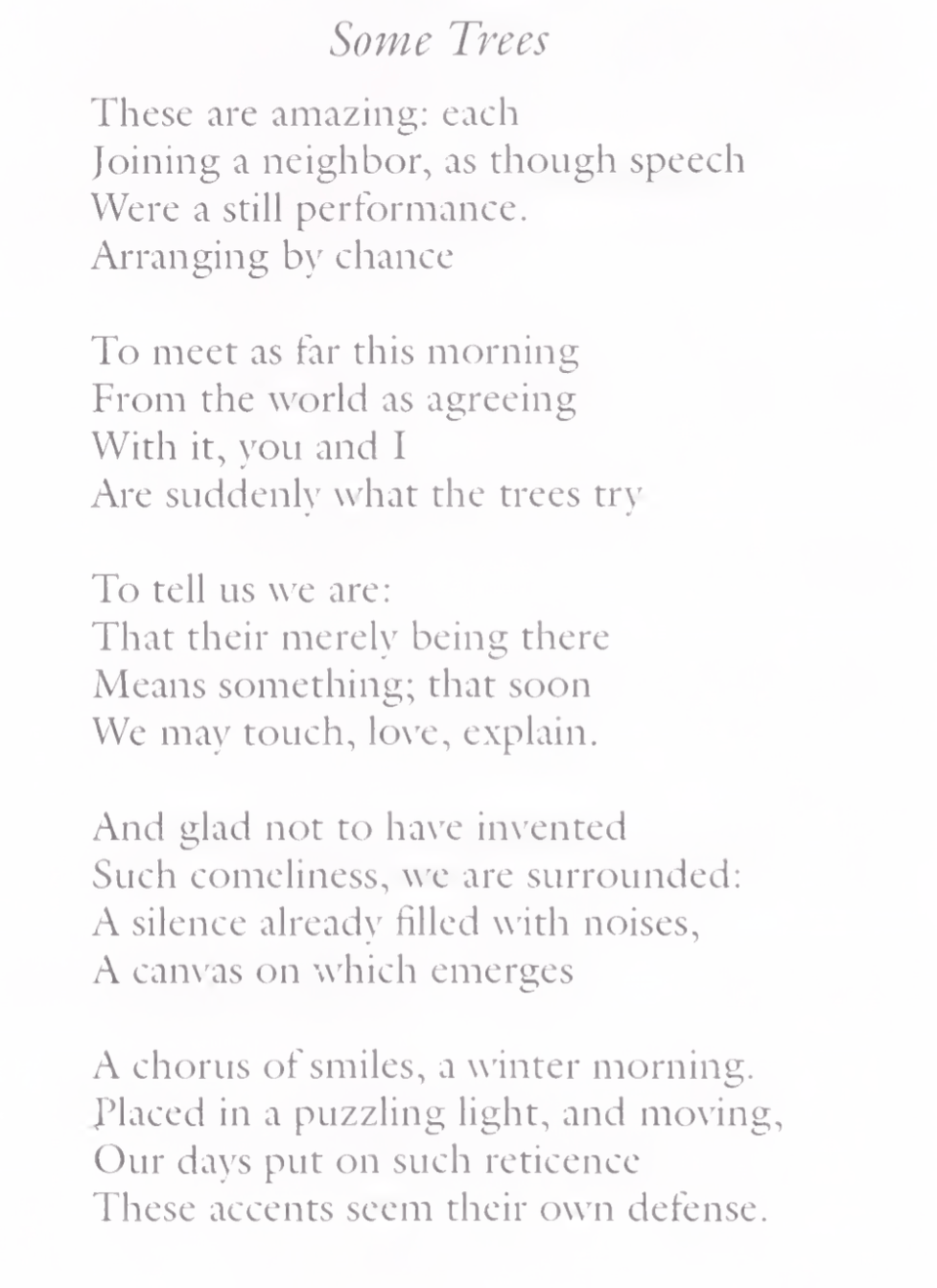
“These are amazing: each / Joining a neighbor, as though speech / Were a still performance. / Arranging by chance // To meet as far this morning / From the world as agreeing / With it, …” —Ashbery, Some Trees
Bronk and Creeley certainly aren’t alone in their theatre of abstraction. Ashbery doesn’t tell you what kind of trees these are any more than Bronk does. He isn’t Schuyler. Stevens tells us only the bare coordinates of our climate “Clear water in a brilliant bowl, / Pink and white carnations. The light / In the room more like a snowy air, / Reflecting snow. A newly fallen snow / At the end of winter when afternoons return.” —Stevens, The Poems of our Climate
Aside: I would really like a historical map of hardiness zones, does it exist?
Still I feel that Ashbery and Stevens are by comparison simply a bit more interested in the world and in life. Whereas for Creeley or Bronk, life would be identical if it were thirty or two thousand years long, or if there were only one type of plant, or if we were Edenic foragers, or if history had begun yesterday, or we lived on Mars. The real phenomenon for them is only that sense of finitude and slipped essence. Something just out of sight that was what it was all along and we missed it. We missed it. We charged somehow after the false, or let something go by. We somehow didn’t put the right questions to it.
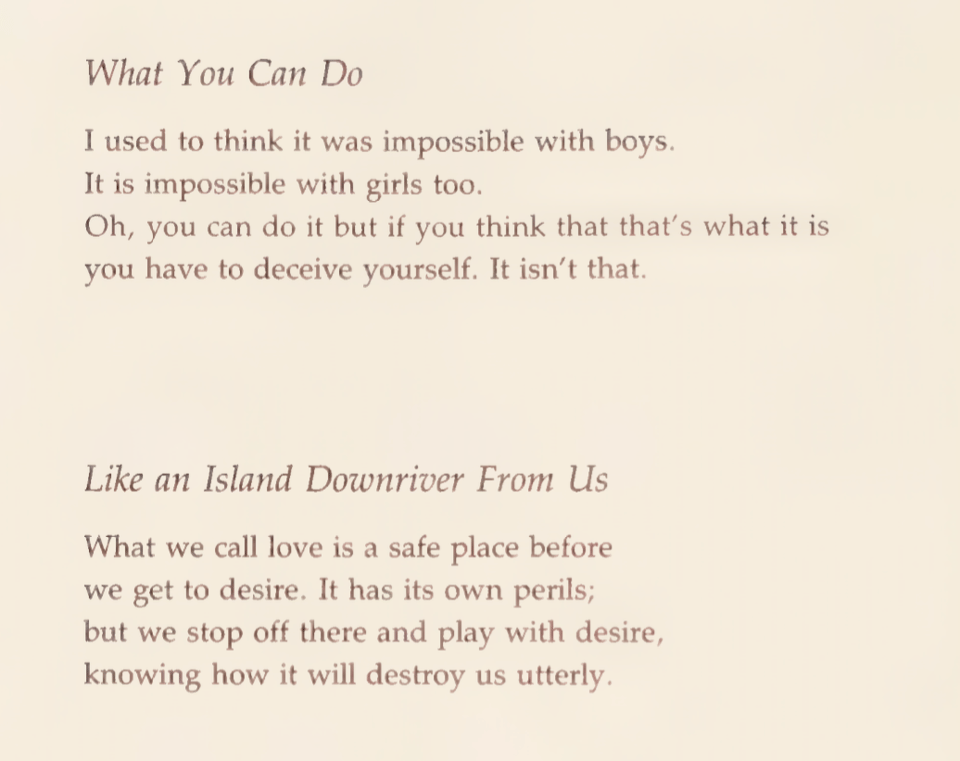
The difference between them I think is that Creeley writes through a frustration at this experience while Bronk presents it as overconfident wisdom. I notice that by comparison, it’s difficult to share Bronk. He feels bitterer, more resentful, and yet nearly all of his poems feel more declarative than expressive, one doesn’t find the man. Or finds him unhappy, yet satisfied in his perspective.
Here is a late Creeley poem that I come back to again and again, which might be right on the edge:
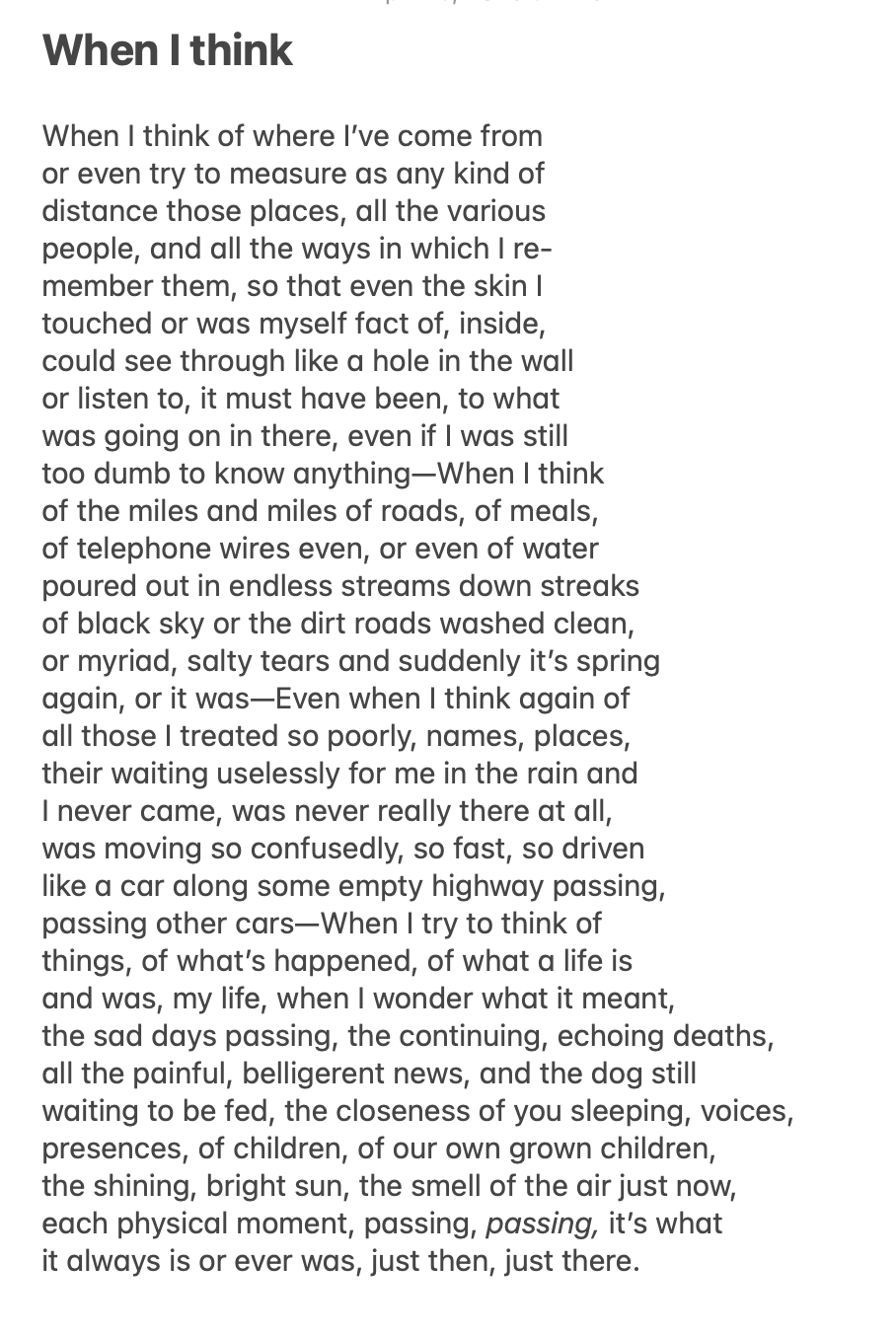
Of course this shares some of Bronk’s gloom and slipped essence, when he speaks of “each physical moment, passing, passing, it’s what / it always is or ever was, just then, just there.“ In the recording above, a few months before his death in 2005, he even changes the line to, “…passing, passing, I think / I no longer know, or care.” But the lines that come back to me sound more like a country and western song, “the miles and miles of roads, of meals, / of telephone wires even,” or his regrets over his treatment of people, his lack of presence. What you can see actually is that without any specialized vocabulary, he seems more interested in combination, interruption, juxtaposition. “the sad days passing, the continuing echoing deaths, / all the painful, belligerent news, and the dog still / waiting to be fed, the closeness of you sleeping, voices / …” nothing is described particularly well or in any specificity, but it is the melding or not-even-melding in experience of the sad days, the deaths, the news, the dog, you sleeping there. It’s a combination unlikely in the same way as flipping a coin five heads in a row on the full moon, the diligent flipper expects to see it every few years, and makes no claim of significance when it does. Still there’s a first person perspective, jackpot moonlight, a way it was, just there.
I always have the feeling that in Creeeley’s is telling us about experience and specificity as something rapidly washing away. He’s trying to hold onto it, but not too tightly. I find that more relatable, it doesn’t claim low tide as a superior perspective, simply as the poet’s residence. It’s something like depression as I’ve known it, when it manifests as inattention. Everything is still there. You see it, but don’t become involved in it in the same way, it somehow doesn’t catch.
It’s very difficult now to write this difference, between styles of inattention and involuntary abstraction. Sometimes what might change for a character is simply a shifting of weight which allows us to move from one form of deficient attention to another. Stairs connecting the basement levels. More than one way to be a stranger here.
Writing the next book remains difficult, but I wrote a light poem in response to Bronk, which has no home, so I’ll share it here.
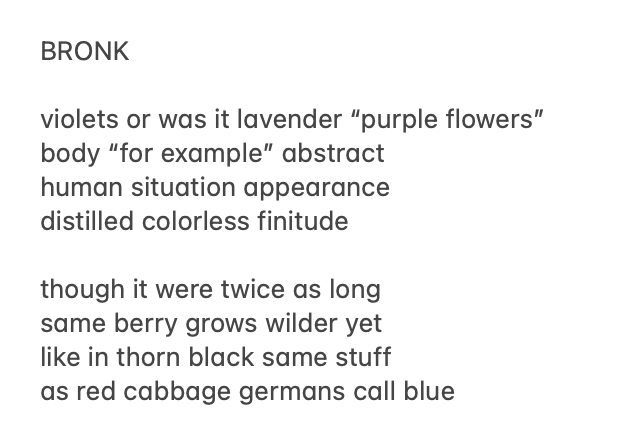
Have wished lately for more context to read poems with people, perhaps poems with a bit more life and colour and argument and drive and curiosity and conflict and Eros and song and puzzle and convention. In person in Berlin? Online? Maybe we could read through a few of Prynne’s, rest in peace.
Here in Berlin I’ve finally got a bicycle, which helps as much as anything can in the refusal to Bronk out. I’ve planted a little herb garden in my window, and I do feel the specific mint, sage, lavender, rosemary, oregano, and bay, which is so beautiful and whose taste no one truly knows. I wrote a little song for Bob. I am waiting for something to change, and it will, and for the sailors to return.
Pardon errors,
Keep your head up,
Call me anytime,
Jackie

